
A sunscreen formula can contain patented technology, achieve SPF 50, carry a natural certification and arrive with an impressive collection of laboratory reports. But does that mean it is ready to launch?
Not necessarily. A patented ingredient might still need finished-product testing. A vegan declaration does not prove cruelty-free certification. And an ISO test report does not automatically grant permission to sell sunscreen in every country.
Sunscreen certifications, patents, testing standards and regulatory approvals serve different purposes. Understanding those differences is essential for formulators, ingredient suppliers and brands navigating increasingly complex product requirements.
So, which certifications actually matter, which are voluntary, and what evidence should a brand request before launching a sunscreen?
Can a Sunscreen Formula Be Patented?
Yes, although patents are not mandatory for selling sunscreen. They protect qualifying inventions, which may involve a formulation’s composition, manufacturing process, delivery system or the surface treatment of an existing UV filter.
Mineral sunscreens offer particularly interesting examples because innovation does not always require inventing a new active ingredient. Sometimes, it involves engineering how zinc oxide or titanium dioxide behaves within a formulation.
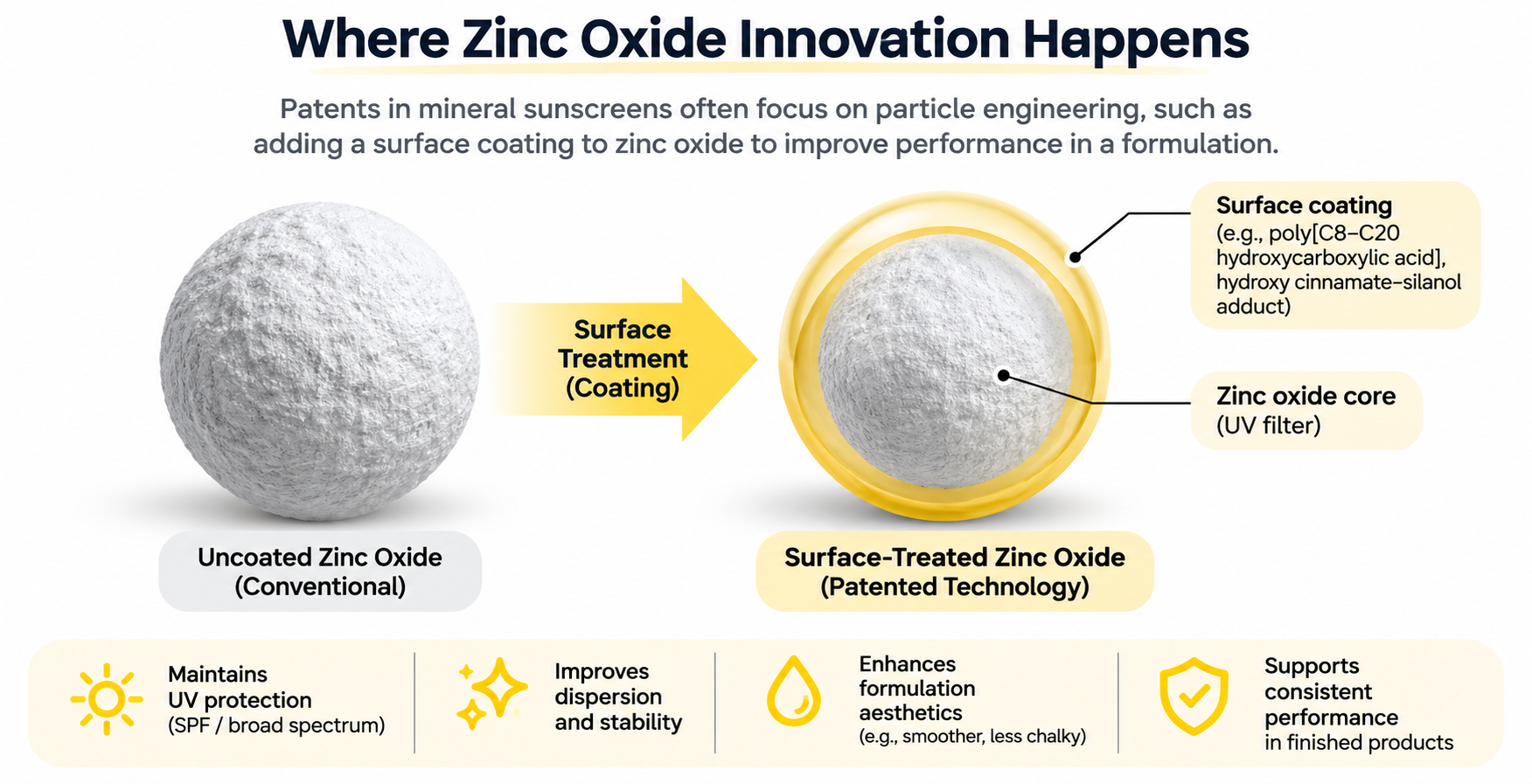
For example, Vizor’s US Patent 11707422B2, granted in July 2023, describes inorganic sunscreen particles coated with poly[C8–C20 hydroxycarboxylic acid]. The invention specifies coating ratios and zeta-potential characteristics under defined measurement conditions.
Vizor also holds US Patent 11679068B2, concerning hydroxy cinnamate–silanol adduct-coated inorganic sunscreen agents, and US Patent 11253448B2, addressing inorganic sunscreen agents with higher UV radiation protection.
These examples illustrate how particle engineering and surface chemistry can become protected technologies. However, patent ownership does not establish finished-product SPF, safety or regulatory compliance.
A brand may also need a freedom-to-operate review because owning a patent does not automatically provide permission to practise every aspect of an invention.
Which Sunscreen Certifications Are Actually Required?
The first distinction is between legal requirements and voluntary certifications.
A manufacturer might comply with Good Manufacturing Practice without holding a particular third-party certificate. A laboratory might be accredited to perform certain tests, but that accreditation does not approve every sunscreen it evaluates.
Several quality-related standards are particularly relevant.
ISO 22716: Cosmetic Good Manufacturing Practice
ISO 22716 provides guidelines for cosmetic production, control, storage and shipment. It covers areas such as personnel, equipment, documentation, quality control and manufacturing procedures.
GMP compliance may be required under applicable cosmetic regulations, but third-party ISO 22716 certification is not universally mandatory.
ISO 9001: Quality Management
ISO 9001 addresses an organisation’s quality-management system. It can provide reassurance about documented processes and continual improvement, but it does not certify a sunscreen’s SPF or UV protection.
ISO/IEC 17025: Testing Laboratory Competence
ISO/IEC 17025 concerns the competence, impartiality and consistent operation of testing and calibration laboratories.
When selecting an SPF testing laboratory, brands should check whether the required method falls within its accredited scope. Laboratory accreditation and product certification are different things.
These standards support quality and reliability, but none replaces the regulatory obligations of the finished sunscreen.
Natural and Organic Sunscreen Certifications: What Do the Labels Mean?
Natural and organic positioning is especially relevant to mineral sunscreen development, where brands frequently seek zinc oxide ingredients compatible with particular formulation standards.
COSMOS NATURAL and COSMOS ORGANIC
The COSMOS standard provides certification criteria for natural and organic cosmetics. COSMOS NATURAL applies to qualifying finished products, while COSMOS ORGANIC requires additional organic-content criteria.
For raw materials, the terminology changes. COSMOS CERTIFIED applies to eligible materials containing organic content, while COSMOS APPROVED applies to eligible non-organic raw materials.
A zinc oxide grade appearing in the COSMOS approved raw-material framework may be suitable for use in qualifying formulations, subject to restrictions. That does not mean every sunscreen containing it automatically receives COSMOS certification.
NATRUE
NATRUE operates another certification scheme for natural and organic cosmetics. It evaluates products against its own ingredient and formulation requirements.
NATRUE and COSMOS are separate schemes. Eligibility under one should not be assumed to establish certification under the other.
USDA Organic
USDA Organic may apply to eligible personal-care products that meet the relevant organic production, handling and labelling requirements.
However, mineral sunscreens cannot simply use the USDA Organic seal because they contain a naturally occurring mineral. The finished product must qualify under the applicable certification rules.
These sunscreen certifications help brands communicate defined formulation attributes. They do not establish UV protection or substitute for market approval.
Halal, Kosher, Vegan and Cruelty-Free: Certification or Suitability?
Some of the most important declarations for ingredient buyers concern religious suitability, animal-derived ingredients and animal-testing practices.
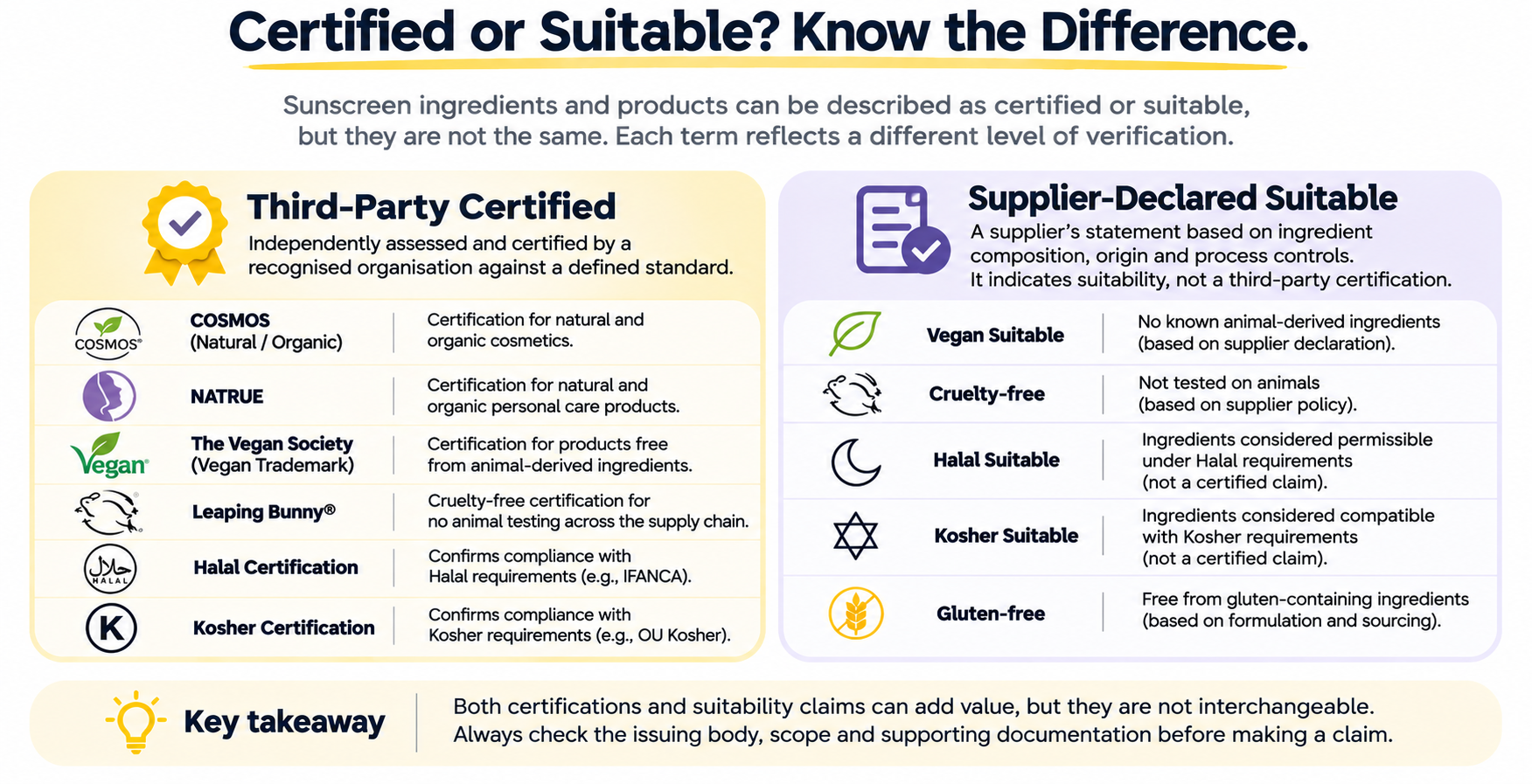
For sunscreen formulators, these distinctions are particularly important when evaluating ingredient documentation. Terms such as Halal Suitable, Kosher Suitable, Vegan Suitable, Cruelty-free and Gluten-free may appear in supplier specifications, but they do not necessarily indicate independent third-party certification. Each claim must be assessed according to its supporting evidence.
Halal certification may involve reviewing ingredient origins, processing aids, manufacturing procedures and contamination controls. Certification organisations such as IFANCA provide formal Halal certification services. A supplier’s “Halal Suitable” statement is not automatically equivalent to holding a certificate from a recognised body.
Kosher certification similarly involves assessing ingredients, manufacturing equipment and processing conditions. Organisations such as OU Kosher operate formal certification programmes. “Kosher Suitable” should be distinguished from “Kosher Certified.”
Vegan certification concerns animal-derived ingredients and other requirements defined by the certifying scheme. The Vegan Society’s Vegan Trademark is one example. A supplier may declare a material vegan-suitable without holding that specific certification.
Cruelty-free certification addresses animal-testing policies and related supply-chain requirements. Leaping Bunny and PETA’s Beauty Without Bunnies are examples of programmes with their own criteria. A cruelty-free declaration does not automatically establish membership in either programme.
Gluten-free is primarily a composition-related claim in this context. Supporting evidence may include ingredient-origin information and contamination-risk assessments. It is not automatically proof of a third-party gluten-free certification.
For sunscreen brands, the practical lesson is straightforward: request the underlying certificate or supplier declaration and check its scope, issuing organisation and validity.
What Is the Difference Between GRAS and GRASE?
The GRAS/E label deserves separate attention because regulatory terminology can easily be mistaken for certification.
In the US, GRASE means Generally Recognized as Safe and Effective, a concept used in over-the-counter drug regulation. GRAS, meaning Generally Recognized as Safe, is a different concept associated with certain food ingredient uses.
The FDA’s sunscreen regulatory guidance discusses the GRASE framework for sunscreen active ingredients, including zinc oxide and titanium dioxide.
GRAS and GRASE are regulatory concepts rather than independent certification schemes. Their applicability depends on the ingredient, intended use and relevant regulatory framework. Neither designation should be presented as a voluntary sunscreen certification.
Neither GRAS nor GRASE should be described as a voluntary sunscreen certification. Regulatory status must be understood in the context of the relevant ingredient, use and applicable legal framework.
SPF, UVA and Water Resistance: Which Tests Support Sunscreen Claims?
Sunscreen testing standards are essential, but a test report is not the same as a certification.
Different methods evaluate different aspects of protection.
| Standard | What it evaluates |
| ISO 24444:2019 | In-vivo sun protection factor |
| ISO 23675:2024 | In-vitro SPF determination |
| ISO 23698:2024 | SPF, UVA protection and critical wavelength using diffuse reflectance spectroscopy |
| ISO 24442:2022 | In-vivo UVA protection |
| ISO 24443:2021 | In-vitro UVA photoprotection |
| ISO 16217 and ISO 18861 | Water-immersion and water-resistance assessment |
The introduction of ISO 23675:2024 and ISO 23698:2024 expanded the available approaches to sunscreen efficacy measurement. However, publication of an international standard does not guarantee its acceptance for every regulatory claim.
For example, the European UVA logo, US broad-spectrum designation and Asian PA ratings operate under different criteria.
Water resistance also requires specific evidence. In the US, the FDA permits qualifying water-resistance claims of 40 or 80 minutes, but not claims that a sunscreen is waterproof.
A formulation may therefore need several tests to substantiate its complete set of claims.
Why Sunscreen Approvals Differ Across Countries
Even with relevant sunscreen certifications and testing reports, a product must comply with the regulations of each market where it will be sold.
United States: Sunscreens making sun-protection drug claims are regulated as OTC drugs. Products must comply with the applicable FDA sunscreen framework, including relevant active-ingredient, testing, manufacturing and labelling requirements.
European Union: Sunscreens are generally cosmetics under Regulation (EC) No 1223/2009. Requirements include safety assessment, a Product Information File, compliant labelling and CPNP notification. Notification is not individual product approval.
Great Britain: Sunscreens generally require a UK Responsible Person and notification through the Submit Cosmetic Product Notifications service. Northern Ireland has different arrangements.
Australia: Most therapeutic sunscreens must be included in the Australian Register of Therapeutic Goods, subject to the relevant TGA requirements.
India: Sunscreens marketed as cosmetics fall under applicable provisions of the Drugs and Cosmetics Act and Cosmetics Rules, 2020. The CDSCO provides information on cosmetic regulation, including imported-product registration.
A certificate obtained for one purpose cannot automatically replace another country’s legal requirements.
Non-Nano, Reef-Safe and Environmental Certifications: What Can Brands Claim?
Environmental and particle-related claims are another area where terminology needs careful attention.
Non-nano describes a material characteristic assessed against applicable particle-size definitions. For zinc oxide, supporting documentation may include particle-size distribution and other relevant characterisation data.
The European Commission’s nanomaterials guidance explains specific obligations for qualifying cosmetic nanomaterials. A generic non-nano declaration is not a universal certification.
Reef-safe and reef-friendly are commonly used marketing claims, but no single globally accepted certification proves that an entire sunscreen is harmless to marine ecosystems. Private schemes may assess selected criteria, but their scope must be examined individually.
Cradle to Cradle Certified evaluates eligible products against defined sustainability criteria. RSPO certification concerns qualifying palm-oil supply chains, which may be relevant to certain sunscreen ingredients. EU Ecolabel is an environmental labelling scheme with product-category-specific eligibility requirements.
These programmes address different subjects. A certified palm-derived ingredient does not make a sunscreen reef-safe, and certified packaging does not establish the environmental impact of the formula inside.
Environmental claims should specify what was assessed, which standard was used and whether the evidence applies to an ingredient, packaging component or finished product.
What Should a Zinc Oxide Supplier Provide?
For mineral sunscreen formulators, documentation begins at the ingredient level.
A supplier may provide technical specifications, INCI information, a Certificate of Analysis, Safety Data Sheet, particle-size characterisation, surface-treatment details and relevant regulatory statements.
Depending on the formulation, brands may also request Halal or Kosher suitability declarations, vegan and cruelty-free statements, non-nano documentation or evidence of eligibility under natural-cosmetics certification schemes.
The distinction between certified, approved, suitable and declared is important. Each describes a different level or type of evidence.
Even comprehensive supplier documentation cannot replace finished-product SPF testing, stability evaluation, safety assessment or regulatory compliance.
Before Launching, Ask What Each Document Actually Proves
A sunscreen development file may contain patents, laboratory reports, quality certificates, ingredient declarations and regulatory documentation. All can be useful, but they answer different questions.
A patent may protect the technology behind a mineral ingredient. A GMP certificate may address manufacturing practices. A Halal or Vegan certificate may support specific positioning requirements. An SPF report measures protection under defined test conditions. Regulatory compliance determines whether the finished product can enter its intended market.
For mineral sunscreen brands, understanding these distinctions helps prevent unsupported claims, unnecessary certification expenses and avoidable launch delays.
Ultimately, sunscreen certifications are valuable when brands understand exactly what they certify. The objective is not to collect the largest number of logos, but to build a sunscreen whose technology, performance, documentation and claims can all withstand scrutiny.
_________________________________________________________________________________________________________
Frequently Asked Questions (FAQs)
-
What are sunscreen certifications, and why are they important?
Sunscreen certifications verify that a product, ingredient, manufacturing process or organisation meets the requirements of a particular certification scheme. Examples include COSMOS for natural and organic cosmetics, ISO 22716 certification for cosmetic manufacturing practices, and Vegan Society certification for qualifying vegan products. They help brands substantiate specific claims, but they do not automatically establish SPF performance or regulatory approval.
-
Which sunscreen certifications are mandatory?
There is no single mandatory sunscreen certification accepted worldwide. Requirements depend on the country and product classification. For example, sunscreens sold in the United States must comply with applicable FDA drug regulations, while those marketed in the European Union must meet cosmetic regulatory requirements. Voluntary certifications such as COSMOS, NATRUE and Leaping Bunny are separate from these legal obligations.
-
Can zinc oxide sunscreen ingredients be Halal, Kosher and vegan certified?
Yes. Zinc oxide ingredients may qualify for Halal, Kosher or vegan certification when they meet the relevant scheme’s requirements. However, a supplier’s statement that an ingredient is Halal Suitable, Kosher Suitable or Vegan Suitable does not necessarily mean it holds third-party certification. Brands should request the relevant documentation and confirm whether it applies to the ingredient or finished formulation.
-
Is COSMOS certification required for mineral sunscreens?
No. COSMOS certification is voluntary and primarily relevant to brands seeking natural or organic cosmetic positioning. COSMOS APPROVED raw materials may be eligible for use in qualifying formulations, but their inclusion does not automatically make the finished sunscreen COSMOS NATURAL or COSMOS ORGANIC certified.
-
What is the difference between sunscreen testing and certification?
Sunscreen testing evaluates measurable characteristics such as SPF, UVA protection and water resistance using defined methods, including ISO 24444 and ISO 24443. Certification verifies compliance with a particular standard or scheme. A sunscreen can pass an SPF test without holding a natural or vegan certification, and a certified natural sunscreen must still substantiate its sun-protection claims.
-
Does a sunscreen patent mean the formula is FDA-approved?
No. A patent protects a qualifying invention, such as a formulation, manufacturing method or zinc oxide surface-treatment technology. FDA compliance concerns the safety, effectiveness, ingredients, testing and labelling requirements applicable to the finished sunscreen. Patented technology does not automatically confer regulatory approval.
-
Are non-nano and reef-safe recognised sunscreen certifications?
Non-nano is a particle-characterisation claim that must be evaluated against applicable definitions and supported by suitable documentation. Reef-safe is a broader environmental claim, and there is no single globally accepted certification proving that a finished sunscreen is harmless to marine ecosystems. Both claims require careful substantiation rather than reliance on marketing terminology.
-
What documents should brands request from a zinc oxide sunscreen supplier?
Brands should request relevant technical specifications, a Certificate of Analysis, Safety Data Sheet, INCI information, particle-size data and applicable regulatory documentation. Depending on the intended market and product positioning, they may also require Halal, Kosher, vegan, cruelty-free or natural-certification-related documentation. Supplier evidence supports ingredient qualification but does not replace finished-product testing.