Zinc oxide has spent decades doing the same job in sunscreen. We add it to a formulation, work on getting it properly dispersed, and rely on its optical properties to help protect skin from ultraviolet radiation. Much of the innovation has focused on particle size, dispersion, surface treatment, and how the mineral behaves once it enters a finished formula.
But there is another part of zinc oxide worth paying attention to.
Its surface.
What if that surface could do more than interact with oils, emulsifiers, and dispersants? What if it could participate in the chemistry used to create its own coating?
Recent materials research is beginning to explore that possibility. And although the technology is still experimental, it opens an interesting discussion about where zinc oxide coating chemistry could go next.
Zinc Oxide Has Always Been More Than a White Powder
When we talk about zinc oxide in sunscreen, we usually focus on what it does with light. Its ability to attenuate ultraviolet radiation is central to its role as a mineral UV filter. But the behaviour of zinc oxide depends on more than its chemical formula.
Particle size, morphology, aggregation, surface chemistry, and the surrounding formulation all influence how the material behaves. Two ZnO materials can share the same chemical identity and still perform differently when introduced into the same system.
The particle surface is one reason.
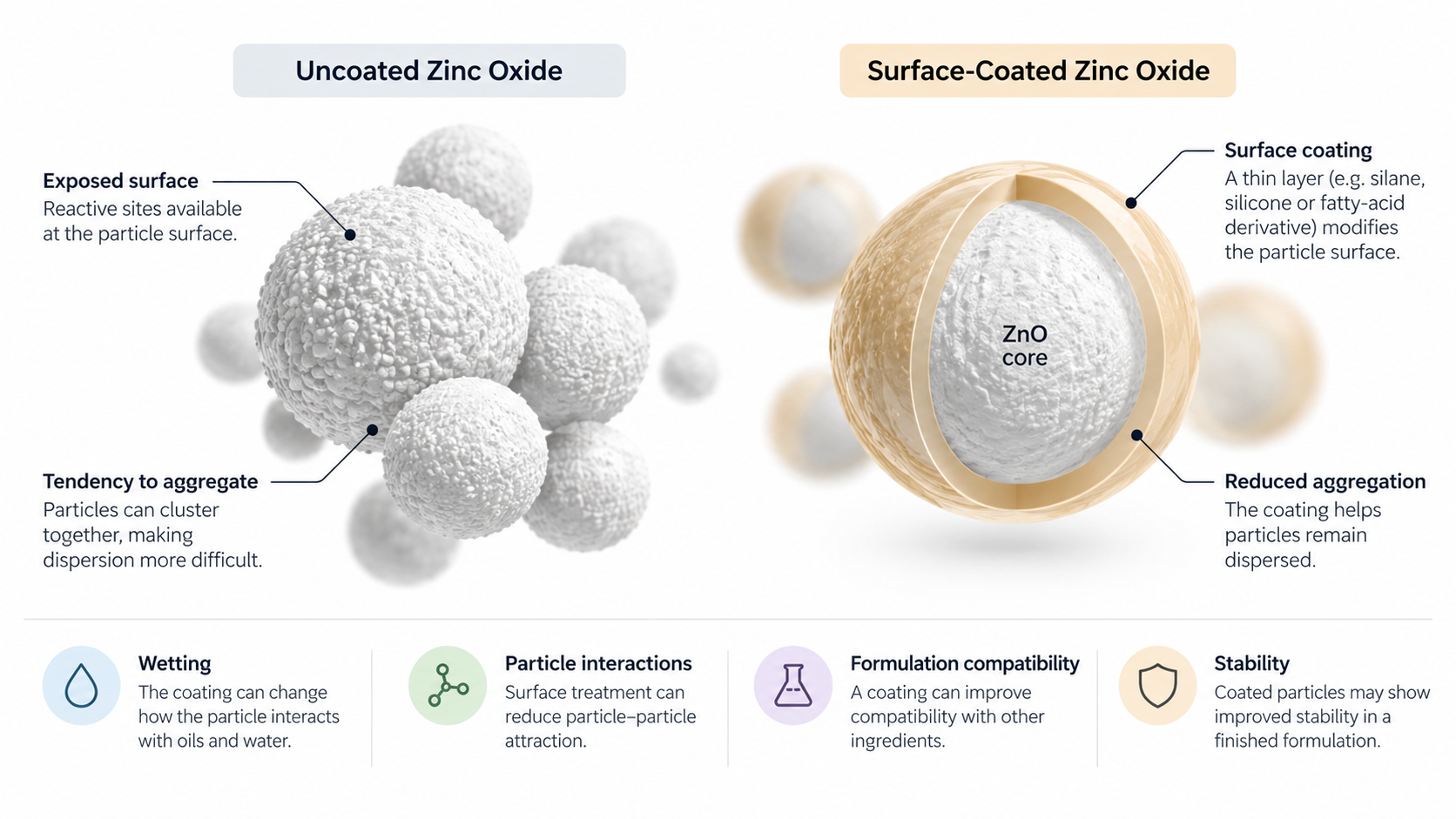
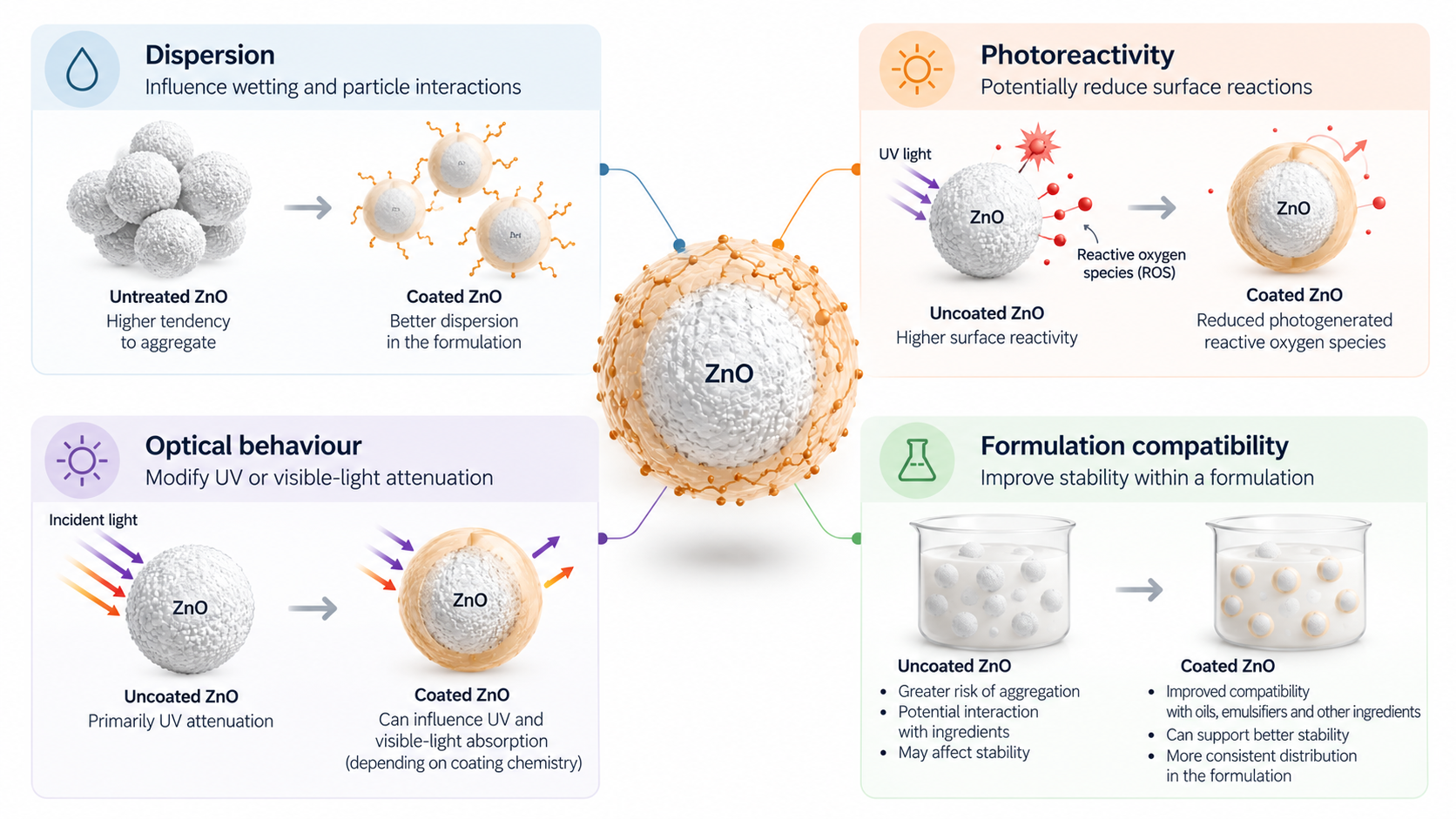
It is the point where zinc oxide meets everything else in the formulation. Oils, water, dispersants, emulsifiers, and other ingredients interact with that interface. The chemistry at this boundary can influence wetting, particle interactions, compatibility, and stability.
This is why surface treatment has become such an important part of commercial zinc oxide development.
A zinc oxide coating can change the way a particle interacts with its surroundings without requiring a completely different mineral underneath.
Why We Started Coating Zinc Oxide in the First Place
Untreated zinc oxide presents several challenges to sunscreen formulators.
Particles can form aggregates, interact unfavourably with certain formulation ingredients, or prove difficult to incorporate uniformly into the chosen phase. These problems can influence texture, appearance, processing, and ultimately the consistency of the applied sunscreen film.
Surface treatments help formulators manage some of these interactions.
Commercial ZnO materials may use treatments based on silanes, silicones, fatty-acid derivatives, or other surface-modifying compounds. The appropriate treatment depends on the material, the formulation environment, and the performance being targeted.
For example, a hydrophobic treatment may improve compatibility with an oil phase. Another treatment may alter wetting behaviour or help particles remain more effectively distributed within a dispersion.
The important point is that these coatings are not interchangeable.
A surface treatment that works well in one formulation may behave differently in another. The final outcome depends on the coating, the ZnO substrate, the dispersion process, and the rest of the formulation.
And this is where the conversation becomes more interesting.
What began as a way to manage particle compatibility has developed into a broader field of surface engineering.
A Zinc Oxide Coating Can Influence More Than Dispersion
A 2024 study published in Cosmetics investigated formulations containing 20% coated and uncoated zinc oxide nanoparticles.
The researchers examined differences in formulation behaviour, including stability and ultraviolet attenuation. Their findings indicated that surface treatment could influence both how the formulation behaved during storage and how the mineral-containing system interacted with UV radiation.
The study is useful because it moves beyond the isolated particle.
A sunscreen is a complete formulation. A coating that performs well on an individual particle still has to function within a mixture of oils, emulsifiers, stabilisers, and other ingredients.
The researchers observed differences between their coated and uncoated ZnO formulations, including stability under elevated-temperature storage conditions.
That does not mean every coated zinc oxide material will outperform every uncoated one. It means the surface treatment deserves attention as part of the formulation system.
This distinction matters whenever we encounter claims about a new zinc oxide coating.
Improved dispersion, higher measured UV attenuation, reduced photoreactivity, and better formulation stability are different outcomes. A treatment may influence one without necessarily improving all the others.
What Happens When Sunlight Meets the Zinc Oxide Surface?
Zinc oxide is a semiconductor. When it absorbs photons with sufficient energy, electrons can be excited into higher-energy states, leaving behind positively charged holes.
Under suitable conditions, these charge carriers can participate in reactions involving oxygen, water, and other molecules at or near the particle surface.
Some of these reactions can generate reactive oxygen species, commonly called ROS.
This behaviour is familiar in materials science, where ZnO’s photocatalytic properties are investigated for applications such as environmental remediation. But sunscreen formulation presents a different objective.
We want the material to contribute to UV protection while maintaining suitable compatibility, stability, and safety within the finished product.
It is important not to confuse laboratory measurements of photocatalytic activity with evidence that a finished zinc oxide sunscreen is harmful. The behaviour of isolated particles under experimental conditions does not automatically describe the behaviour of a formulated product on skin.
Still, surface photoreactivity gives researchers another reason to investigate coatings.
A suitably designed surface layer may help limit interactions between photoexcited ZnO and surrounding molecules. Depending on its chemistry and structure, it may influence charge transfer, the accessibility of reactive sites, or the interaction between the particle and its environment.
That makes the coating part of the material’s photochemical design.
A 2021 study investigating zinc oxide alongside organic UV filters also demonstrated why these interactions deserve attention. Under the conditions examined, uncoated micro- and nano-sized ZnO affected the photostability of certain filter combinations.
The results should not be generalised to every zinc oxide sunscreen, but they reinforce an important formulation principle: ingredients must be evaluated together, not simply judged by their individual properties.
Could Zinc Oxide Help Build Its Own Coating?
In July 2025, researchers published an unusual approach to zinc oxide surface engineering in the Chemical Engineering Journal.
Instead of simply depositing a conventional coating onto ZnO, they used a chemical property of the mineral itself to help construct the coating.
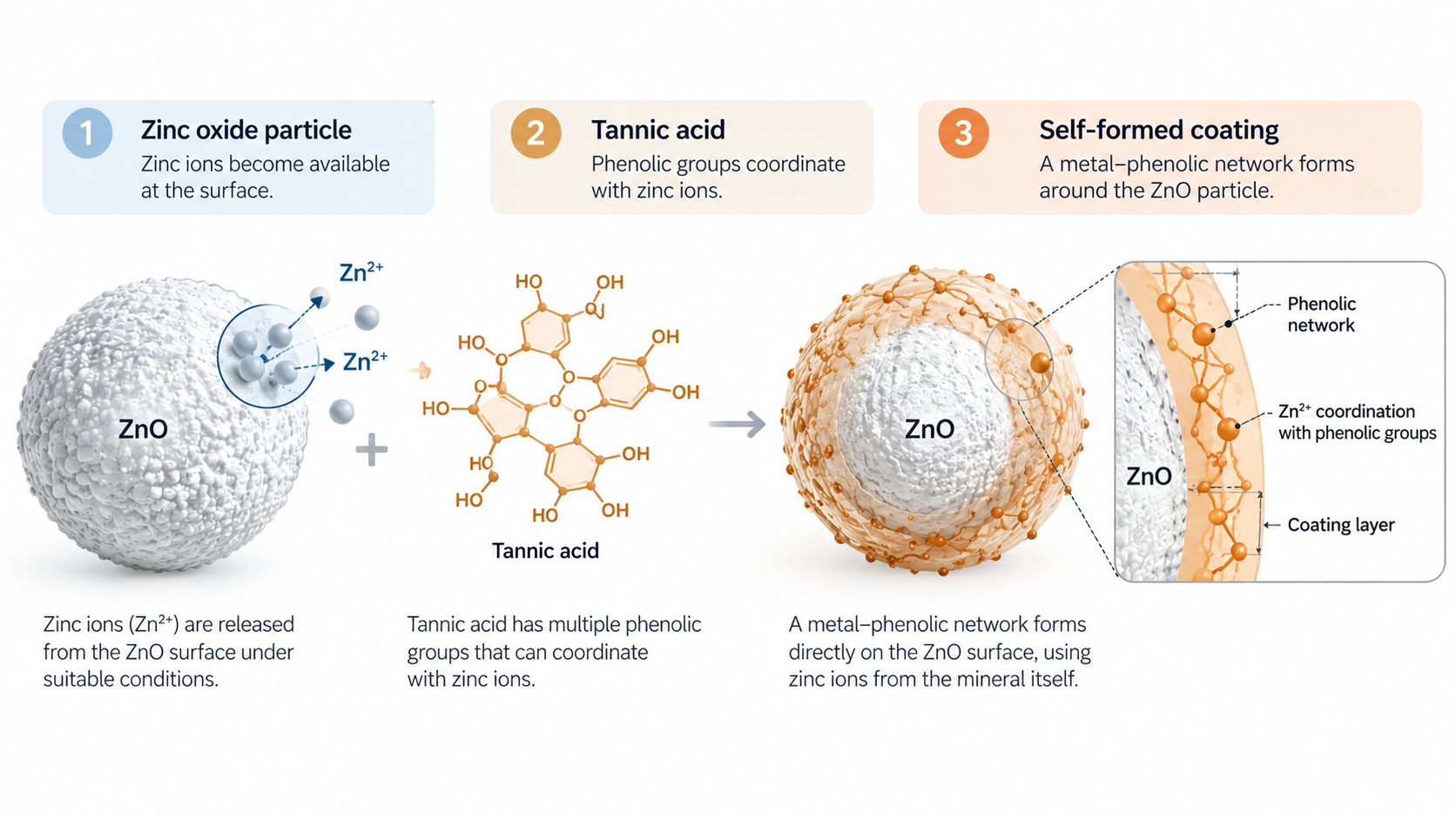
In their study on the spontaneous formation of metal–phenolic networks, the researchers used zinc ions released from ZnO to initiate the formation of a metal–phenolic network, or MPN, using tannic acid.
Tannic acid is a naturally occurring polyphenol. Its chemical groups can coordinate with metal ions, helping form interconnected structures. In this experiment, zinc ions originating from ZnO participated in the formation of a coating directly around the particles.
The researchers also observed oxidation reactions involving tannic acid, which changed the coating’s optical properties.
In other words, the ZnO was doing something quite interesting. It was supplying part of the chemistry needed to modify its own surface.
This differs from many conventional surface treatments, where coating ingredients are introduced to modify the mineral’s interface.
Here, the underlying ZnO participated in the process through the release of zinc ions. The coating was assembled without adding an external metal-ion source.
It is a subtle but important shift in how we might think about mineral surface engineering.
The Coating Did Something Unexpected With Light
The resulting material was not simply zinc oxide with an additional layer around it.
The metal–phenolic coating introduced new optical behaviour. As tannic acid underwent oxidation and related reactions, the resulting material developed a brown appearance and extended its light absorption into the high-energy visible region.
This is an important distinction because zinc oxide’s established sunscreen role is primarily associated with ultraviolet protection.
The 2025 experimental findings indicated approximately threefold improvements in SPF and UVA protection factor measurements relative to the uncoated ZnO nanoparticle comparator.
The researchers also reported suppression of more than 99% of measured photogenerated reactive oxygen species under their experimental conditions.
Those are interesting results, particularly because they involve two different aspects of performance: optical attenuation and photochemical behaviour.
But they require careful interpretation.
The findings relate to specific experimental nanoparticle materials. They do not establish that an equivalent coating would produce the same results with non-nano ZnO, in every sunscreen formulation, or after commercial manufacturing and storage.
The brown colour is another important consideration. A material that extends visible-light attenuation may also change the appearance of a finished sunscreen.
For formulators, that creates a new set of questions about shade, aesthetics, compatibility, and the type of product in which such a material could realistically be used.
Zinc Oxide Isn’t the Only Mineral Getting This Treatment
The 2025 ZnO study becomes more meaningful when we look at related research involving titanium dioxide.
In 2024, researchers published a study on metal–phenolic network coatings of titanium dioxide nanoparticles in ACS Applied Materials & Interfaces.
The researchers developed TiO₂–MPN hybrid nanoparticles using tannic acid and metal ions. Their experimental materials demonstrated broader optical absorption and substantial reductions in measured photoinduced reactive oxygen species.
The work also investigated how interactions between the metal ions and phenolic compounds could introduce new light-absorption pathways.
In that experiment, the researchers reported approximately fourfold increases in SPF and UVA protection factor measurements compared with their untreated TiO₂ comparator, along with 99.9% suppression of measured photoinduced ROS over six hours of simulated solar irradiation.
That matters because it suggests the broader idea is not limited to one mineral.
Researchers are exploring whether inorganic UV-filter surfaces can support additional chemistry that changes the optical and photochemical behaviour of the resulting materials.
The two studies also highlight an important difference. In the TiO₂ system, the metal–phenolic network was assembled using introduced metal ions. In the later ZnO approach, zinc ions released from the mineral itself helped form the coating.
The distinction is central to the idea of zinc oxide participating in its own surface modification.
Together, these findings suggest that metal–phenolic coatings offer researchers a wider range of design variables than simply choosing whether a mineral particle should be coated.
Not Every Zinc Oxide Coating Needs to Absorb More Light
It would be tempting to treat every new coating technology as another route to higher SPF. But that would overlook much of the work being done in surface engineering.
Some coatings are designed to improve compatibility with a formulation. Others are investigated for their ability to reduce surface reactivity, influence particle interactions, or alter how the mineral behaves during processing.
These objectives do not necessarily lead to the same material.
For example, a coating that reduces access to reactive surface sites might be useful for controlling certain photochemical interactions. But it could also change how the particle wets, disperses, or interacts with other ingredients.
Likewise, a coating that introduces visible-light absorption may affect colour. A treatment that improves dispersion in an oil-based system may be less suitable for a different formulation environment.
A 2025 critical review examining the optical and structural properties of ZnO-based sunscreens discusses the relationship between material characteristics and sunscreen performance.
The broader research direction highlights why structural and optical characterisation matter when evaluating these systems.
The coating cannot be considered independently from the particle underneath it or the formulation around it.
What Would It Take to Bring This Chemistry Into a Sunscreen?
A promising laboratory result is only the beginning.
For an experimental zinc oxide coating to become useful in commercial sunscreen development, formulators and material suppliers would need to answer several practical questions.
Can the coating be produced consistently? A laboratory process must be reproducible across manufacturing batches. Small variations in reaction conditions, coating thickness, or surface coverage could influence the resulting material.
Will it remain stable in a finished formula? Sunscreens contain multiple ingredients that may interact with a coated particle. The material needs to be evaluated under realistic processing and storage conditions, not only immediately after synthesis.
What happens to colour and texture? A coating that changes visible-light absorption could also change the appearance of the product. That may be useful in certain tinted formulations but undesirable in others.
Does it work with different ZnO materials? Particle size, morphology, surface area, and existing treatments may affect coating formation. Results obtained using nanoparticles cannot simply be transferred to non-nano materials.
How will protection be measured? Changes in optical properties must be evaluated using appropriate methods, followed by testing of finished formulations where relevant. Laboratory measurements alone cannot establish the SPF of a commercial sunscreen.
There are also regulatory and safety questions to consider. A new surface-engineered material may require additional characterisation and evaluation, depending on its composition and intended market.
These questions are not reasons to dismiss the research. They are the steps that separate an interesting materials experiment from a usable sunscreen ingredient.
The Next Change in Zinc Oxide May Be Happening at Its Surface
I find the direction of this research interesting because it changes how we think about zinc oxide development.
For years, much of the discussion has focused on particle size, shape, dispersion, and the challenges of getting mineral sunscreens to feel and look better on skin. Those remain important areas of formulation science.
But surface chemistry introduces another set of possibilities.
Researchers can investigate how a coating influences particle compatibility, photoreactivity, optical attenuation, and interactions with surrounding materials. In some experimental systems, the mineral itself may even contribute to the chemistry that creates that coating.
We are still some distance from knowing which of these approaches will become commercially practical. The evidence is promising in specific laboratory systems, but the results need to be tested across different materials and finished formulations.
The bigger idea is worth following.
Zinc oxide may remain chemically familiar, but the interface between the mineral and everything around it offers plenty of room for innovation.
And the next important development in mineral sunscreen technology may come from changing what happens on that surface.
____________________________________________________________________________________________________________________
Frequently Asked Questions
What is a zinc oxide coating?
A zinc oxide coating is a layer or surface treatment applied to ZnO particles to modify how they interact with their surroundings. Depending on the chemistry, it may influence dispersion, compatibility, photoreactivity, or optical behaviour.
Why is zinc oxide coated for sunscreen applications?
Surface treatments can help improve compatibility with formulation ingredients, influence wetting and dispersion, and address particular stability or surface-reactivity challenges. The benefits depend on the coating and the finished formulation.
Can zinc oxide create its own coating?
Experimental research published in 2025 demonstrated that zinc ions released from ZnO nanoparticles could participate in the formation of a metal–phenolic network coating using tannic acid. This is an emerging research approach, not an established property of all commercial ZnO materials.
Does coated zinc oxide provide higher SPF?
Not necessarily. Certain experimental coated ZnO materials have demonstrated improved UV attenuation compared with specific uncoated comparators, but the result depends on the material, coating chemistry, and formulation. Finished-product SPF must be established through appropriate testing.
Can zinc oxide coatings reduce photoreactivity?
Some coatings are investigated for their ability to limit surface reactions or suppress measured reactive oxygen species. The extent of any improvement depends on the coating design and experimental conditions.