

Zinc Oxide Uses and Applications Across Industries
What Is Zinc Oxide Used For? Key Applications Explained
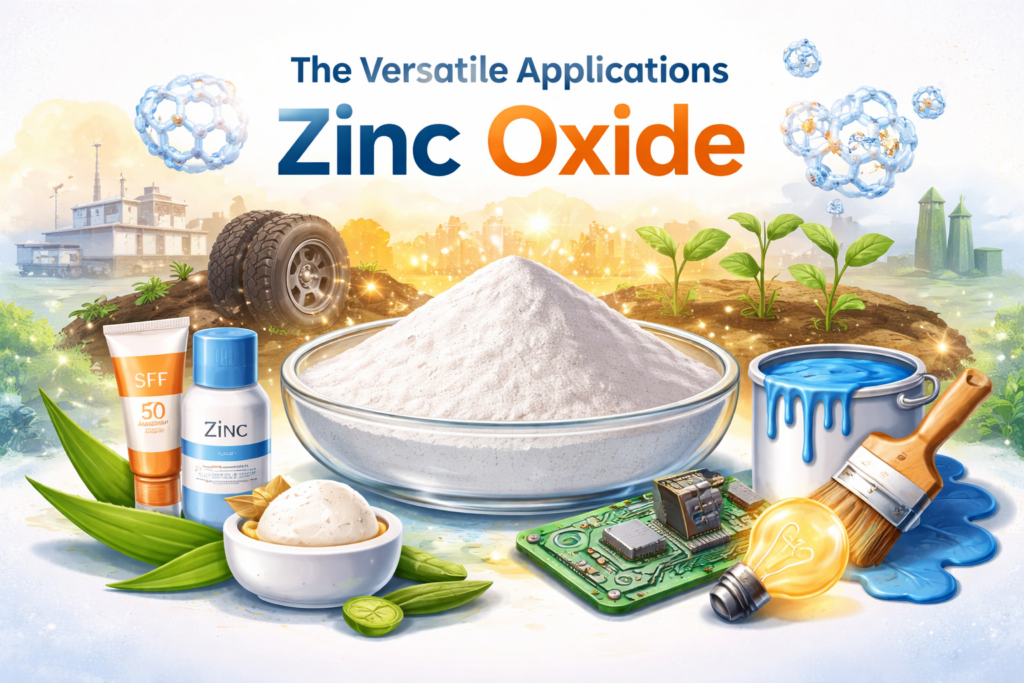
Zinc oxide (ZnO) is one of the most commonly used inorganic compounds in modern industry, known for how well it performs across a wide range of applications. These zinc oxide uses and zinc oxide applications span multiple industries, from personal care products and pharmaceutical creams to rubber manufacturing, coatings, electronics, and advanced materials. Zinc oxide has become an important functional ingredient that supports both protective and performance-related roles.
The wide use of zinc oxide comes from its unique mix of physicochemical properties. It provides broad-spectrum ultraviolet (UV) protection, shows antimicrobial effects, supports catalytic reactions, demonstrates semiconducting behavior, and forms protective barriers in different formulations. These combined properties explain why zinc oxide uses continue to expand across industries that need durability, safety, and stable performance under different environmental conditions.
- Broad-spectrum UV protection
- Antimicrobial activity
- Catalytic support
- Semiconducting properties
- Protective barrier formation
However, the way zinc oxide performs in real applications is not defined only by its chemical composition. It also depends heavily on particle engineering, including factors like particle size distribution, shape, surface treatment, and dispersion stability. These aspects influence how ZnO behaves in a formulation, affecting things like transparency in sunscreens, curing performance in rubber, and durability in coatings. This is why modern zinc oxide applications increasingly rely on engineered material design.
Zinc Oxide Uses in Sunscreens and UV Protection Applications
One of the most familiar zinc oxide uses is in sunscreen and UV protection products. Zinc oxide acts as a broad-spectrum UV filter, helping protect the skin from both UVA and UVB radiation. UVA rays go deeper into the skin and contribute to early aging and long-term damage, while UVB rays mainly cause sunburn. ZnO covers both ranges, making it one of the most complete UV filters available.
Unlike chemical sunscreens, which absorb UV radiation and convert it into heat within the skin, zinc oxide works through a mix of reflection, scattering, and absorption at the surface of the skin. This reduces the chance of irritation, which is why this remains one of the safest zinc oxide applications for sensitive skin, baby care, and post-treatment dermatological use.
Zinc oxide is also closely linked with environmentally conscious formulations. Non-nano ZnO is often described as reef-safe because it does not contribute to coral bleaching in the same way as certain chemical UV filters like oxybenzone. This has helped strengthen its role in modern zinc oxide applications within sunscreen products.
Earlier, zinc oxide sunscreens were known for leaving a thick, white layer on the skin. But improvements in particle engineering have made a big difference. Microfine and nano-sized particles, along with surface-treated dispersions, now allow better transparency, smoother application, and a more comfortable feel without reducing UV protection. Today, these zinc oxide uses extend beyond traditional mineral sunscreens into:
- Tinted SPF products
- BB creams
- Hybrid cosmetic formulations that combine sun protection with daily skincare

Zinc Oxide Uses in Skin Care and Pharmaceutical Applications
Zinc oxide plays an important role in dermatological and pharmaceutical products because of its soothing, protective, and antimicrobial properties. These zinc oxide uses have been well established over time in formulations designed to treat and protect sensitive, damaged, or irritated skin.
When applied to the skin, zinc oxide forms a protective layer that shields it from external irritants while helping maintain moisture balance. Its anti-inflammatory properties reduce redness and irritation, and its mild antimicrobial action helps support healing by limiting bacterial growth.
These qualities make ZnO a key ingredient in:
- Diaper rash creams
- Wound healing ointments
- Calamine lotions
- Acne treatments
- Eczema management products
In these cases, zinc oxide is valued for providing benefits without penetrating deeply into the skin, which helps reduce the risk of unwanted reactions. These practical zinc oxide applications are widely trusted in clinical and over-the-counter products.
The reason behind these effects is that it stays on the surface of the skin while releasing small amounts of zinc ions. These ions help support skin repair, contribute to immune responses, and maintain a balanced microbial environment. This combination of surface protection and biological support is why zinc oxide uses remain central in dermatology.
Zinc Oxide Uses in the Rubber Industry
In the rubber industry, zinc oxide works as an essential vulcanization activator. This is one of the most critical industrial zinc oxide uses. During vulcanization, ZnO works with stearic acid to activate sulfur crosslinking, a process that turns raw rubber into a strong, elastic, and durable material.
This function plays a major role in determining the mechanical properties of rubber products. Zinc oxide helps:
- Improve tensile strength
- Increase elasticity
- Enhance resistance to wear
- Support heat resistance
These properties are important for applications such as:
- Tires
- Conveyor belts
- Industrial seals
- Gaskets
- Footwear
The performance of zinc oxide in vulcanization depends on factors like particle size and surface area, which affect how reactive it is and how well it spreads within the rubber matrix. Because of this, advanced zinc oxide applications in rubber often use engineered ZnO grades.
At the same time, environmental concerns about zinc leaching have led to regulations aimed at reducing ZnO levels in rubber formulations. This has pushed research toward low-zinc systems and more efficient activators that can maintain performance while lowering environmental impact.
Zinc Oxide Applications in Paints, Coatings, and Corrosion Protection
Zinc oxide is widely used in paints and coatings because it works both as a pigment and as a performance additive. These zinc oxide applications are especially valuable in protective coatings where durability matters.
In environments exposed to UV light, ZnO helps prevent the breakdown of polymer binders by absorbing and scattering UV radiation. This helps coatings last longer and maintain their strength over time. It also slows down the growth of mold and mildew, which makes it suitable for humid and outdoor conditions.
Its corrosion-resistant properties are especially important in metal coatings, where ZnO forms protective layers that reduce oxidation and material damage. Because of these benefits, common zinc oxide uses in this segment include:
- Exterior paints
- Marine coatings
- Wood finishes
- Industrial protective coatings
Zinc Oxide Applications in Ceramics and Electronics
Zinc oxide is also an important material in advanced ceramics and electronic applications. These zinc oxide applications rely on its behavior as a wide bandgap semiconductor with unique electrical, optical, and piezoelectric properties.
In electronics, zinc oxide is used in:
- Varistors to protect circuits from voltage surges
- Sensors
- Piezoelectric devices that respond to mechanical stress
- Transparent conductive films
In ceramic applications, ZnO helps improve thermal stability, supports better sintering, and enhances optical properties. These technical zinc oxide uses make it valuable in both traditional and advanced material systems.
The performance of zinc oxide in these applications depends strongly on particle purity, crystal structure, and morphology, since even small differences can affect electrical and optical behavior.
Zinc Oxide Uses in Agriculture and Animal Nutrition
In agriculture and animal nutrition, zinc oxide serves as an important source of zinc, a micronutrient needed for enzyme function, protein production, and overall biological growth. These zinc oxide uses are essential for both plant and animal health.
ZnO is widely used in:
- Animal feed, especially piglet nutrition
- Fertilizers
- Crop sprays
These applications help support growth, maintain digestive health, and correct zinc deficiencies in soil, improving plant health and yield.
However, the use of high-dose zinc oxide in animal feed has come under regulatory scrutiny due to concerns about environmental buildup. As a result, there is increasing focus on optimizing dosage levels and improving efficiency in these zinc oxide applications.
Zinc Oxide Applications in Catalysis and Chemical Manufacturing
Zinc oxide also plays an important role in chemical manufacturing as both a catalyst and a catalyst support. These zinc oxide applications depend on its stability and surface characteristics.
It is commonly used in:
- Methanol production
- Gas purification processes
- Hydrogenation reactions
- Desulfurization systems
In these cases, ZnO helps improve reaction efficiency while maintaining stability under high temperatures and pressure. These industrial zinc oxide uses are critical for large-scale chemical processes.
Zinc Oxide Applications in Nanotechnology and Advanced Materials
In advanced material science, zinc oxide is valued for its nanoscale properties and optical behavior. These zinc oxide applications are growing quickly with new technological developments.
Zinc oxide is used in:
- Antimicrobial coatings
- Transparent UV-blocking films
- Photocatalytic systems
- Nanotechnology research
The difference between nano and micron-sized ZnO is important, since particle size directly affects transparency, reactivity, and surface interactions.
Why Zinc Oxide Performance Depends on Particle Engineering
Across all applications, the performance of zinc oxide is mainly controlled by its physical characteristics. These factors directly influence how different zinc oxide uses and zinc oxide applications perform in practice.
For example:
- In sunscreens, particle size affects transparency and UV protection efficiency
- In rubber, it influences curing performance and mechanical strength
- In coatings, it affects UV stability and antimicrobial performance
This is why engineered ZnO powders and dispersions are so important in modern zinc oxide applications.
Future Trends in Zinc Oxide Applications
The future of zinc oxide is being shaped by progress in material science and sustainability. New zinc oxide applications are emerging as nano-engineered materials improve performance across industries.
Emerging applications include:
- Antimicrobial surfaces
- Transparent UV films
- Advanced semiconductor devices
At the same time, industries are focusing on more sustainable production methods and environmentally responsible formulations, ensuring that zinc oxide applications continue to evolve with changing regulatory and environmental expectations.
Why Zinc Oxide Remains a Critical Industrial Material
Zinc oxide is a highly versatile material with applications across personal care, pharmaceuticals, rubber manufacturing, coatings, electronics, agriculture, and chemical processing. These wide-ranging zinc oxide uses and zinc oxide applications highlight its importance across industries.
However, its real value depends on how it is engineered and applied. Particle characteristics, dispersion quality, and formulation design ultimately determine how effective it is in real-world use.
As industries continue to look for better performance and more sustainable solutions, zinc oxide remains one of the most useful and widely used functional minerals in modern manufacturing.
_____________________________________________________________________________________________________________________
Frequently Asked Questions (FAQs)
What factors influence zinc oxide performance across different applications?
Zinc oxide performance is primarily controlled by particle engineering factors such as particle size distribution, surface treatment, morphology, and dispersion stability. These determine how ZnO behaves in a formulation, affecting transparency in sunscreens, reactivity in rubber, durability in coatings, and electrical behavior in electronics.
What is the difference between zinc oxide powders and dispersions?
Zinc oxide powders are dry particles that require proper wetting and dispersion during formulation, which can impact consistency and performance. Dispersions, on the other hand, are pre-processed systems where ZnO is already stabilized in a carrier medium, offering better uniformity, improved stability, and easier incorporation into formulations such as sunscreens and coatings.
How does zinc oxide provide broad-spectrum UV protection?
Zinc oxide protects against both UVA and UVB radiation through a combination of absorption, scattering, and reflection. Its wide-bandgap properties allow it to interact with a broad range of UV wavelengths, making it one of the most effective mineral UV filters available.
Why is particle size critical in zinc oxide applications?
Particle size directly influences optical, chemical, and functional behavior. Smaller particles improve transparency and reduce white cast in sunscreens, while larger or optimized particle distributions can enhance reactivity and mechanical performance in industrial applications like rubber and coatings.
How is zinc oxide used in skincare and pharmaceutical formulations?
In dermatological applications, zinc oxide forms a protective barrier on the skin, helps reduce inflammation, and supports healing. It is commonly used in formulations for irritation relief, wound care, and protective creams due to its stability and minimal skin penetration.
What role does zinc oxide play in rubber manufacturing?
Zinc oxide acts as a vulcanization activator, enabling sulfur crosslinking in rubber. This process enhances the mechanical strength, elasticity, heat resistance, and durability of rubber products such as tires, seals, and industrial components.
How does zinc oxide improve coatings and corrosion resistance?
Zinc oxide enhances coatings by providing UV stability, antimicrobial resistance, and protection against material degradation. It helps prevent polymer breakdown under UV exposure and contributes to corrosion resistance in metal surfaces.
Why is zinc oxide used in electronics and advanced materials?
Zinc oxide functions as a wide bandgap semiconductor with unique electrical and optical properties. It is used in applications such as varistors, sensors, piezoelectric devices, and transparent conductive films, where material purity and structure are critical.
What are the key industrial applications of zinc oxide beyond personal care?
Beyond personal care, zinc oxide is widely used in rubber manufacturing, coatings, ceramics, electronics, agriculture, and chemical processing. Its multifunctional properties enable it to act as an activator, stabilizer, protective agent, and functional material across these industries.
How are sustainability concerns shaping zinc oxide applications?
Sustainability considerations are driving the development of low-zinc formulations, improved material efficiency, and environmentally responsible processing methods. Industries are focusing on optimizing performance while reducing environmental impact, particularly in sectors like rubber and agriculture.