


Sunscreen Water Resistance Testing: ISO 16217, FDA Protocol, and What Formulators Need to Know
There’s a conversation I’ve had more times than I can count, usually somewhere between the stability chamber and a looming launch deadline. A brand comes in with a W/O emulsion they’re proud of — nice skin feel, elegant finish, high zinc loading — and they want to label it “waterproof.” Sometimes they’ve already printed the boxes. That conversation never gets easier. Water resistance is among the most valuable claims available in sun care. It’s also one of the most regulated, most litigated, and most frequently misunderstood. And the misunderstanding usually isn’t about chemistry — it’s about what the words on the label actually commit you to, legally and scientifically.
So let me walk through what these protocols actually demand, where brands and formulators tend to go wrong, and what I’d prioritize if I were commissioning this testing for the first time.
What “Water Resistant” Actually Means Legally
Start here, because this is where most of the confusion originates.

Under FDA regulations (OTC Monograph M020, posted September 24, 2021), a sunscreen can claim either 40 minutes or 80 minutes of water resistance. Those are your two options. Not 60, not 120, not “extended.” And the terms “waterproof,” “sweatproof,” “sunblock,” and “all-day protection” are prohibited outright — have been since 2012 — because they imply unlimited protection that no product can scientifically support.
I still see “waterproof” on products at the airport duty-free. I don’t know how they’re getting away with it. I wouldn’t bet on it continuing.
The important nuance that often gets lost: water resistance isn’t a comparison claim. You’re not demonstrating that SPF holds relative to a pre-immersion baseline — you’re demonstrating that the product achieves its labeled SPF after water immersion. The labeled SPF value is the post-immersion value. Full stop.
Outside the U.S., ISO 16217 serves as the principal international reference framework, recognized in Europe, Australia, Japan, Korea, and across ASEAN markets. The two protocols are structurally similar, and I’ll get into where they diverge — because those differences matter more than most people realize.
The FDA Protocol
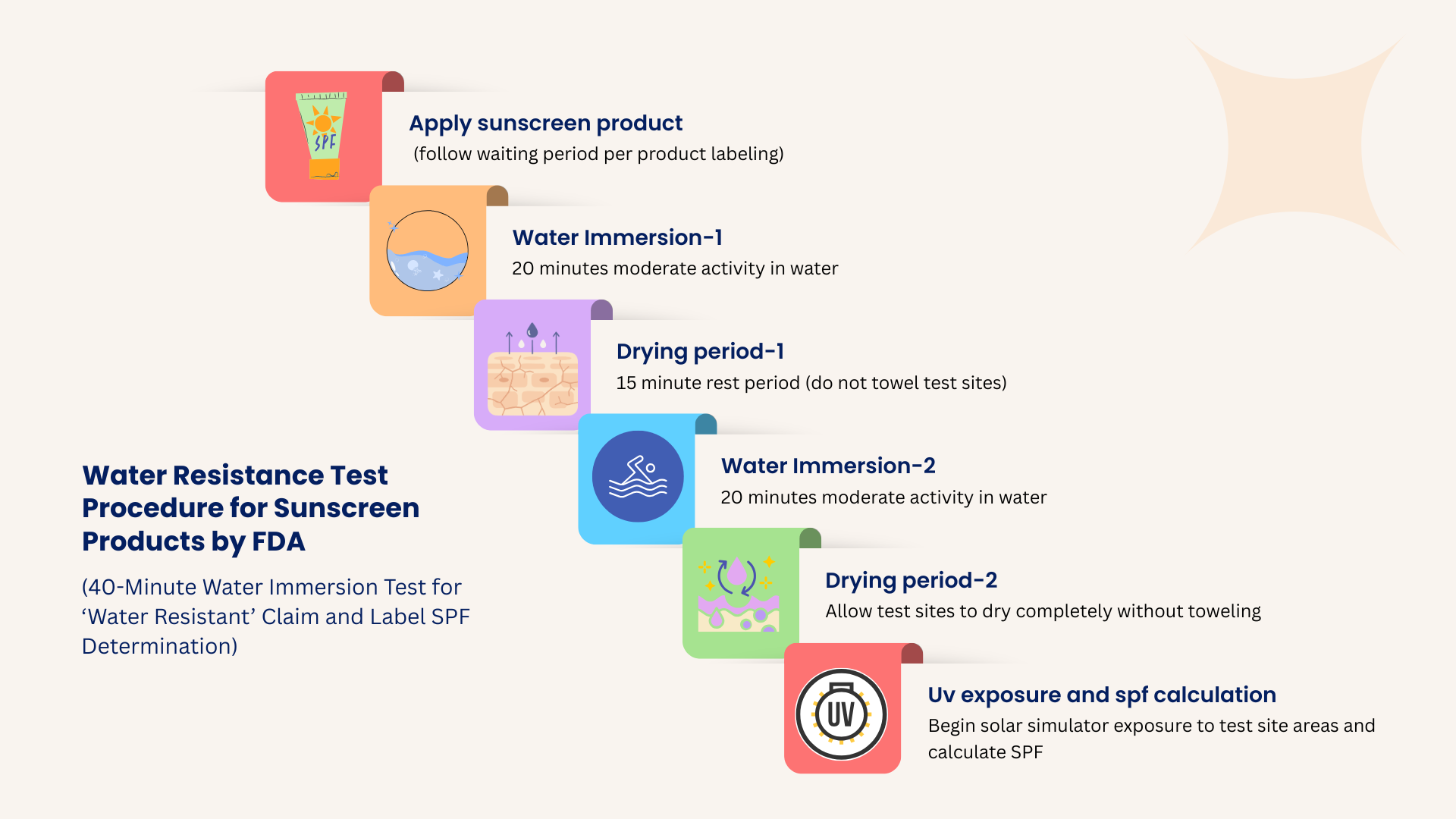
The FDA water resistance test is an in vivo procedure. Human subjects, not panels of rubber duck skin in a laboratory bath.
The sequence for a 40-minute claim:
- Sunscreen applied at 2 mg/cm² to at least 10 human subjects
- Minimum 15-minute dry-down before entering the water
- 20 minutes of water immersion (or moderate water activity covering the test area)
- 15-minute air dry — no toweling
- Second 20-minute immersion
- Second 15-minute air dry
- SPF measurement
For an 80-minute claim, you run that full cycle twice — four immersion periods total, with drying phases between each.
A few things worth emphasizing. The minimum of ten subjects is a floor, not a target. Labs will often recruit more to account for exclusions and to give the statistics enough room to breathe. And the drying periods are strict — no toweling means no toweling. I’ve seen tests invalidated over smaller protocol deviations than that.
Water and air temperature during the FDA protocol is 23–32°C. That range matters for reproducibility, and it’s one of the parameters where lab environments vary.
ISO 16217: The International Standard
ISO 16217:2020 operates within the broader ISO sunscreen testing suite alongside ISO 24444 (in vivo SPF) and ISO 24442 (in vivo UVA), and the immersion structure is nearly identical to FDA: two 20-minute immersions for a 40-minute claim, four for an 80-minute claim.
Where ISO diverges is in the specificity of water conditions. The standard controls:
- Water flow rate: 0.02–0.05 m/s
- Conductivity: ≥500 µS/cm
- pH: 6.5–7.5
- Water temperature: 30 ± 2°C
- Room temperature: 20–26°C
The drying window between immersions is also broader — 5 to 20 minutes rather than the fixed 15 minutes FDA specifies.
These aren’t cosmetic differences. Water conductivity and flow rate affect how aggressively the film is challenged during immersion. The standardization exists precisely because variability in these parameters across labs was producing inconsistent results.
ISO 16217 is also the only protocol that measures SPF both before and after immersion, giving you a comparative retention picture the FDA protocol doesn’t provide. That data can be genuinely useful for internal formulation optimization, even when you’re primarily seeking FDA compliance.
FDA vs. ISO 16217: A Direct Comparison
| Parameter | FDA Protocol | ISO 16217 |
| Test type | In vivo human subjects | In vivo human subjects |
| 40-minute claim | Two 20-min immersions | Two 20-min immersions |
| 80-minute claim | Four 20-min immersions | Four 20-min immersions |
| SPF assessment | After final immersion only | Before and after immersion |
| Drying period | 15 min (fixed) | 5–20 min |
| Room temperature | 23–32°C | 20–26°C |
| Water temperature | 23–32°C | 30 ± 2°C |
| Water parameters | Not specified | Flow, conductivity, pH controlled |
| Wait before UV | 15 minutes | 15 minutes |
| Accepted by | USA, Canada, Mexico, MERCOSUR¹ | EU, Australia, Japan, Korea, ASEAN², Mexico, MERCOSUR |
¹ Argentina, Brazil, Paraguay, Uruguay, Venezuela
² Brunei, Cambodia, Indonesia, Laos, Malaysia, Philippines, Singapore, Thailand, Vietnam
The critical takeaway: ISO compliance does not satisfy FDA requirements. If you’re selling in the U.S., you need FDA-protocol data. Full stop. I’ve watched brands burn for months, assuming ISO data would transfer. It doesn’t.
Formulation Factors That Actually Move the Needle
This is where I’ll be direct about what I’ve seen work and what I’ve seen fail.

Emulsion type is your biggest lever. W/O emulsions have a structural advantage — the external oil phase is hydrophobic by design, which means water is trying to penetrate something that actively repels it. O/W emulsions can absolutely achieve 80-minute water resistance, but it takes more intentional formulation work to get there.
On emulsifiers: less is more, and I mean that literally. The emulsification system dries down with the waterproofing agents on the skin. Add too much emulsifier, and it will re-emulsify your protective film back into the water. I’ve seen this sink 80-minute tests on formulas that looked excellent on paper. There’s no hard number I can give you here — it’s formulation-specific — but if you’re failing water resistance and you can’t figure out why, the emulsifier level is the first thing I’d audit.
Film-forming polymers are essential for O/W systems and meaningfully additive in W/O. Acrylate copolymers, cellulose derivatives, and similar materials create a continuous protective layer that resists mechanical disruption during immersion. The right polymer also helps maintain uniform UV filter distribution across the film as immersion stress increases.
Waxes — carnauba, candelilla, microcrystalline — increase hydrophobicity and mechanical durability. Higher wax content generally improves water resistance. The trade-off is always aesthetics: there’s a wax loading at which the formula becomes unacceptable to spread, and that’s a commercial constraint as real as any regulatory one. Finding that balance is most of the work.
Silicone ingredients reduce surface energy and promote uniform film formation, and silicone elastomers in particular add flexibility that matters when the film is being mechanically stressed during swimming. For silicone-free formulations — which we work in extensively at VIZOR — equivalent performance is achievable but requires more sophisticated polymer architecture. It’s not a concession; it’s just a different path.
On surface-treated zinc oxide: the particle surface chemistry directly affects how well ZnO retains its position within the sunscreen film during immersion. Hydrophobic treatments — triethoxycaprylylsilane, dimethicone — reduce aggregation and improve retention in the hydrophobic phase. This isn’t a secondary consideration for high-SPF zinc formulas; it’s load-bearing for water resistance performance.
Choosing a Lab and Commissioning the Test
A few things I’d insist on before signing any testing agreement:
For U.S. claims, confirm the lab routinely performs FDA-protocol water resistance testing — not just SPF, and not just ISO. These are different procedures, and not every accredited SPF lab maintains the full FDA water resistance protocol infrastructure.
Before commissioning an 80-minute test, explicitly ask whether the lab performs four-immersion protocols routinely. Some don’t. You don’t want to find this out after you’ve locked the formula and submitted samples.
For international markets, look for ISO/IEC 17025 accreditation alongside ISO 24444 and ISO 16217 capabilities. Accreditation matters for regulatory submissions in the EU and Australia, particularly.
Deliverables I’d always request:
- Raw SPF values before and after immersion (even for FDA testing, this is useful internally)
- Subject demographics and sample size
- Mean, standard deviation, and 95% confidence intervals
- Pass/fail determination against labeled SPF
And on timing: test after formula lock. This sounds obvious. It isn’t, in practice. Any modification to emulsifier concentration, polymer type, wax level, or UV filter dispersion after testing invalidates your data. I’ve seen development timelines extended by months because a minor aesthetic tweak was made post-testing. Build testing cost and lead time into your development plan early, before the pressure to launch makes the temptation to test-and-modify real.
Label Claims: The Strategic Dimension
One thing worth being explicit about: if your formula passes the 80-minute protocol, claim 80 minutes. There is no regulatory benefit to claiming 40 minutes on a formula that cleared the higher bar. I’ve seen brands do this out of excessive caution, or because they only commissioned 40-minute testing to begin with. It limits your marketing positioning for no scientific reason.
FDA labeling also requires reapplication directions instructing consumers to reapply:
- After 40 or 80 minutes of swimming or sweating
- After towel drying
- At least every 2 hours
These directions are mandatory regardless of your water resistance classification.
And SPF consistency must be maintained through testing. A product labeled SPF 50 that demonstrates SPF 30 after water immersion cannot retain its SPF 50 claim. The post-immersion value is the claim.
Water resistance testing is one of those areas where the regulatory requirements and the formulation science are deeply intertwined, and getting it right requires understanding both. The protocols aren’t arbitrary — they were designed to simulate real conditions of use, and the distinctions between FDA and ISO exist because the agencies that wrote them had different priorities and different markets in mind.
If you’re developing a sunscreen with water resistance claims and want to talk through formulation strategy or testing sequencing, we work through these decisions regularly at VIZOR. The zinc oxide we supply is surface-treated for hydrophobic phase compatibility — but that’s a conversation for another day.
Frequently Asked Questions I Get Regularly
Does ISO 16217 satisfy FDA requirements?
No. This is the single most common misconception in this space. ISO data supports claims in the EU, Australian, Japanese, and other markets that recognize ISO protocols. It does not satisfy the FDA for U.S. label claims.
Can W/O formulations achieve 80-minute water resistance more easily?
Generally, yes — the hydrophobic external phase is a structural advantage. But “more easily” is relative. I’ve seen W/O formulas fail 80-minute testing, and I’ve seen carefully optimized O/W systems pass. Formulation type creates favorable conditions; it doesn’t guarantee the outcome.
How many subjects are required?
FDA protocol requires a minimum of ten. ISO 16217 has similar requirements. Labs often recruit additional subjects to improve statistical robustness and account for screening exclusions. More subjects generally means tighter confidence intervals, which matters if you’re working near the edge of your labeled SPF.
What if my formula fails?
Go back to the emulsifier level first. Then, the polymer concentration and type. Then, wax loading. If you’re in a W/O system and still failing, look at the internal phase volume and emulsifier HLB. Failing water resistance is rarely a single-ingredient problem — it’s usually an architecture problem.