

In Vitro vs. In Vivo SPF Testing: Methods, Tradeoffs, and What’s Changing
In Vitro vs In Vivo SPF Testing: What Formulators Actually Need to Know
I’ve been watching the ALT-SPF conversation play out since the consortium published its 2025 results in the International Journal of Cosmetic Science, and I keep seeing the same misunderstanding repeated across formulation forums, conference panels, and brand briefs: the idea that in vitro SPF testing is either about to replace in vivo, or that it’s essentially useless because regulators won’t accept it.
Neither is true. The reality is more useful than either of those positions, but it requires understanding what each method is actually measuring, where it breaks down, and — critically — what stage of development it belongs to.
Let me walk through both methods properly, cover the ALT-SPF findings honestly, and give you a practical framework for when to use which.
How In Vivo SPF Testing Works (ISO 24444 and FDA Protocol)
The in vivo method under both ISO 24444 and the FDA protocol is built around the Minimal Erythemal Dose — the lowest UV dose that produces a visible, reproducible reddening of the skin on a test subject.

The protocol runs like this:
- Sunscreen is applied to defined test sites on the back of at least ten evaluable subjects at exactly 2 mg/cm²
- After a 15–30 minute wait, those sites are exposed to graded UV doses from a xenon arc solar simulator — a controlled light source designed to closely replicate the natural solar UV spectrum
- MED readings are taken 16–24 hours post-exposure, both on protected and unprotected control skin
- SPF is calculated as the ratio: MED (protected) ÷ MED (unprotected)
Subject selection isn’t arbitrary. ISO 24444 requires Fitzpatrick skin types I through III — individuals with limited melanin and consistent, measurable UV sensitivity. Anyone with active skin conditions, recent photosensitizing medication use, prior tanning, or a history of UV sensitivity disorders is excluded.
The methodology is rigorous, and it should be. It’s also genuinely variable in ways that aren’t always acknowledged. Individual differences in skin physiology, application pressure and uniformity, evaluator judgment when grading erythema, and even equipment calibration between labs all introduce noise. The 2019/2020 revision of ISO 24444 specifically addressed this — tightening solar simulator specifications, clarifying MED assessment criteria, adding photographic grading references, and revising subject selection requirements. These weren’t cosmetic changes; they were responses to real reproducibility problems the industry had been sitting with for years.
SPF Testing Cost and Timeline
Turnaround from sample submission to final results is four to eight weeks as a baseline, and testing panels book out. Per-study SPF testing costs run from $5,000 to $15,000, depending on complexity, number of SPF levels, and the lab. If you’re running a full product line with SPF 15, 30, 50, and 50+ variants through full in vivo studies at every formulation iteration, those costs compound fast.
The Structural Problem with Exclusive In Vivo Reliance
I’ll be honest about something: the ethical argument against exclusive reliance on in vivo testing carries more weight now than it did ten years ago, and not just because consumers have become more vocal about cruelty-free positioning.
Controlled UV exposure of human volunteers is not a small thing. The European regulatory framework has been steadily pushing toward alternative testing approaches — driven partly by the 2010 EU Cosmetics Regulation — and that regulatory pressure has accelerated investment in ISO 24444 alternative methods in ways that pure scientific interest alone probably wouldn’t have.
The more practical issue for development teams, though, is that in vivo testing is a confirmation tool, not a development tool. It tells you what your finalized formula achieves under standardized conditions. It doesn’t help you decide between ten prototype variants. It doesn’t tell you why a formulation is underperforming, or what changing the emulsifier system or film-forming agent does to your UV profile. You get a number after weeks, after the formulation is locked.
That’s the structural limitation that makes in vitro SPF test methods genuinely valuable — not as replacements, but as development tools that get used earlier and differently.
In Vitro SPF Test Methods: What They Measure and Where They Struggle
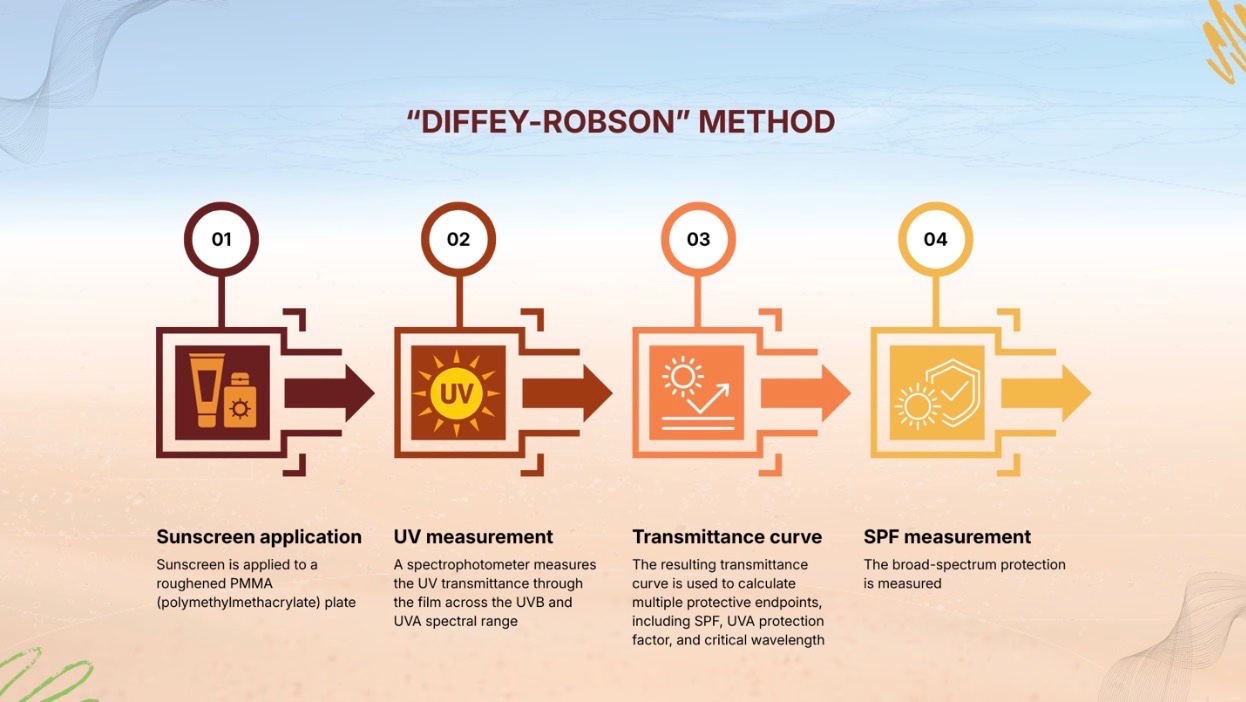
The most established in vitro SPF test method is the Diffey-Robson approach. Sunscreen is applied to a roughened PMMA (polymethylmethacrylate) plate at a defined density, and a spectrophotometer measures UV transmittance through the film across the UVB and UVA spectral range. From that transmittance curve, you can calculate SPF, UVA protection factor, and critical wavelength — the broadness of the UV coverage.
ISO 24443 formalizes this approach for UVA characterization specifically, based on COLIPA methodology, and is accepted for UVA claims in the EU and many other markets. The FDA doesn’t recognize it for label claim purposes, which I’ll come back to.
In Vitro SPF Correlation: Where It Holds and Where It Doesn’t
The honest summary on in vitro SPF correlation: the data is encouraging for mineral formulations, considerably messier for organic filter systems, and the reason for that asymmetry matters.
Zinc oxide and titanium dioxide are photostable. They don’t degrade under UV exposure. This is relevant because in the in vivo protocol, the solar simulator is actively irradiating the skin while delivering graded UV doses — meaning an organic filter formula is degrading throughout the measurement period, progressively losing absorbance as the test runs. An in vitro measurement on a static PMMA plate doesn’t capture that degradation. For mineral formulas, that source of divergence doesn’t exist, which is why in vitro-to-in vivo SPF correlation is substantially more reliable for ZnO and TiO2 systems than for organic filter formulas (Pissavini et al., 2025; Gackowska et al., 2014).
That said, mineral formulas have their own in vitro complications. Particle size and surface treatment affect the optical behavior of ZnO particles, and dispersion quality is load-bearing for measurement reproducibility. Agglomerated zinc oxide — insufficiently dispersed particles clustering together — produces inconsistent in vitro results because agglomerates have different optical properties than fully dispersed particles (Cavalcanti et al., 2025). If your in vitro ZnO data is noisy, dispersion is the first thing I’d look at.
What the ALT-SPF Initiative Actually Found
The ALT-SPF initiative was formed in 2018 with a specific mandate: identify, characterize, and validate in vitro alternatives to ISO 24444. It’s not a single company or academic group — it’s a consortium of sunscreen testing users and developers, which matters because the data has more credibility than any single lab’s findings would.

In 2025, the ALT-SPF initiative published results from a ring test study involving 32 sunscreen formulations evaluated across five proposed in vitro SPF test methods, compared against ISO 24444:2019 in vivo reference data (CTPA, n.d.; International Journal of Cosmetic Science, 2025).
The findings were genuinely useful, and I’d characterize them as cautiously optimistic rather than either triumphant or disappointing. Some of the five proposed in vitro methods showed acceptable in vitro SPF correlation with in vivo results across the evaluated formulation set. That correlation was not uniform — mineral-based systems tracked in vivo data more reliably than organic filter formulas, and some methods performed acceptably in the SPF 15–30 range while showing greater divergence at higher protection levels.
What this means practically: we have in vitro SPF test methods that can reliably indicate relative performance within a formulation set, particularly for mineral systems. Still, the correlation isn’t tight enough or consistent enough across formulation types to replace in vivo testing for regulatory purposes. Not yet.
The Road to Regulatory Acceptance for ISO 24444 Alternative Methods
The path from these findings to regulatory acceptance for ISO 24444 alternative methods runs through ISO validation ring tests — structured inter-laboratory studies benchmarking the new methods against established references across a broad range of labs and formulation types. Organizing those studies at the scale and diversity required for regulatory consideration takes time. Regulatory adoption by individual markets takes more time after that.
Most analysts I find credible are expecting hybrid frameworks to emerge: in vitro screening during development, in vivo confirmation at launch. A structured division of function rather than a wholesale replacement. That strikes me as the realistic outcome, and it’s also the most practically useful framework for development teams working now rather than waiting for the regulatory landscape to resolve.
How to Choose a Testing Strategy: In Vitro vs In Vivo SPF Testing in Practice
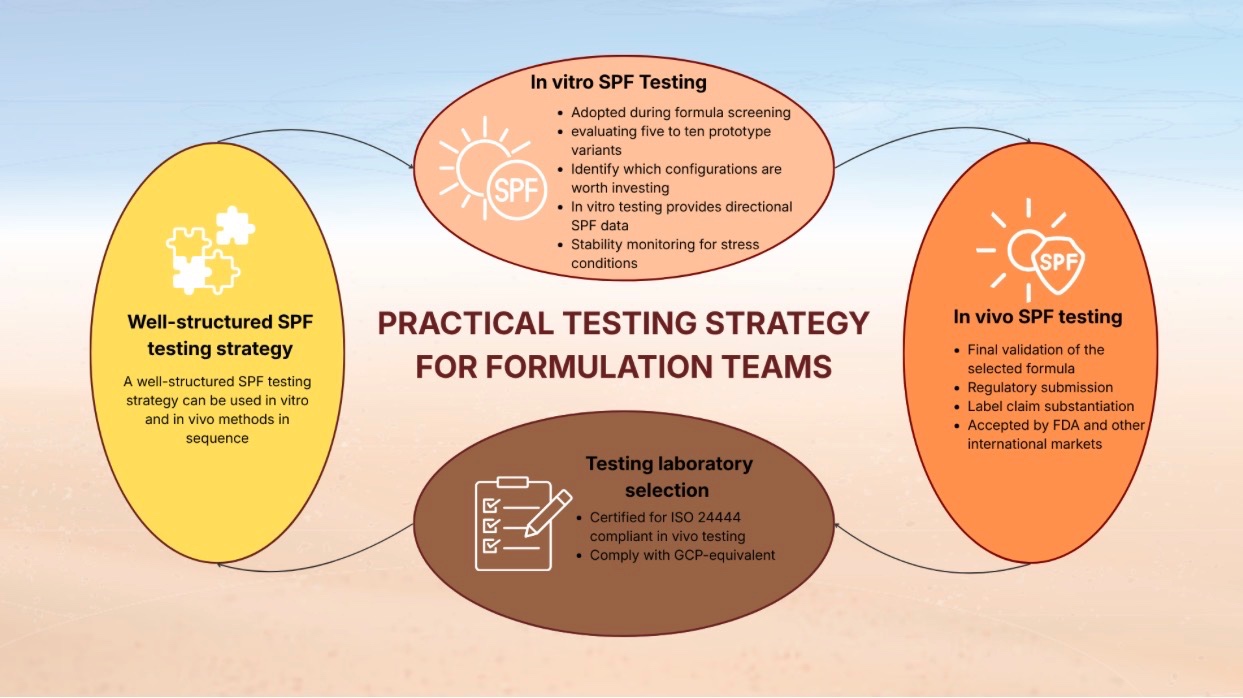
The question isn’t which method is better. They serve different functions at different stages, and a well-structured program uses both deliberately.
Early formulation screening is where in vitro SPF test methods belong. If you’re evaluating five to ten prototype variants — iterating on UV filter combinations, emulsifier systems, film-formers, aesthetics — in vitro SPF measurement gives you directional data quickly and cheaply. It’s a ranking and elimination tool. You’re not trying to generate a label claim; you’re trying to identify which two or three formulas are worth investing in.
Stability monitoring is another strong application. SPF retention through heat, humidity, and light stress is a critical quality attribute, and running in vitro measurements before and after stress cycling lets you monitor formulation stability without burning in vivo budget on samples that aren’t final candidates.
Development lock is where in vivo takes over. Once you’ve selected the formula going to market, in vivo testing under ISO 24444 or the FDA protocol is the required final validation. This is non-negotiable for regulatory submissions and label claims in the US, Australia, and most major international markets.
One thing worth stating explicitly: in vitro and in vivo SPF values are not interchangeable numbers. An in vitro result of 47 is not a claim of SPF 47. It’s directional development data. Using in vitro numbers in regulatory submissions or on product packaging without in vivo validation isn’t a gray area — it’s a regulatory and legal problem. For brands with ethical positioning commitments, in vitro methods are genuinely appropriate during early development and can be communicated accurately as development tools. The issue arises only when they’re conflated with regulatory claims, which they aren’t.
Choosing an SPF Testing Lab
Selecting the right SPF testing lab is more nuanced than it appears, and the in vitro vs in vivo distinction matters here, too.
Labs certified for ISO 24444-compliant in vivo testing operate under GCP-equivalent subject handling requirements — they’re running human subjects studies, and the compliance framework reflects that. Labs offering in vitro SPF measurement as a development service operate differently, under analytical rather than clinical compliance frameworks. The two categories serve different functions and should be evaluated on different criteria.
For in vivo testing, the key questions for any SPF testing lab are: Do they run the FDA-specified protocol or ISO 24444, or both? What is their panel availability and average turnaround? Can they provide example reports formatted to the submission requirements of your target markets? For 80-minute water resistance, do they run four-immersion protocols routinely, or only on request?
For in vitro SPF testing, ask about their PMMA substrate sourcing and conditioning procedure, their spectrophotometer calibration frequency, and how they handle dispersion of inorganic filter samples before measurement. These aren’t bureaucratic questions — they’re the variables that determine whether your in vitro data is reliable enough to make meaningful development decisions.
A Note for Formulators Working with Zinc Oxide
If ZnO is your primary UV filter — which is the case for most of what we develop at VIZOR — the in vitro-to-in vivo SPF correlation story is more favorable than it is for most of the sunscreen market, for the photostability reasons covered above.

That doesn’t mean in vitro data can substitute for in vivo confirmation, but it does mean your early-stage in vitro screening data are more likely to be predictive of your in vivo outcomes than they would be for an organic filter formula. The formulation variables that matter for reliable in vitro data are dispersion quality and surface treatment consistency. Get those right, and your screening data will be meaningfully informative about which direction to take.
One thing I’ve seen trip up development teams: assuming that because ZnO is photostable, in vitro SPF data is inherently reliable. It’s a necessary condition, not a sufficient one. Particle distribution, application uniformity on the PMMA substrate, and film thickness consistency all affect measurement quality independently of filter photostability. Treat the in vitro measurement as a tool that requires the same care and consistency as any other analytical method, and it will give you useful data.
Current Regulatory Status: In Vitro vs In Vivo SPF Testing by Market
The current regulatory picture is clear on what isn’t permitted and somewhat unresolved on the trajectory.
The FDA does not accept in vitro SPF data for label claims. Full stop. The EU’s regulatory framework is exploring standardization of in vitro SPF test methods, but has not formalized acceptance. Australia’s TGA similarly does not permit in vitro data to substantiate SPF claims (TGA, 2025). ISO 24443 for UVA characterization is accepted in the EU and several other markets, but that’s UVA, not SPF.
For brands operating across multiple markets — which increasingly describes most serious sun care businesses — the strategic testing question is sequencing and budget allocation, not whether to skip in vivo testing. In vitro screening early, in vivo confirmation late, with the in vitro investment treated as R&D cost rather than regulatory spend.
The ALT-SPF initiative moves this conversation forward meaningfully, and the 2025 publication series gives the industry a more rigorous evidence base than it had before. Whether that translates into regulatory acceptance for ISO 24444 alternative methods within the next three to five years depends on how quickly ring tests can be organized and completed, and how receptive individual regulatory agencies are to the accumulated evidence.
My honest read: movement is coming, but it’s measured in years, not months. Design your testing strategy for the regulatory environment that exists today, not the one that might exist in 2028.
Frequently Asked Questions: In Vitro vs In Vivo SPF Testing
Can in vitro SPF results appear on packaging or regulatory submissions?
No. In vitro SPF values are development data, not label claim data. Presenting them as regulatory-substantiated claims is a compliance problem in every major market.
What is the SPF testing cost difference between in vitro and in vivo?
In vivo SPF testing costs typically run $5,000–$15,000+ per formulation, depending on the SPF testing lab, protocol complexity, and number of test subjects. In vitro spectrophotometric measurement costs a fraction of that, often completed in days rather than weeks. For high-iteration early development, the economics of in vitro screening are material.
Is the in vitro SPF correlation reliable enough to use for development decisions?
Yes, for ranking and eliminating prototype variants — particularly for mineral filter systems, where in vitro-to-in vivo SPF correlation is stronger. No, for generating numbers that substitute for in vivo validation at the development lock.
What is the ALT-SPF initiative, and what did it find?
An industry consortium formed in 2018 by sunscreen testing users and developers to identify and validate in vitro alternatives to ISO 24444. Their 2025 ring test results, published in the International Journal of Cosmetic Science, evaluated five proposed in vitro SPF test methods against in vivo reference data across 32 formulations. Cautiously promising for mineral systems, more variable for organic filter formulas, not yet definitive enough for regulatory acceptance.
Are ISO 24444 alternative methods accepted by regulators?
Not yet for SPF label claims. ISO 24443 is accepted for UVA characterization in the EU. In vitro SPF test methods remain development tools rather than regulatory submission tools in all major markets as of 2025.
Does ISO 24443 acceptance in the EU apply to SPF claims?
No. ISO 24443 covers UVA characterization specifically and is accepted for UVA claims in the EU. SPF label claims require in vivo testing in the EU. They’re separate endpoints with separate validation requirements.
The field is moving. The ALT-SPF data is real, and the direction is clear. But the practical reality for a formulation team today is that in vivo testing remains the path to regulatory compliance in every major market, and the most sensible strategy is to use in vitro screening to get to your best formula faster and cheaper, then validate it properly. That’s not a consolation position — it’s a genuinely more efficient development process than running in vivo studies on every prototype.
If you’re developing sunscreens with zinc oxide and want to talk through a testing strategy that reflects both the current regulatory requirements and the emerging in vitro landscape, this is something we think about regularly at VIZOR. The surface chemistry of the ZnO you’re working with affects both your in vitro SPF measurement reliability and your in vivo performance — but that’s a longer conversation.