

If someone asked me what the future of sunscreen looks like, I probably wouldn’t start by talking about SPF. We’ve spent decades improving UV filters, refining formulations, and making sunscreens more pleasant to wear. Yet every time one challenge is solved, another appears. Better aesthetics can reduce water resistance. Higher mineral filter loading can increase white cast. A more elegant texture may require additional stabilizers or film formers. The more I think about it, the more convinced I become that the industry isn’t waiting for another UV filter. It’s waiting for an ingredient that can solve several problems at once.
That might sound unrealistic, but today’s sunscreen formulations already tell us why such an ingredient would be valuable. Modern sunscreens are not built around a single hero ingredient. Instead, they are carefully balanced systems. Zinc oxide provides broad-spectrum UV protection and remains one of the most trusted mineral UV filters because of its photostability. Organic filters such as Bemotrizinol (BEMT), Bisoctrizole (MBBT), and Mexoryl 400 have significantly improved UVA coverage in markets where they are approved. Yet none of these ingredients can independently deliver excellent protection, elegant skin feel, easy manufacturing, regulatory flexibility, and environmental compatibility.
To compensate, formulators build increasingly sophisticated ingredient systems. Surface-treated zinc oxide particles coated with materials such as Triethoxycaprylylsilane improve compatibility with oils and help reduce agglomeration. Film formers including Trimethylsiloxysilicate and VP/Eicosene Copolymer improve water resistance, while rheology modifiers help keep mineral particles evenly suspended throughout a product’s shelf life. Each ingredient has a specific job because no single material can do them all.
If I could invent one ingredient tomorrow, I wouldn’t ask it to deliver SPF 100. I’d ask it to simplify the entire formulation.
The Perfect Ingredient Would Replace Three Ingredients Instead of One
One of the biggest misconceptions about sunscreen development is that success depends on finding a better UV filter. In reality, formulators spend just as much time making ingredients work together as they do selecting the UV filters themselves. A formulation containing zinc oxide, for example, must also solve challenges related to particle dispersion, suspension stability, sensory feel, manufacturing consistency, and long-term storage. Improving one property often means adding another functional ingredient somewhere else in the formula.
Imagine increasing the zinc oxide concentration to improve UV protection. The formulation may become thicker and more difficult to spread. Consumers notice the heavier texture immediately, so formulators may introduce different emollients or rheology modifiers to restore skin feel. If water resistance also needs to improve, additional film formers may be required. What began as one formulation change quickly affects several parts of the ingredient system.
This is why I believe the future of sunscreen lies in multifunctional materials rather than simply stronger UV filters. An ingredient that could simultaneously improve particle dispersion, strengthen the sunscreen film, support photostability, and maintain elegant sensory properties would remove several formulation compromises at once. Instead of replacing zinc oxide or modern UV filters, it would allow them to perform closer to their full potential.
Interestingly, research is already moving in this direction. Scientists are investigating lignin nanoparticles, a naturally derived material with intrinsic UV-absorbing and antioxidant properties. Rather than acting only as another UV filter, lignin nanoparticles are being explored as multifunctional carriers capable of improving photostability, reducing oxidative degradation, and enhancing the performance of conventional sunscreen actives. That shift—from single-function ingredients to multifunctional systems—may represent one of the most important changes in the future of sunscreen.
The Future of Sunscreen May Look More Like Smart Materials Than New UV Filters
For years, sunscreen innovation was largely measured by the discovery of new UV filters. While that remains important, I think the industry’s attention is gradually shifting. Today, many researchers are asking a different question: instead of inventing another UV filter, can we make existing filters perform better?
One area receiving significant attention is encapsulation technology. Some UV filters, particularly avobenzone, are highly effective but can degrade when exposed to sunlight if they are not properly stabilized. Researchers are investigating encapsulation systems that surround these filters with protective materials, improving their photostability while reducing direct interaction with the surrounding formulation. Rather than changing the chemistry of the UV filter itself, these systems help preserve its performance over longer periods of UV exposure. This allows formulators to improve durability without dramatically changing the ingredient list.
Another exciting area is the use of lignin nanoparticles. Lignin is one of the most abundant natural polymers on Earth and is produced as a by-product of the paper and forestry industries. Traditionally viewed as industrial waste, it is now being investigated as a multifunctional cosmetic material. Studies have shown that lignin nanoparticles can provide antioxidant activity, absorb portions of the UV spectrum, and improve the photostability of conventional UV filters. Instead of performing one task, they may contribute several benefits simultaneously, exactly the kind of multifunctionality formulators have been searching for.

Researchers are also exploring cellulose nanocrystals and other bio-based materials that can reinforce sunscreen films while reducing dependence on conventional synthetic polymers. These materials are attracting attention because they combine renewable sourcing with promising mechanical properties. Although many remain at the research stage, they reflect a broader industry movement toward ingredient systems that deliver performance through smarter material design rather than simply increasing the concentration of existing UV filters.
To me, this is where the future of sunscreen becomes genuinely exciting. The next breakthrough may never appear on the front of a sunscreen bottle as a brand-new UV filter. It could be a quiet innovation hidden within the formulation—a smarter carrier, a multifunctional particle, or an advanced polymer that allows every other ingredient to perform better. Those breakthroughs may not attract the same headlines as a new active ingredient, but they have the potential to change how formulators build sunscreens for years to come.
The Hardest Part Isn’t Inventing the Ingredient. It’s Getting the World to Agree
Even if someone developed the perfect sunscreen ingredient tomorrow, there is no guarantee consumers would see it anytime soon. One of the biggest challenges facing the future of sunscreen isn’t chemistry. It’s regulation. An ingredient can show excellent safety data, impressive UV performance, and strong consumer benefits, yet still face years of evaluation before reaching the market. By the time it receives approval in one region, another market may still be following a completely different regulatory pathway.
We’ve already seen how changing regulations can reshape sunscreen development. In 2022, the European Commission reduced the maximum permitted concentration of homosalate in face products after scientific review by the Scientific Committee on Consumer Safety (SCCS). More recently, the EU also adopted measures affecting 4-methylbenzylidene camphor (4-MBC), leading manufacturers to reformulate products that had previously met regulatory requirements. These decisions weren’t driven by poor product quality. They reflected evolving scientific assessments and demonstrate that sunscreen formulations must continue adapting long after they reach consumers.
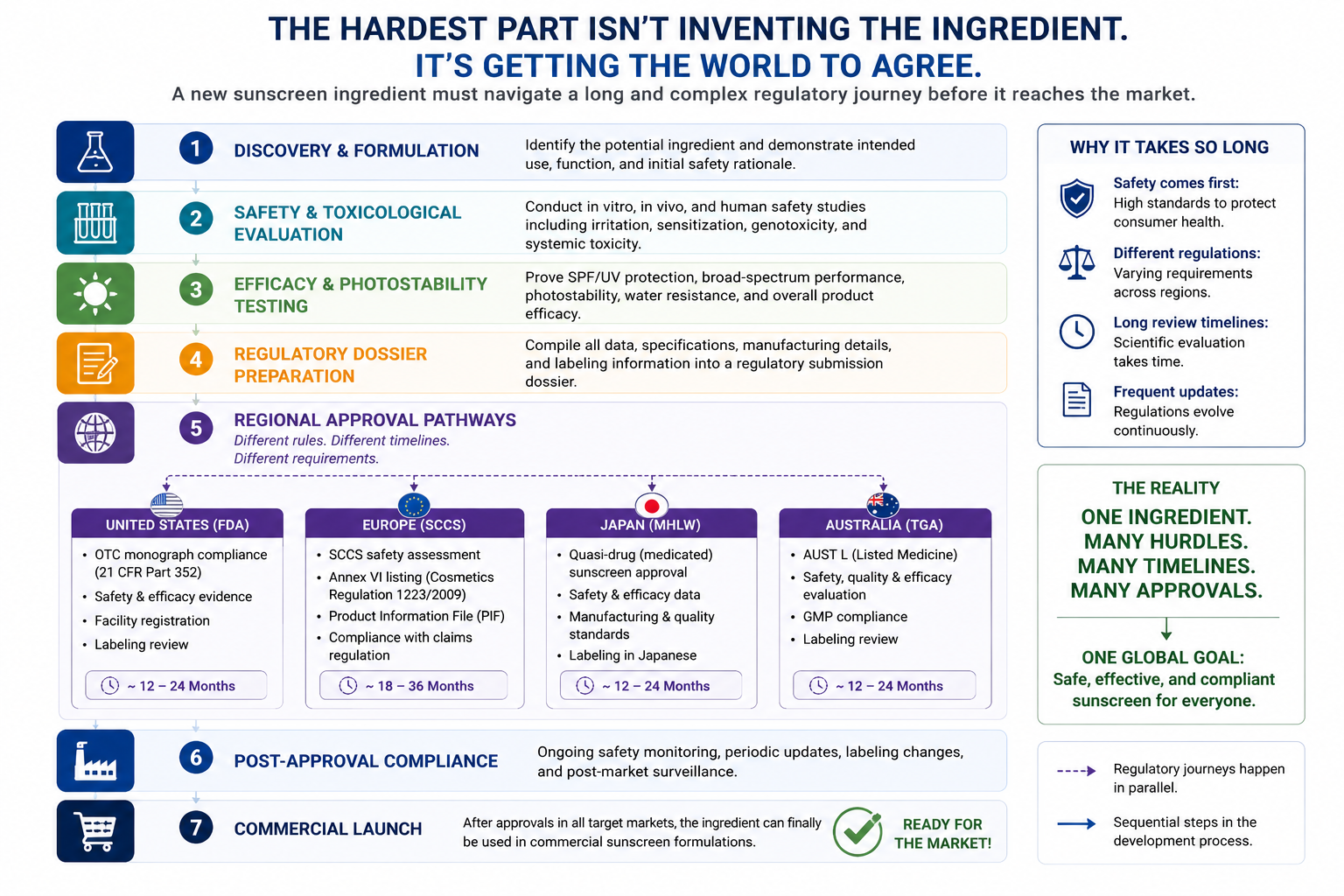
Regional differences make the challenge even greater. Ingredients such as Bemotrizinol (BEMT) and Bisoctrizole (MBBT) have been widely used in Europe and many international markets for years, while newer filters such as Mexoryl 400 have expanded long-wave UVA protection in selected markets. At the same time, companies launching products globally must navigate different approval systems, testing requirements, and labeling rules depending on where they intend to sell. The result is that the same sunscreen brand may offer different formulations in Europe, Australia, Asia, and the United States, even when the packaging looks nearly identical.
If I could add one final characteristic to my imaginary ingredient, it wouldn’t be higher SPF or even better sensory performance. I’d want it to satisfy regulators around the world from day one. Imagine how much faster innovation could reach consumers if formulators didn’t need multiple regional versions of the same product. Until that happens, the future of sunscreen will depend not only on better chemistry, but also on building enough scientific confidence for regulators worldwide to move in the same direction.
The Ingredient Every Sunscreen Formulator Wishes Existed Probably Isn’t a UV Filter
After writing this article, I’ve realised that I may have asked the wrong question. I started by imagining one revolutionary ingredient that could transform the future of sunscreen. Along the way, I kept finding examples of scientists solving problems in a different way. Instead of searching for one “super ingredient,” they’re improving the entire formulation ecosystem through smarter materials, better delivery systems, advanced particle engineering, and multifunctional technologies.
Today’s research reflects that shift. Surface-treated mineral particles improve compatibility without changing the UV filter itself. Encapsulation technologies help stabilise filters such as avobenzone rather than replacing them. Bio-based materials like lignin nanoparticles are being explored because they can contribute UV absorption, antioxidant activity, and carrier functionality at the same time. At the same time, advances in particle engineering continue to improve how zinc oxide disperses, feels on the skin, and integrates into increasingly elegant formulations. None of these innovations solves every challenge alone, but together they begin to reduce the compromises that have defined sunscreen development for decades.
I also don’t think formulators are asking for impossible chemistry anymore. They’re asking for simplicity. They want ingredients that reduce the number of formulation adjustments needed during development. They want materials that are easier to disperse, easier to scale up, easier to manufacture consistently, and easier to register across multiple markets. Most importantly, they want ingredients that help consumers use sunscreen more willingly by improving texture, transparency, and overall wearability without sacrificing protection.
Perhaps that is what the future of sunscreen really looks like. Not one miracle UV filter that changes everything overnight, but a new generation of intelligent ingredients designed to perform multiple functions at once. An ingredient that disperses like a processing aid, stabilises like a polymer, protects like a UV filter, feels invisible on every skin tone, supports sustainability goals, and satisfies regulators around the world. We haven’t invented that material yet, but the direction of today’s research suggests the industry is already moving towards it.
For me, that’s what makes this field so exciting. Every new paper on lignin nanoparticles, every improvement in surface-treated minerals, every advancement in encapsulation technology, and every new multifunctional polymer is another step towards solving a puzzle that formulators have been working on for decades. The ingredient every sunscreen formulator wishes existed may not have a name yet, but the future of sunscreen is being shaped by the scientists trying to create it.
Frequently Asked Questions
-
What does the future of sunscreen look like?
The future of sunscreen is expected to focus on multifunctional ingredients, smarter material design, improved photostability, enhanced cosmetic elegance, and more sustainable formulations. Instead of relying solely on new UV filters, researchers are developing technologies that help existing ingredients perform more efficiently.
-
Are scientists still developing new sunscreen ingredients?
Yes. Researchers continue to investigate new UV filters, advanced polymers, encapsulation technologies, bio-based materials, and multifunctional nanoparticles. Many current research projects aim to improve stability, sensory performance, and environmental compatibility rather than simply increasing SPF.
-
Why can’t one ingredient do everythingina sunscreen?
Every sunscreen ingredient is designed for a specific function. UV filters protect against ultraviolet radiation, film formers improve water resistance, dispersants help distribute mineral particles evenly, while rheology modifiers maintain stability. Combining these functions into one ingredient remains one of the biggest scientific challenges in sunscreen development.
-
What are multifunctional ingredients?
Multifunctional ingredients perform more than one role within a formulation. For example, researchers are exploring materials that combine UV protection, antioxidant activity, improved photostability, and carrier functionality. These innovations could simplify formulations while improving overall product performance.
-
Why do sunscreen formulations differ around the world?
Different countries approve different UV filters and follow different regulatory requirements. As a result, companies often reformulate products for specific markets to comply with local regulations while maintaining similar performance and consumer experience.
-
Could the perfect sunscreen ingredient ever exist?
Perhaps not as a single molecule. The future of sunscreen is more likely to be shaped by intelligent ingredient systems, advanced materials, and multifunctional technologies that work together to reduce the trade-offs formulators face today.