
When I first started thinking about sunscreen testing, I assumed the expensive part was the laboratory work. SPF studies are not cheap, water-resistance testing adds another layer of complexity, and every additional claim seems to bring another round of validation. The more I looked into it, however, the more I realised that the biggest costs often appear after the testing has already finished.
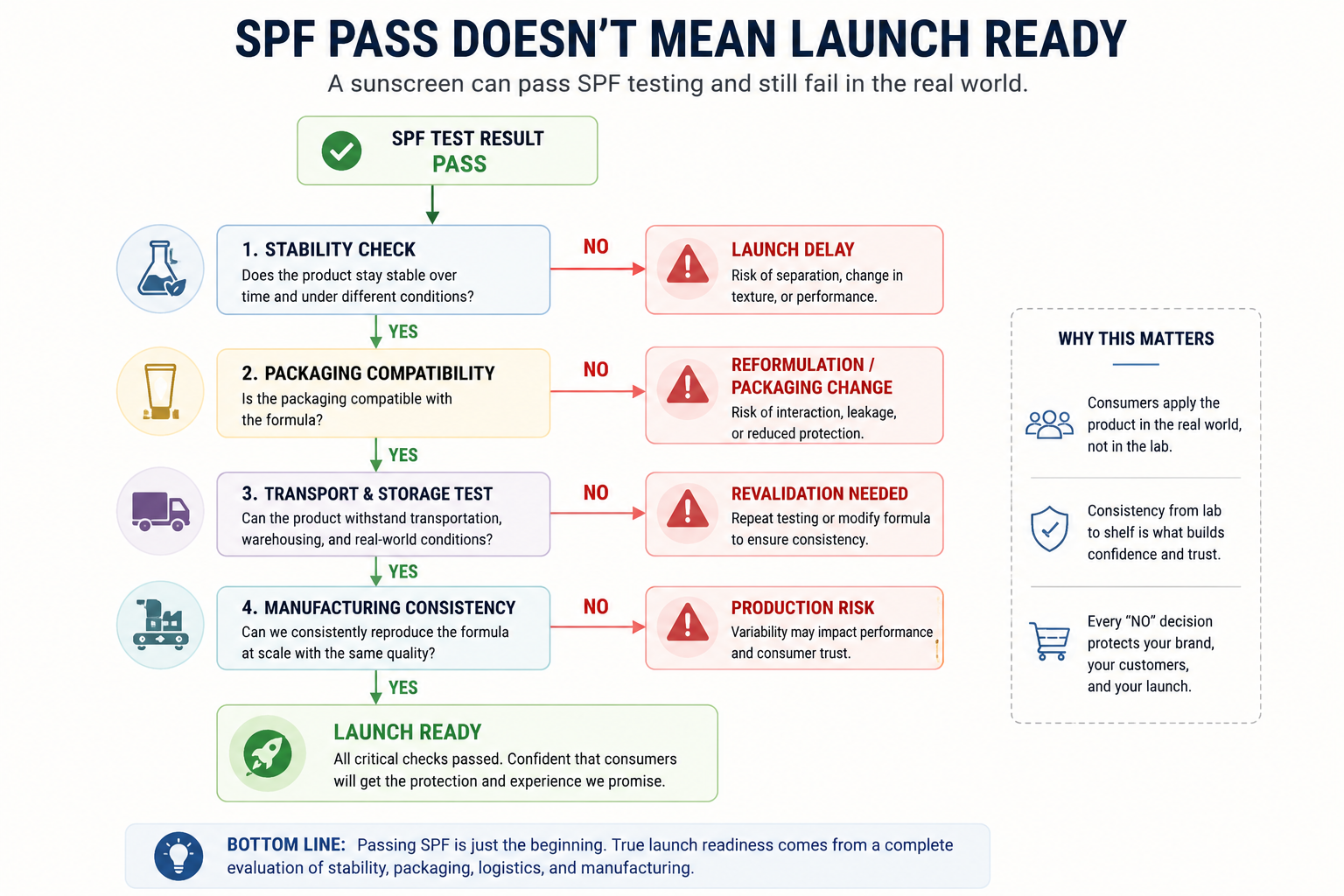
By the time a sunscreen reaches the final stages of development, companies have usually committed to much more than a formula. Packaging may already be in production, retailers may have allocated shelf space, and marketing teams may be preparing launch campaigns months in advance. A single testing result can suddenly influence decisions being made by procurement teams, manufacturers, distributors, and retailers simultaneously.
What surprised me most during my research was how interconnected sunscreen products can be behind the scenes. Consumers tend to imagine that every sunscreen is developed independently, but that is not always how the industry works. Shared manufacturing sites, common formulation platforms, and white-label development models mean that one technical issue can sometimes affect multiple products across multiple brands.
Recent investigations in Australia demonstrated exactly that. Questions that initially appeared to involve a small number of products eventually expanded into a much larger conversation involving shared formulations and connected product portfolios. What looked like an isolated technical issue quickly became a business issue involving retailers, distributors, and manufacturers.
The lesson I took away from this was surprisingly simple: sunscreen testing is rarely just about one product. Increasingly, it is about understanding how risk moves through an entire commercial ecosystem.
A Sunscreen Can Pass SPF Testing And Still Fail In The Market
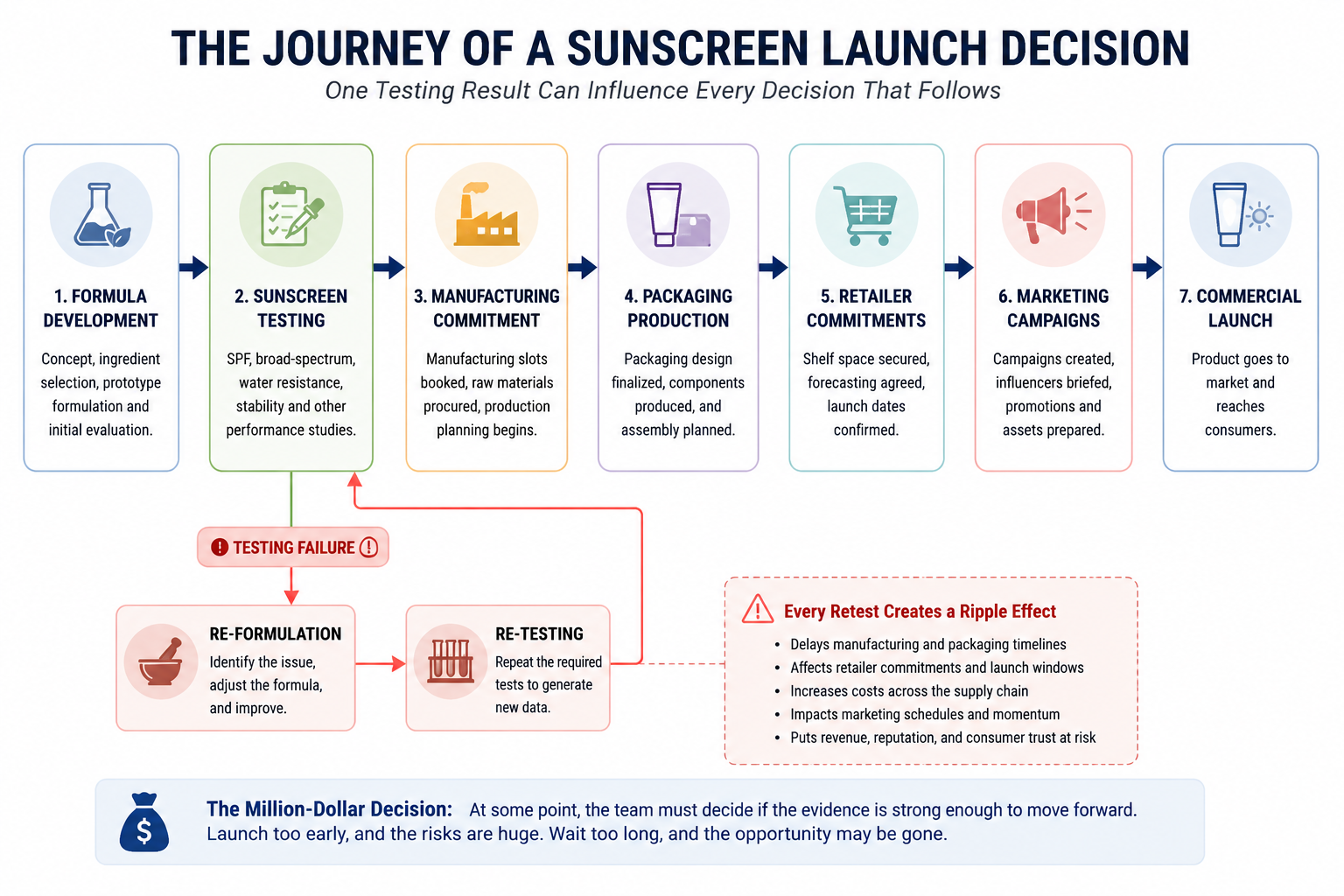
One of the things that surprised me most while researching this topic was how often sunscreen testing is reduced to a single number. If the product achieves SPF 50, most people assume the difficult part is over. The reality is much less straightforward. A sunscreen can achieve its target SPF and still encounter problems serious enough to delay launch or trigger market action later.
Some of the recent sunscreen recalls and investigations around the world weren’t driven by low SPF performance at all. Instead, they involved concerns around separation, texture changes, or physical instability during storage. That might sound like a quality issue rather than a sunscreen issue, but the distinction matters far more than most people realise.
Consumers do not apply laboratory results to their skin. They apply the product that comes out of the bottle after it has spent months being manufactured, transported, stored in warehouses, shipped to retailers, and left in bathroom cabinets or beach bags. If the product behaves differently at that stage than it did during testing, companies need to ask a difficult question: is this still the same product that was originally validated?
The more I thought about this, the more I realised that sunscreen testing is really a confidence exercise rather than a pass-or-fail exercise. Companies are not simply trying to prove that a product worked once under controlled conditions. They are trying to prove that consumers will receive the same experience months later under completely different conditions.
This probably explains why development teams spend so much time looking beyond SPF studies. Stability programmes, transportation simulations, packaging compatibility assessments, and manufacturing validation may never appear on the front of the bottle, but they play an enormous role in determining whether a product is genuinely ready for market.
The Laboratory Has Quietly Become Part Of The Product
Before working on this article, I had never really considered how much influence testing laboratories have over sunscreen launches. Most consumers probably assume laboratories function like any other testing service: samples go in, results come out, and the process moves on.
The reality appears much more complicated.
Recent industry discussions have highlighted questions around reproducibility, methodology, and consistency between facilities. Some companies repeating studies through different laboratories have obtained different outcomes, creating difficult conversations around confidence, methodology selection, and evidence quality. The issue is no longer simply whether testing was performed, but whether the resulting evidence will withstand scrutiny from regulators, retailers, and consumers.
That changes the role laboratories play in sunscreen development quite significantly. Laboratory experience, familiarity with regional requirements, and expertise with particular methodologies can influence launch decisions just as much as formulation performance itself. A laboratory report may still look like a technical document, but the decisions that depend on it are often commercial ones.
I think this is one of the least visible parts of sunscreen development. Consumers compare SPF numbers and ingredient lists, but very few people think about the infrastructure that sits behind those claims. The choice of testing partner can influence launch timelines, regulatory submissions, retailer confidence, and ultimately whether a product reaches the shelf when the company originally intended.
The more I researched this area, the more I realised that laboratories have quietly become part of the product itself. Consumers may never see their name on the packaging, but their work influences almost every major decision that follows.
Trust Is Becoming More Valuable Than Claims
The more I looked into recent sunscreen investigations, the more I noticed something interesting. The industry conversation has slowly shifted away from asking whether products meet regulatory requirements and towards asking whether consumers trust the evidence behind those requirements.
Ten years ago, a testing dispute might have remained a technical discussion between laboratories, manufacturers, and regulators. Today, those conversations spread far beyond the industry. Dermatologists discuss them online, beauty publications publish detailed breakdowns, and consumers compare testing reports across brands and markets within hours of a story emerging.
This creates a very different environment for sunscreen companies. Meeting the minimum regulatory requirement may no longer be enough to satisfy retailers or consumers who expect greater transparency around product performance and substantiation. As a result, some brands have started commissioning additional studies or validating products through multiple laboratories, even when regulations do not explicitly require it.
What I find particularly interesting is that these decisions are rarely driven by science alone. They are often commercial decisions designed to protect consumer confidence and brand credibility. In an industry built almost entirely on trust, the value of confidence can easily exceed the cost of additional testing.
The sunscreen industry has spent decades teaching consumers to apply enough product, reapply regularly, and trust the number printed on the bottle. Once that trust is questioned, rebuilding it becomes far more difficult than generating another laboratory report.
The Rise Of Defensive Testing
One phrase that kept coming up during my research was something I had not really considered before: defensive testing.
Traditionally, sunscreen testing existed to support claims. Companies performed SPF studies because they wanted to launch SPF 30 or SPF 50 products. Water resistance studies supported water resistance claims, and broad-spectrum testing supported broad-spectrum labeling.
Increasingly, however, some testing programmes appear to be designed to answer a different question:
“What happens if somebody challenges this claim later?”
That is a very different way of thinking about product development.
Additional studies, duplicate testing, larger evidence packages, and multiple laboratory validations can all serve as insurance against future scrutiny from regulators, retailers, media, or consumers. The objective is not necessarily to satisfy today’s requirements. It is to prepare for tomorrow’s questions.
The more I thought about this, the more I realised that sunscreen testing is starting to look much more like risk management than traditional product validation. Companies are no longer only proving that products work. Increasingly, they are proving that they can defend those conclusions years after launch if they ever need to.
For premium brands in particular, this logic becomes surprisingly easy to understand. The cost of an additional study may feel expensive during development, but it can look very different when compared with the financial and reputational cost of a recall, reformulation programme, or public investigation.
The Million-Dollar Decision
When I first came across the title for this article, I assumed the million-dollar decision referred to the cost of sunscreen testing itself. After spending time researching the subject, I no longer think that is true.
The real decision happens much later.
At some point, every development team has to decide whether the available evidence is strong enough to release manufacturing budgets, approve packaging production, commit inventory, secure retailer agreements, and move into commercial launch. Waiting longer may provide more information and greater confidence. Launching sooner may protect timelines and commercial opportunities.
Neither option is automatically correct. Launch too early and companies risk expensive problems later. Wait too long and they risk missing the opportunity entirely.
Somewhere between those two outcomes sits the decision that every sunscreen company eventually has to make. It is rarely made by formulators alone, and it is rarely based on science alone. Regulatory teams, manufacturers, commercial teams, retailers, and leadership groups all have a stake in the outcome because all of them inherit the consequences of the decision.
After spending time with this topic, I think that may be what makes sunscreen testing so interesting. Most consumers see it as a technical process designed to generate a number for a label.
The industry sees something very different. It sees a decision about confidence, timing, trust, and risk. And that is probably the real million-dollar decision behind every launch.
________________________________________________________________________________________________________
Frequently Asked Questions
Why is sunscreen testing becoming more important for brands?
Sunscreen has always been a high-trust category, but the level of scrutiny around claims has increased significantly in recent years. Consumers are more informed, retailers are asking more questions, and testing discussions that once remained within regulatory circles now spread quickly through social media and beauty publications. As a result, sunscreen testing is increasingly being viewed as an investment in brand credibility rather than simply a regulatory requirement.
Can a sunscreen pass SPF testing and still be recalled?
Yes. SPF testing measures protection under specific testing conditions, but products can still face market action for reasons unrelated to SPF performance itself. Physical instability, separation, packaging interactions, manufacturing issues, or changes in product behaviour during storage can all create concerns that require investigation even when the original SPF study was successful.
Why do some brands perform more testing than regulations require?
One of the more interesting developments in the industry is the growth of what some teams informally describe as defensive testing. Additional studies, repeat testing, or validation through multiple laboratories may help companies prepare for future scrutiny from regulators, retailers, or consumers. In many cases, the objective is not simply to support a claim but to strengthen confidence in the evidence behind it.
Why can sunscreen issues affect multiple brands at once?
Many companies use shared manufacturing facilities, white-label development partners, or common formulation platforms to improve efficiency and reduce development timelines. While this approach offers significant advantages, it can also mean that questions surrounding one formulation system or manufacturing process may extend beyond a single product or brand.
Is sunscreen testing only about SPF?
Not anymore. SPF remains one of the most visible measurements in sunscreen development, but companies increasingly evaluate products through a much broader lens that includes stability, packaging compatibility, manufacturing robustness, transportation performance, and long-term product consistency. The objective is not only to achieve a target SPF but also to ensure consumers receive the same experience throughout the product’s intended life cycle.
Why is sunscreen testing sometimes described as a business decision rather than a scientific one?
Scientific testing generates evidence, but companies still need to decide how much evidence is enough to support launch. Those decisions influence manufacturing schedules, inventory commitments, retailer agreements, marketing investment, and launch timing. At some point, development teams move from asking whether more information can be generated to asking whether additional information would materially change the decision to launch.