

Why Sunscreen Pilling Happens Under Makeup? The Formulation Science Behind It
Sunscreen pilling is one of the most common frustrations in modern skincare routines. A sunscreen may apply smoothly at first, but once foundation, primer, concealer, or even another skincare layer is added, the product begins to roll into flakes or tiny clumps across the skin. In many cases, users assume they applied too much product or layered their skincare incorrectly. While application technique can contribute, sunscreen pilling is often a formulation issue rather than a simple user mistake.
This has become more relevant as sunscreen has shifted from occasional beach use to an everyday cosmetic product. Modern consumers expect sunscreen to behave like skincare, makeup primer, and protective film at the same time. They want lightweight textures, invisible finishes, smooth layering, and long wear under makeup without compromising protection. These expectations place enormous pressure on formulation design, especially in mineral sunscreen systems where particulate UV filters already create structural complexity.
Most online discussions around sunscreen pilling focus on quick fixes such as waiting between layers or applying less product. However, the real explanation is more technical. Sunscreen pilling often reflects incompatibility between formulation systems, instability in film formation, particle aggregation, polymer interactions, rheology mismatch, and friction during layering. Understanding why this happens reveals how modern sunscreen engineering is evolving beyond SPF numbers alone.
Why Sunscreen Pilling Happens More Often Than People Realize
What sunscreen pilling actually looks like
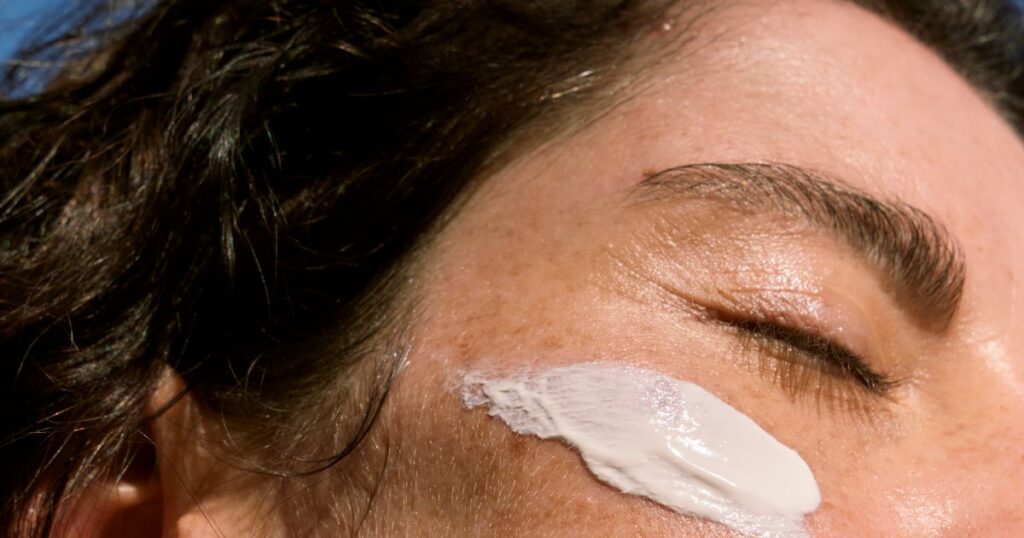
Sunscreen pilling refers to the visible rolling, flaking, or clumping that occurs when sunscreen is rubbed or layered on the skin. Instead of remaining as a smooth continuous layer, the product begins separating into small particles or residue fragments. This often appears during foundation blending, reapplication, or even while touching the face later in the day.
The issue is especially noticeable under makeup because multiple cosmetic layers increase friction across the skin surface. Users may see small flakes around the cheeks, jawline, forehead, or areas where brushes and sponges repeatedly move across the skin. In some cases, the sunscreen itself lifts off the skin in patches, disrupting both appearance and coverage.
Importantly, sunscreen pilling does not always indicate poor-quality sunscreen. Even technically advanced formulations can pill when layered with incompatible skincare or makeup systems. The behavior is often the result of how multiple formulations interact after application rather than the sunscreen alone.
Why the issue becomes worse under makeup
Under makeup, sunscreen must tolerate additional layers that contain their own oils, silicones, pigments, polymers, powders, and film-forming ingredients. Each layer changes the mechanical behavior of the film already sitting on the skin.
Foundation brushes, beauty sponges, and fingers apply repeated friction during blending. If the sunscreen film underneath has not stabilized properly or if the layers are incompatible, this friction can disrupt the film and create rolling residue. The problem becomes even more noticeable with modern long-wear foundations and silicone-heavy primers that are designed to grip strongly to the skin surface.
Powder foundations can worsen the issue because powders increase surface friction while simultaneously absorbing oils and volatile carriers from the sunscreen layer underneath. Matte foundations also tend to contain absorbent particles and fast-drying systems that may destabilize partially formed sunscreen films. Liquid foundations can create different problems, especially when water-based foundations are layered over silicone-rich or oil-heavy sunscreen systems.
This creates a difficult requirement for sunscreen formulators. A sunscreen is no longer expected to function only as UV protection. It must also behave compatibly with skincare and makeup systems that were often developed independently.
Sunscreen Is Designed to Form a Stable Film on the Skin
Why film formation matters in sunscreen performance
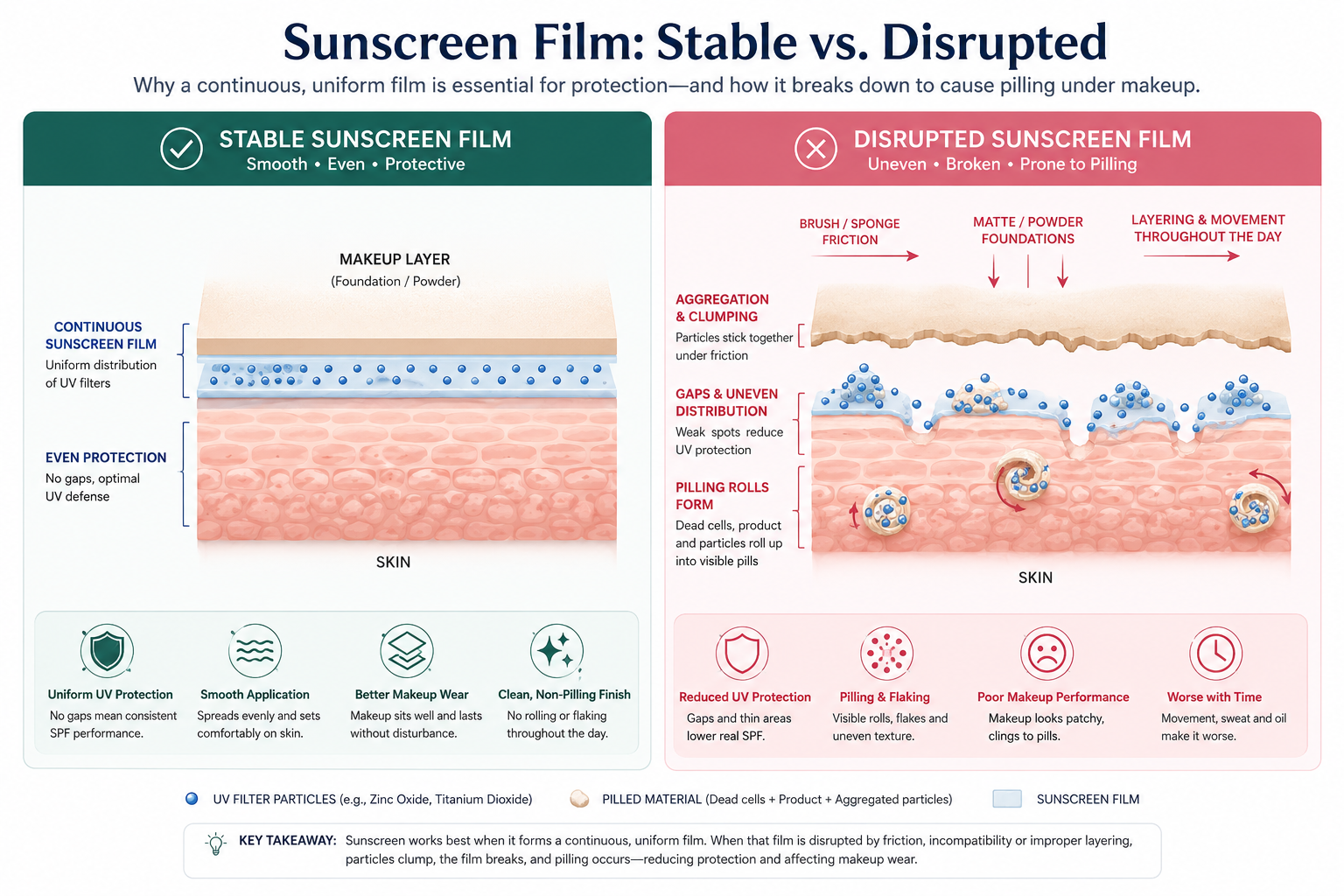
Sunscreen works by forming a continuous film across the surface of the skin. This film distributes UV filters evenly so that ultraviolet radiation encounters a consistent protective layer instead of exposed gaps. In practical terms, sunscreen protection depends heavily on how uniformly this film forms after application.
A sunscreen that spreads unevenly creates areas with lower UV filter concentration. This affects both appearance and protection. Even if the formula contains the correct percentage of active ingredients, inconsistent film formation can reduce real-world reliability.
Film formation also determines how the sunscreen behaves mechanically during wear. Once the product dries or settles, the film must remain flexible enough to tolerate movement while maintaining adhesion to the skin. If the film becomes unstable, brittle, or incompatible with later cosmetic layers, pilling becomes more likely.
Modern sunscreen formulations are therefore designed not only around UV attenuation but also around film architecture. Spreadability, viscosity, drying behavior, and layer compatibility all influence how the sunscreen behaves after application.
What disrupts sunscreen film formation
Several factors can interfere with film stability once sunscreen is applied. Excessive rubbing is one of the most obvious causes. Friction mechanically disrupts the layer and may cause partially dried material to separate from the skin surface.
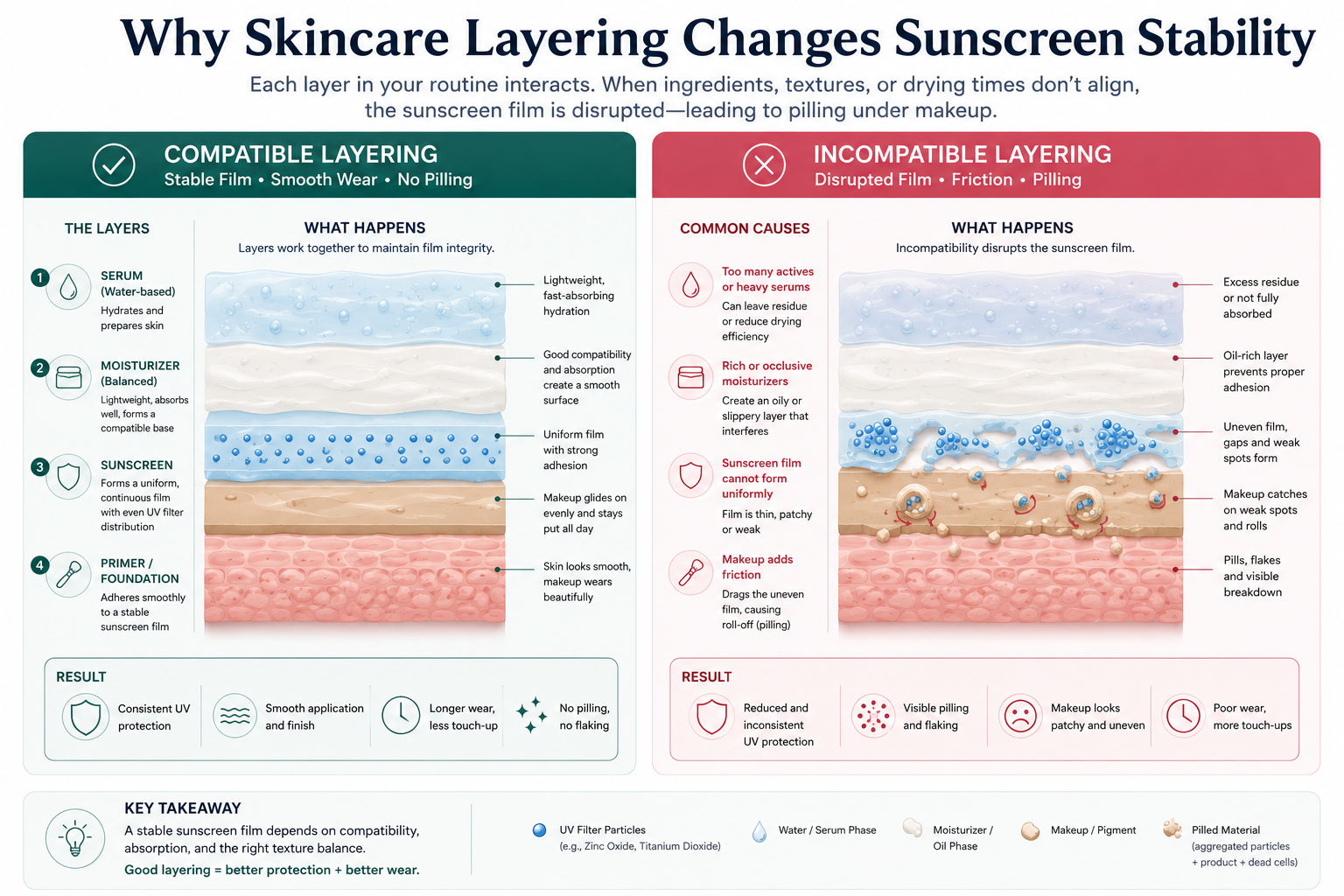
Layering incompatible formulations also creates instability. Water-heavy serums, silicone primers, oil-rich moisturizers, and matte foundations can all alter how the sunscreen film behaves. If these systems dry at different rates or interact poorly, the film may lose uniformity and begin to roll under pressure.
Incomplete drying is another important factor. Many sunscreen systems require time for volatile ingredients to evaporate and for polymers or film formers to stabilize across the skin surface. If makeup is applied too quickly afterward, the sunscreen layer may still be structurally weak.
Pilling therefore often begins as a film integrity problem. The visible flakes are simply the final result of instability that already exists within the layered cosmetic system.
Why Rheology Plays a Major Role in Sunscreen Pilling
What rheology means in sunscreen formulation
Rheology refers to how a formulation flows, spreads, deforms, and responds to mechanical force. In sunscreen systems, rheology strongly affects texture, pickup, drag, spreadability, and how the product behaves during blending.
A sunscreen with poor rheological balance may initially feel smooth but become unstable once pressure is applied during makeup layering. If the formulation creates too much drag, friction increases across the skin surface. If it becomes too dry too quickly, residue buildup may occur during blending.
Rheology also affects how evenly mineral particles remain distributed across the film. In unstable systems, local concentrations of particles may increase in certain areas, making rolling and residue formation more likely.
Why rheology mismatch increases pilling risk
Pilling often occurs when products with very different rheological behaviors are layered together. A lightweight serum may spread quickly and absorb rapidly, while a dense mineral sunscreen remains more structured on the skin surface. When a fast-drying matte foundation is added on top, the layers may no longer move cohesively.
This mismatch creates uneven mechanical stress across the film. Under friction from blending or touching the skin, sections of the sunscreen layer may detach and roll into visible flakes.
Modern sunscreen engineering therefore requires careful rheological balancing, especially in products designed for daily wear under makeup.
Why Sunscreen Pilling Behaves Differently in Mineral Sunscreens
Mineral UV filters are particulate systems
Mineral sunscreens behave differently from many chemical sunscreen systems because zinc oxide and titanium dioxide are insoluble particles rather than dissolved UV filters. These particles remain suspended throughout the formulation and later distribute themselves across the skin surface during application.
This creates additional complexity. Particulate systems naturally increase solids loading inside the formulation, which changes viscosity, drag, spreadability, and friction behavior. A sunscreen containing high levels of mineral filters often behaves more like a suspension system than a lightweight fluid.
Because the particles do not dissolve, they must remain evenly dispersed. If they begin clustering together during processing, storage, or application, aggregation can occur. Aggregation affects texture, appearance, and layer stability.
This is one reason mineral sunscreen pilling becomes more noticeable under makeup. The particulate structure increases sensitivity to rubbing, layering, and film disruption.
Why higher particle loading affects spreadability and wear
Mineral sunscreen systems often contain higher particulate content than many chemical sunscreen formulas. This influences how the product spreads and settles on the skin.
Higher particle loading can change how the formulation spreads and settles during wear. Instead of gliding smoothly, the formula may resist movement slightly, especially once partial drying begins. Under repeated friction from makeup blending, the film may start rolling into residue.
Particle aggregation further worsens this behavior. When zinc oxide or titanium dioxide particles cluster together, the film loses uniformity. These clusters can create localized thickness variations that are more likely to separate under pressure.
Poor dispersion can intensify this issue even further. If mineral particles are not distributed evenly throughout the formulation, certain areas may contain higher local solids concentration. Under makeup blending, these concentrated regions experience greater friction and are more likely to pill or roll.
The issue becomes even more complicated in high-SPF mineral systems because achieving stronger UV protection often requires additional mineral loading. Formulators therefore face a continuous balance between protection, transparency, spreadability, and wear behavior.
Why Lightweight Texture Is Difficult to Achieve in Mineral Sunscreens
Creating lightweight texture in mineral sunscreen systems is technically challenging because zinc oxide and titanium dioxide are particulate filters rather than dissolved UV systems. Many chemical sunscreen filters dissolve directly into the oil phase of the formulation instead of remaining as suspended particles. This allows the film to behave more uniformly during application and reduces some of the friction associated with particulate systems.
As a result, certain chemical sunscreen systems may feel lighter or layer more easily under makeup. However, this does not automatically make them superior formulations. Modern mineral sunscreen systems continue evolving rapidly through better dispersions, surface treatments, and advanced emulsion design aimed at improving wearability without sacrificing mineral-filter benefits.
The Hidden Role of Silicones, Polymers, and Film Formers
Why silicones change layering behavior
Silicones are widely used in sunscreen and makeup formulations because they improve slip, spreadability, and cosmetic elegance. They create smoother textures and help products glide across the skin surface more evenly.
However, silicones can also create compatibility problems between layered formulations. Silicone elastomers and silicone-heavy primers may interact differently with water-based sunscreen systems. Under friction, these mismatched layers may begin separating mechanically instead of remaining integrated.
Some silicone systems create high-slip surfaces that reduce adhesion between layers. Others form flexible films that roll when additional pressure is applied during blending. This is why sunscreen pilling often becomes worse when certain primers or foundations are layered over SPF products.
Importantly, the issue is rarely caused by a single ingredient alone. It is usually the interaction between multiple formulation systems that creates instability.
Film formers improve durability but can increase residue buildup
Film formers are important sunscreen ingredients because they improve water resistance, durability, and long-wear performance. These materials help the sunscreen remain attached to the skin during sweat exposure, humidity, or extended outdoor conditions.
However, stronger film formation can also increase pilling risk under certain layering conditions. As the film becomes more durable, friction from makeup application may cause sections of the layer to roll instead of blending smoothly into surrounding products.
Repeated layering can also create residue accumulation. When sunscreen, primer, foundation, and powder each deposit film-forming materials onto the skin, the surface becomes increasingly complex. Under movement, portions of these overlapping layers may detach and form visible flakes.
This explains why some long-wear sunscreens pill more noticeably under makeup despite performing well during SPF or water-resistance testing.
Why Emulsion Architecture Changes Makeup Compatibility
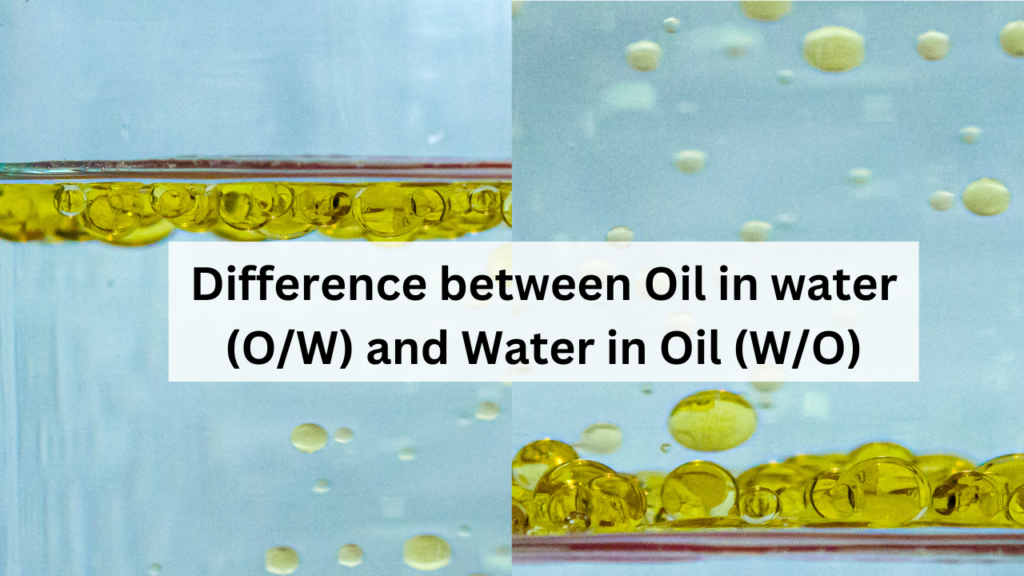
Oil-in-water and water-in-oil systems behave differently
Sunscreen formulations are often structured as emulsions, where oil and water phases are stabilized together using emulsifiers. However, not all emulsions behave the same way during layering.
Oil-in-water systems generally feel lighter and less greasy because water forms the outer phase. Water-in-oil systems tend to feel richer and often provide stronger water resistance because oil surrounds the water droplets.
When products with incompatible emulsion structures are layered together, instability can occur. For example, a water-heavy foundation may interact poorly with a sunscreen designed around a richer oil-continuous structure. Under friction, this mismatch can destabilize the film and contribute to pilling.
Why emulsion stability matters during wear
A stable emulsion helps mineral particles remain evenly distributed throughout the product. If the emulsion becomes unstable during application or layering, localized separation may occur. This can increase uneven residue formation and worsen rolling behavior during makeup blending.
Emulsion architecture therefore affects much more than texture alone. It also influences how the sunscreen behaves mechanically throughout wear.
Why Skincare Layering Changes Sunscreen Stability
Moisturizers, serums, primers, and sunscreen do not always behave compatibly
Modern skincare routines involve multiple products layered sequentially across the skin. Each product introduces its own emulsifiers, oils, polymers, silicones, humectants, powders, and rheology modifiers.
These systems are not necessarily designed to work together. A water-heavy serum may destabilize an oil-rich sunscreen layer. A silicone primer may interfere with how the sunscreen film adheres to the skin. A thick moisturizer may prevent proper settling of the SPF layer above it.
Different formulations also evaporate differently. Water-based products may dry quickly while oil-rich systems remain mobile longer. These differences create instability during blending.
As a result, sunscreen pilling often reflects incompatibility between multiple cosmetic systems rather than a failure of sunscreen alone.
Why waiting between layers sometimes reduces pilling
One common recommendation for reducing sunscreen pilling is to wait between skincare and makeup layers. While often presented as a beauty tip, there is actual formulation science behind it.
Many sunscreen systems require time for volatile carriers to evaporate and for film formers to stabilize across the skin surface. During this period, the film gradually becomes more structurally cohesive.
If another product is applied before this stabilization occurs, friction may disrupt the partially formed layer and create rolling residue. Allowing the sunscreen to settle reduces mechanical disruption during subsequent application steps.
This does not solve all compatibility issues, but it explains why drying time sometimes improves layering performance.
Why Sunscreen Texture Has Become a Major Formulation Challenge
Modern users expect sunscreen to behave like skincare and makeup
Consumer expectations around sunscreen have changed dramatically over the last decade. Users no longer want sunscreen that simply provides UV protection. They expect lightweight textures, invisible finishes, non-greasy wear, and compatibility with daily makeup routines.
This creates a major formulation challenge. High UV protection often requires higher filter loading, stronger film formers, or more structured emulsions. But consumers simultaneously expect these systems to feel weightless on the skin.
The demand for cosmetic elegance has therefore become directly tied to sunscreen usability. If the texture feels greasy, pills under foundation, or leaves visible residue, many users stop applying the product consistently.
Texture is no longer only a sensory feature. It now influences real-world sunscreen adoption and routine compliance.
Why lightweight mineral sunscreens are difficult to formulate
Lightweight mineral sunscreen systems are particularly difficult to engineer because mineral UV filters are particulate solids. Increasing zinc oxide or titanium dioxide levels can quickly increase viscosity, opacity, drag, and residue sensitivity.
Reducing these sensory issues requires sophisticated formulation strategies. Formulators may use advanced dispersions, surface-treated particles, volatile carriers, rheology modifiers, and optimized emulsion systems to improve feel and transparency.
However, improving one parameter can destabilize another. Increasing spreadability may reduce film durability. Reducing viscosity may weaken suspension stability. Improving transparency may change UV attenuation efficiency.
This is why lightweight mineral sunscreens remain one of the most technically demanding categories in modern sun care.
What Sunscreen Pilling Reveals About the Future of SPF Formulation
Wearability is becoming as important as protection
The sunscreen industry is gradually shifting from protection-only positioning toward wearability-focused design. Consumers increasingly expect sunscreen to integrate naturally into daily routines alongside skincare and makeup.
This means sunscreen performance is no longer judged only by SPF value. Products are also evaluated based on:
- texture
- transparency
- layering behavior
- reapplication comfort
- makeup compatibility
- finish on different skin tones
Hybrid SPF products such as serum sunscreens, skin tints with SPF, lightweight milky fluids, SPF primers, and skincare-makeup hybrids are becoming more common because users increasingly want protection without cosmetic compromise.
The future of sunscreen formulation will increasingly focus on balancing UV protection with cosmetic behavior. A technically strong formula that performs poorly under real-world wear conditions may struggle to achieve consistent user adoption.
Why formulation architecture matters more than individual ingredients
Modern sunscreen behavior is determined by the entire formulation system rather than any single ingredient alone. Zinc oxide percentage, SPF number, or film former selection cannot independently predict real-world performance.
Instead, performance depends on how the formulation behaves as an integrated structure. Dispersion quality, rheology, evaporation dynamics, particle distribution, polymer compatibility, and film architecture all interact simultaneously once the product reaches the skin.
Sunscreen pilling makes these interactions visible. It reveals how difficult it is to engineer a system that remains stable across multiple cosmetic layers while still maintaining protection, transparency, and wearability.
As sunscreen continues evolving into a daily cosmetic product, formulation design will increasingly move toward sensory engineering, compatibility optimization, and film-behavior control. The next generation of mineral sunscreen innovation will likely be defined not only by SPF performance, but by how seamlessly the product integrates into real-world routines.
_____________________________________________________________________________________________________________
Frequently Asked Questions (FAQs)
Why does sunscreen pill under makeup?
Sunscreen pilling usually happens when the sunscreen film becomes unstable during layering or blending. This can occur due to friction, incompatible skincare and makeup combinations, incomplete drying, or interactions between silicones, polymers, mineral particles, and film-forming ingredients.
Why is sunscreen pilling more common with mineral sunscreens?
Mineral sunscreens use particulate UV filters such as zinc oxide and titanium dioxide, which remain suspended in the formulation rather than dissolving completely. Higher particle loading can increase drag, friction sensitivity, and residue buildup during makeup application, especially if the formulation is not evenly dispersed.
Does sunscreen pilling reduce protection?
It can. Sunscreen works by forming a continuous film across the skin. When the film breaks apart or rolls into flakes, coverage may become uneven, creating weak spots where UV protection is reduced.
Why does sunscreen pill after skincare layering?
Different skincare products often contain incompatible oils, silicones, emulsifiers, and polymers. When multiple layers interact poorly or dry at different rates, the sunscreen film may lose stability and begin rolling under friction.
Why does sunscreen pill more with foundation or primer?
Foundation and primer introduce additional pigments, powders, silicones, and film-forming materials onto the skin. During blending, these layers can create mechanical stress and friction that disrupt the sunscreen film underneath.
Does waiting between skincare and sunscreen layers help?
Yes, in some cases. Allowing each layer to settle gives volatile ingredients time to evaporate and helps the sunscreen film stabilize properly before additional products are applied on top.
Why are lightweight mineral sunscreens difficult to formulate?
Mineral UV filters are particulate solids, so increasing SPF often increases viscosity, opacity, and texture complexity. Creating lightweight mineral sunscreen systems requires careful balancing of dispersion quality, rheology, emulsion stability, transparency, and film integrity.
What role does film formation play in sunscreen performance?
Film formation determines how evenly sunscreen spreads across the skin. A stable and uniform film improves both UV protection and wearability, while disrupted films are more prone to pilling, patchiness, and uneven coverage.
Can sunscreen pilling happen even with high-quality formulations?
Yes. Even advanced formulations can pill if layered with incompatible skincare or makeup products. Pilling is often the result of interactions between multiple formulation systems rather than a single product failure.
Why is sunscreen texture becoming so important in modern SPF products?
Consumers increasingly expect sunscreen to feel lightweight, invisible, and compatible with makeup and daily skincare routines. As a result, modern sunscreen formulation now focuses heavily on wearability, cosmetic elegance, layering behavior, and long-term comfort in addition to UV protection.