
Is the Sunscreen Industry Moving Toward Hybrid Sunscreen Filters?
Sunscreen formulation is no longer built around SPF number alone. A modern SPF product is expected to protect across the UV spectrum, remain stable under sunlight, spread evenly, look transparent, feel light on skin, and work inside daily skincare routines. This has made sunscreen formulation more difficult, especially for products that aim to deliver high SPF with low residue and broad-spectrum performance.
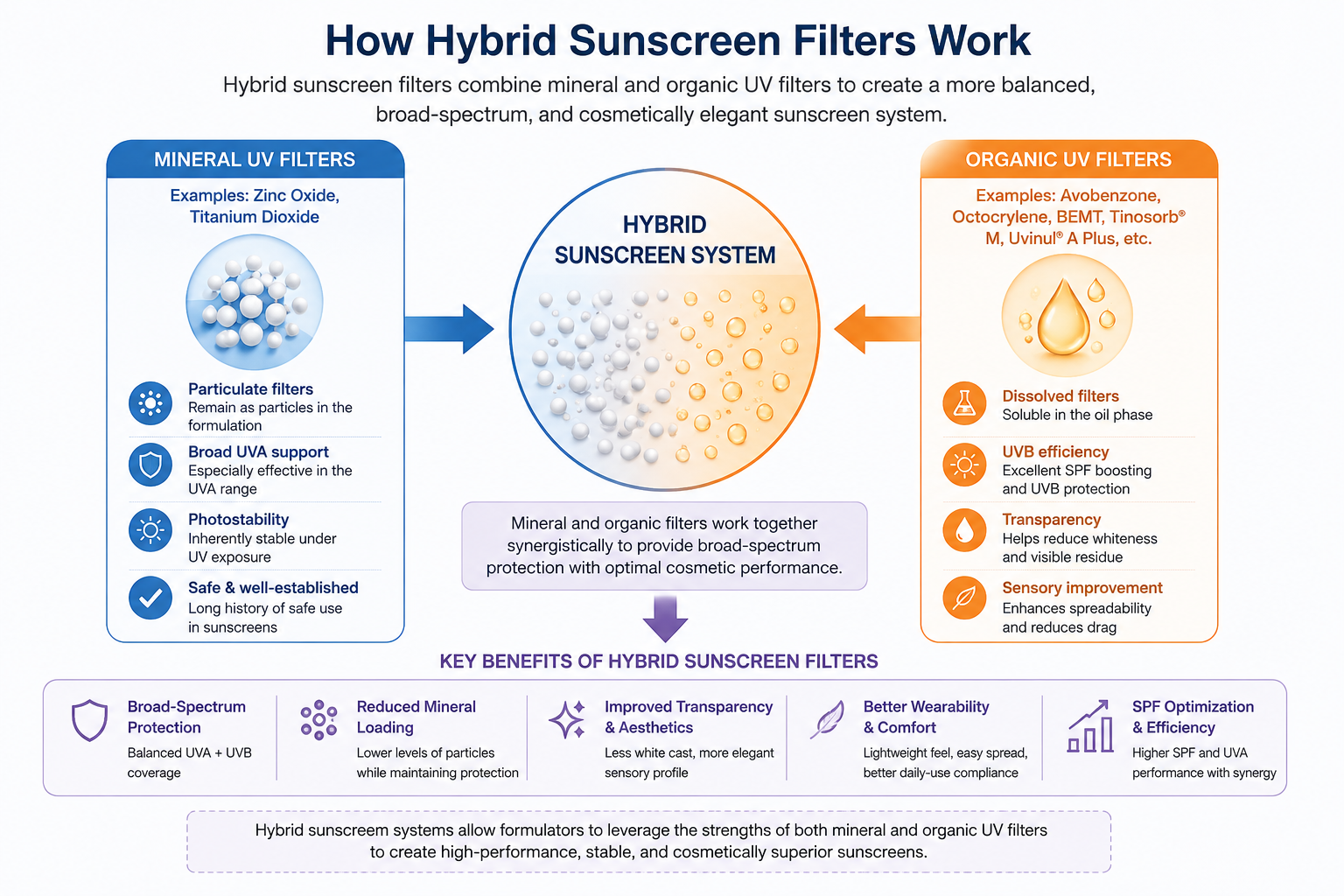
This is where hybrid sunscreen filters are becoming important. A hybrid sunscreen system combines mineral UV filters, such as zinc oxide or titanium dioxide, with organic UV filters in the same formulation. The goal is not simply to mix two categories. The goal is to distribute UV protection across different filter technologies so that each one supports a specific part of the formulation.
The shift toward hybrid UV filters is connected to three major pressures: stronger broad-spectrum expectations, improved cosmetic elegance, and regulatory changes around modern UV filters. The FDA’s recent proposal to add bemotrizinol, also called BEMT, as a permitted sunscreen active ingredient shows how strongly sunscreen innovation is now tied to filter modernization. FDA noted that bemotrizinol provides both UVA and UVB protection, has low systemic absorption, and rarely causes irritation.
What Hybrid Sunscreen Filters Actually Mean
A hybrid sunscreen does not mean a product is half mineral and half chemical. In formulation terms, hybrid sunscreen filters refer to UV filter systems where particulate mineral filters and dissolved organic filters work together inside one sunscreen architecture.
Zinc oxide and titanium dioxide are insoluble mineral particles. They remain dispersed in the formulation and later form part of the protective film on the skin. Organic UV filters behave differently. Many dissolve into the oil phase and absorb radiation across specific wavelength ranges. Because these two filter types behave differently, they also solve different formulation problems.
A zinc oxide hybrid sunscreen may use zinc oxide as the stable UVA-supporting backbone, while organic filters contribute SPF efficiency, UVB coverage, or improved transparency. This allows the formulator to reduce pressure on any one filter. A high-SPF mineral-only system may need high particulate loading, which can increase opacity or drag. A hybrid system can reduce that burden by distributing UV absorption across mineral and organic filters.
This is why hybrid sunscreen filters are best understood as a system design choice. They are not just ingredient combinations. They are a way to build a more balanced broad-spectrum sunscreen formulation.
Why Hybrid Systems Are Not the Same as Mineral vs Chemical Comparisons
The older sunscreen conversation was often framed as mineral versus chemical. That framing is too simple for modern formulation work. Mineral and organic UV filters are not always competing categories. In hybrid systems, they can be complementary tools.
Mineral filters are useful because they are photostable and can support broad-spectrum coverage. Zinc oxide is especially valuable because it contributes UVA protection, which is essential for balanced sunscreen performance. Organic filters, meanwhile, can improve SPF efficiency and help reduce some of the sensory challenges linked with high mineral loading.
The important difference is physical behavior. Mineral filters remain as particles. Their performance depends on dispersion quality, particle distribution, surface treatment, and film uniformity. Organic filters are usually dissolved into the formulation phase, so they can influence texture and transparency differently. This difference in physical behavior is one of the main reasons hybrid UV filters are becoming more useful.
A hybrid system allows the formulator to manage both optical and protective requirements at the same time. The zinc oxide portion can strengthen UVA support, while organic filters can fill UVB or short-UVA gaps and improve the efficiency of the SPF system. That is a more precise formulation strategy than choosing one category and forcing it to solve every performance requirement.
Why Hybrid Sunscreen Filters Are Growing
The first major driver is high-SPF formulation pressure. SPF 50 products are now common, but delivering SPF 50 with a light texture is technically difficult. In mineral-only systems, increasing zinc oxide concentration can improve protection, but it can also increase visible light scattering. That may lead to whitening, opacity, heavier feel, and reduced spreadability.
Hybrid sunscreen filters give formulators another path. Instead of raising zinc oxide loading alone, the formulator can combine zinc oxide with selected organic filters to reach the target SPF and UVA balance more efficiently. This can help reduce the sensory burden of a heavily particulate system while keeping zinc oxide as an important part of the UV architecture.
The second driver is transparency. Sunscreens are now expected to work across more skin tones with less visible residue. This is especially important for daily-use sunscreens, tinted SPFs, serum SPFs, and lightweight fluids. A formulation that performs well in testing but looks heavy on skin may struggle in real use. Croda’s 2025 sunscreen formulation guidance highlights the challenge of creating high-performance broad-spectrum products without compromising sensory aesthetics and regulatory compliance.
The third driver is daily-wear behavior. Sunscreens are now often used with moisturizers, makeup, primers, and skincare actives. This means the sunscreen film must be protective, flexible, and cosmetically acceptable. Hybrid systems give formulators more control over how the formula spreads, settles, and feels on the skin.
The Role of Zinc Oxide in Hybrid Sunscreen Systems
The movement toward hybrid sunscreen filters does not reduce the importance of zinc oxide. In many cases, it makes zinc oxide more strategic.
Zinc oxide offers stable UVA support and is widely used in mineral sunscreen systems. In a hybrid formula, zinc oxide can provide a reliable mineral foundation while other filters contribute additional spectral coverage or SPF efficiency. This is different from using zinc oxide as the only active. The hybrid approach allows zinc oxide to be placed inside a broader system where its strengths are used more efficiently.
For example, a zinc oxide hybrid sunscreen may be designed to reduce the high mineral load needed for a mineral-only SPF 50 system. Lowering particulate load can help improve transparency, reduce drag, and support more elegant textures. At the same time, zinc oxide still supports broad-spectrum architecture.
This is where particle engineering and dispersion quality become important. The performance of zinc oxide in hybrid systems depends on whether particles remain evenly distributed, whether agglomeration is controlled, and whether the mineral phase remains compatible with the rest of the formulation. In other words, hybrid sunscreen filters still need strong zinc oxide engineering.
Regulatory Pressure and the BEMT Factor
Regulation is one of the biggest reasons hybrid sunscreen filters are being discussed more seriously. The U.S. has historically had fewer approved modern UV filters than Europe and other markets. This has limited the range of filter combinations available to U.S. sunscreen formulators.
A 2025 article on modernizing U.S. sunscreen regulations explains that newer filters such as bemotrizinol and bisoctrizole are organic broad-spectrum UV filters that absorb both UVA and UVB radiation, and that wider access to newer filters could improve sunscreen options.
The FDA’s proposal to add bemotrizinol is therefore important because BEMT is not just another UV filter. It is known internationally as a photostable broad-spectrum filter. FDA’s announcement states that BEMT provides UVA and UVB protection and may expand consumer choice if finalized.
This matters for hybrid sunscreen systems because newer filters can change formulation strategy. If formulators have access to more photostable broad-spectrum organic filters, they can build hybrid architectures with better spectral balance and improved sensory flexibility. In markets with broader filter availability, hybrid systems have more room to evolve.
Hybrid Systems Are a Formulation Response, Not a Marketing Label
A weak definition of hybrid sunscreen is “mineral plus chemical.” A stronger definition is this: hybrid sunscreen filters are a formulation response to the limitations of single-category systems.
A mineral-only formula may provide strong stability and mineral positioning, but it can face challenges with transparency and high solids loading. An organic-only formula may offer better transparency and lighter sensory feel, but may require careful photostability management and may face different regulatory or skin-sensitivity considerations.
Hybrid systems try to solve these challenges through filter distribution. Instead of asking one filter type to do everything, the formulation uses different technologies for different roles. Zinc oxide may support UVA and photostability. Organic filters may support UVB efficiency, SPF boosting, or improved transparency. Film formers, emulsifiers, dispersants, and rheology modifiers then control how the system behaves on skin.
This makes hybrid sunscreen formulation more complex, but also more flexible. It is not a shortcut. It requires careful compatibility work.
Formulation Challenges in Hybrid UV Filter Systems
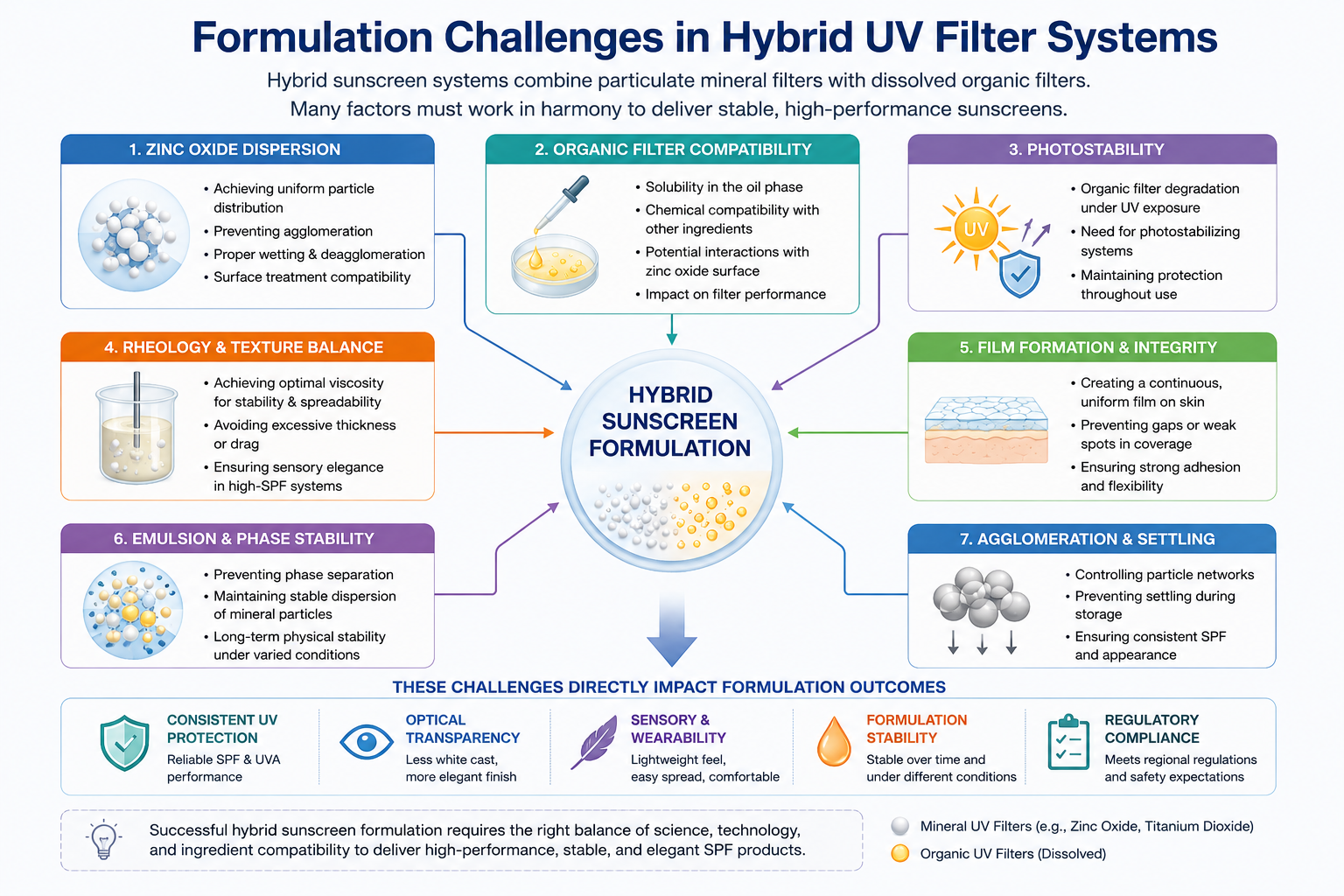
Hybrid sunscreen filters are not automatically easier to formulate. They can be more difficult because they combine two different physical systems. One part of the formulation contains particles. Another part contains dissolved organic molecules. The two must remain stable in the same emulsion, spread evenly, and form a consistent film on the skin.
One major challenge is interaction between zinc oxide and organic UV filters. A peer-reviewed study found that zinc oxide can induce changes in small-molecule sunscreen ingredients after UV exposure and concluded that care is needed when formulating sunscreens containing zinc oxide with small-molecule UV filters. This does not mean zinc oxide should not be used in hybrid systems. It means hybrid systems require proper stabilization, surface treatment, and compatibility testing.
Another challenge is photostability. Some organic UV filters can degrade under UV exposure unless stabilized by other ingredients or filter combinations. Hybrid systems must be designed so that the full filter package remains effective during exposure, not just at the time of application.
Emulsion stability is also critical. A hybrid sunscreen may contain mineral particles, oil-soluble filters, emulsifiers, film formers, dispersants, preservatives, and sensory modifiers. If these components are not compatible, the formula can show sedimentation, phase separation, viscosity drift, poor spreadability, or inconsistent SPF performance.
Why Dispersion Quality Matters More in Hybrid Sunscreens
Dispersion quality is one of the most important technical factors in hybrid sunscreen formulation. Zinc oxide does not dissolve. It must be wetted, separated, and stabilized as particles within the formulation.
If zinc oxide particles agglomerate, several problems can appear. The formula may become less transparent because large clusters scatter more visible light. The film may become less uniform because particles are not evenly distributed. SPF performance may become less predictable because UV filter density varies across the applied film.
In a hybrid system, dispersion quality becomes even more important because the zinc oxide phase must work alongside dissolved organic filters. A poorly dispersed mineral phase can disturb texture, film formation, and optical appearance even if the organic filter system is well designed.
This is why advanced zinc oxide dispersions matter in modern hybrid sunscreen systems. Good dispersion helps the mineral phase integrate more predictably into the full filter architecture. It also supports consistency across manufacturing, storage, and application.
For a company working with engineered zinc oxide systems, this is the strongest point of relevance. Hybrid sunscreen filters do not remove the need for zinc oxide expertise. They increase the need for controlled zinc oxide behavior inside more complex formulations.
Hybrid Sunscreens and Broad-Spectrum Design
Broad-spectrum sunscreen formulation is not only about adding many filters. It is about covering the UV spectrum in a balanced and stable way.
UVB protection drives SPF. UVA protection is essential for broader photoprotection. A hybrid filter system can give formulators more control over both sides of the spectrum. Zinc oxide can contribute strong UVA support, while selected organic filters can improve UVB efficiency or add photostable broad-spectrum contribution.
BEMT is particularly relevant because FDA states that it provides both UVA and UVB protection. In hybrid systems, a filter like BEMT can help formulators create more efficient multi-filter designs. The result may be a sunscreen that reaches target SPF and UVA performance with improved sensory properties compared with systems that rely heavily on one filter class.
This is why the future of hybrid sunscreen filters is not simply about mixing mineral and organic filters. It is about designing UV filter architecture around spectral coverage, photostability, film behavior, and sensory outcome.
What Hybrid Sunscreen Filters Mean for Future Formulation
Hybrid sunscreen systems are likely to become more important because they reflect the direction of modern SPF development. The industry is moving toward products that are high-performing, transparent, stable, and easy to wear every day.
This creates a practical formulation problem. High SPF often requires more UV filter contribution. Better transparency often requires lower visible residue. Stronger wearability requires smoother films and better skin feel. These goals can conflict with each other. Hybrid sunscreen filters help formulators manage these conflicts by distributing performance across mineral and organic technologies.
For zinc oxide systems, the future is not only mineral-only sunscreen. Zinc oxide can remain highly relevant as part of hybrid UV architectures, especially where stable UVA support, photostability, and mineral positioning are important. The value will depend on how well zinc oxide is engineered for dispersion, transparency, compatibility, and film uniformity.
This is the real reason hybrid sunscreen filters matter. They are not a trend label. They are a formulation strategy for building modern sunscreen systems that meet multiple performance demands at once.
____________________________________________________________________________________________________________
Frequently Asked Questions (FAQs)
What are hybrid sunscreen filters?
Hybrid sunscreen filters are sunscreen systems that combine mineral UV filters, such as zinc oxide or titanium dioxide, with organic UV filters within the same formulation. These systems are designed to balance broad-spectrum protection, texture, transparency, and formulation stability more effectively than relying on a single filter category alone.
Why are hybrid sunscreen filters becoming more popular?
Hybrid sunscreen filters are growing because modern sunscreen products are expected to deliver high SPF protection while also maintaining lightweight texture, transparency, and better wearability. Combining mineral and organic UV filters gives formulators more flexibility when balancing protection, cosmetic elegance, and formulation performance.
Are hybrid sunscreens better than mineral sunscreens?
Hybrid sunscreens are not necessarily better than mineral sunscreens. They are designed differently. Mineral sunscreens rely mainly on particulate UV filters such as zinc oxide, while hybrid systems distribute UV protection across both mineral and organic filters. This can help improve formulation flexibility, especially in lightweight or high-SPF sunscreen systems.
Why is zinc oxide still important in hybrid sunscreen systems?
Zinc oxide remains important because it provides stable broad-spectrum protection, especially in the UVA range. In hybrid sunscreen systems, zinc oxide often acts as a photostable foundation within the UV filter architecture while organic filters contribute additional SPF efficiency or transparency benefits.
How do hybrid sunscreen filters improve transparency?
Hybrid sunscreen filters can reduce the amount of mineral loading required to achieve target SPF values. Lower particulate loading may reduce visible whitening and improve optical transparency, especially in fluid sunscreens, serum-SPFs, and lightweight daily-wear formulations.
What formulation challenges exist in hybrid sunscreen systems?
Hybrid sunscreen systems are more complex because they combine particulate mineral filters with dissolved organic UV filters. Formulators must carefully manage dispersion quality, photostability, emulsion stability, rheology, and film formation to maintain consistent sunscreen performance and texture.
Why is dispersion quality important in hybrid sunscreen formulations?
Mineral UV filters such as zinc oxide remain suspended as particles inside the formulation. Poor dispersion may cause particle agglomeration, uneven film formation, whitening, and SPF inconsistency. In hybrid sunscreen systems, dispersion quality becomes even more important because the mineral phase must remain compatible with dissolved organic filters within the same formulation.