
Sunscreen may sit on your skin for hours. But some of the chemistry that determines what happens to a UV filter begins in a fraction of a second so small that it is difficult to imagine.
A femtosecond is one quadrillionth of a second. In the time it takes us to blink, countless molecular events can already have taken place inside a sunscreen exposed to light. Researchers can now watch some of these events using ultrafast spectroscopy, revealing what happens immediately after a UV filter encounters radiation.
And it turns out that absorbing UV is only the beginning of the story.
Absorbing UV Is Only the Beginning
When we say a UV filter “absorbs UV,” the phrase sounds almost passive. Radiation arrives, the filter catches it, and the skin underneath receives less of it.
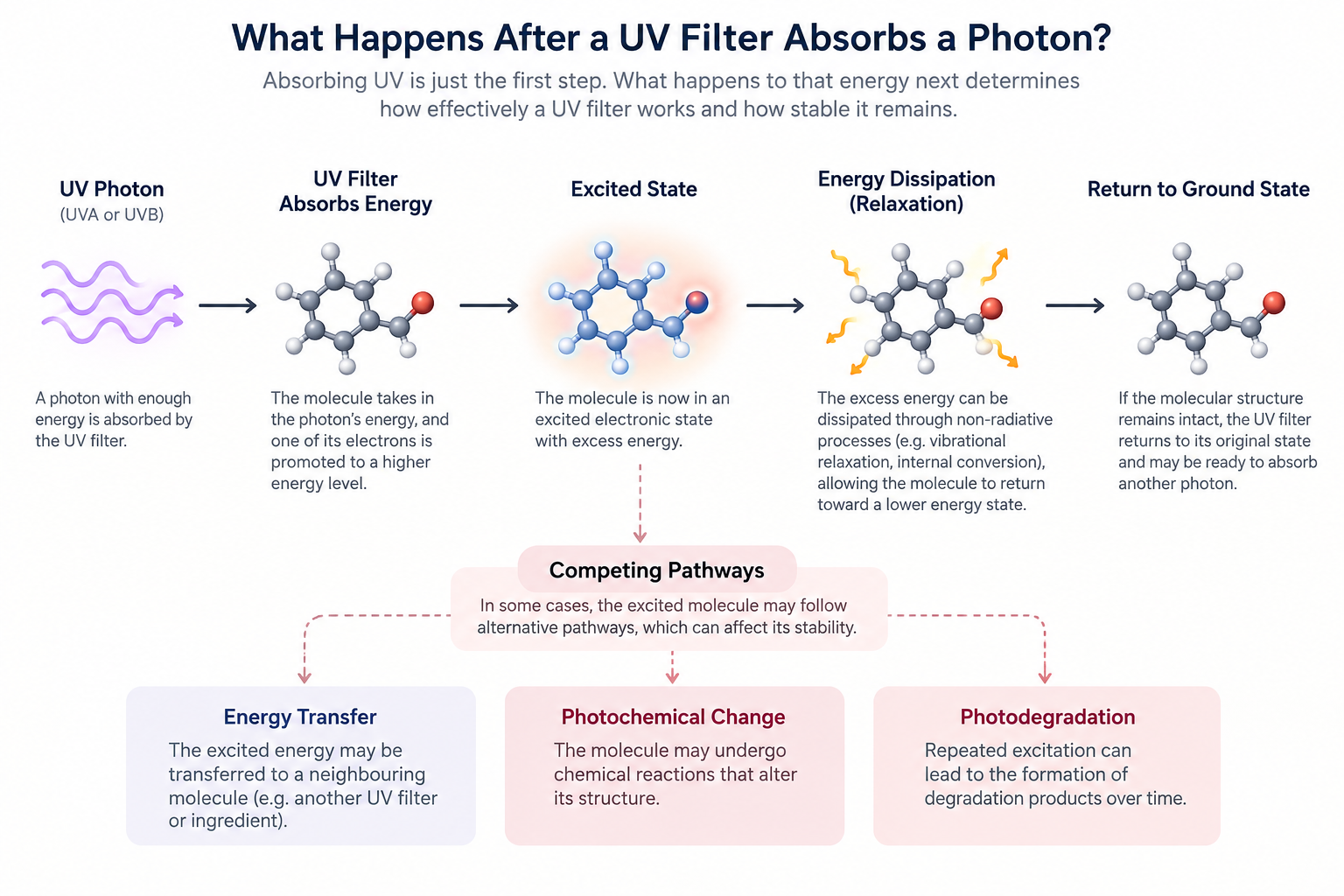
At the molecular level, something much more dynamic is happening. In an organic UV filter, the energy from an absorbed photon can promote the molecule from its ground electronic state into an excited state. The molecule now has excess energy, and what happens to that energy next is an important part of its photochemical behaviour.
A useful UV filter therefore needs more than the ability to absorb radiation at relevant wavelengths. Its behaviour after absorption matters too, including how efficiently it manages the absorbed energy and how resistant it remains to undesirable changes during irradiation.
That all begins incredibly quickly.
For a UV Filter, Getting Excited Is the Easy Part
Once a molecule absorbs a photon, it doesn’t simply stay excited.
A series of relaxation processes can follow as the molecule moves toward lower-energy states. Depending on its molecular structure and surroundings, energy may be dissipated through non-radiative processes, transferred through interactions with other molecules, or enter competing photochemical pathways.
Many of the earliest events happen on femtosecond and picosecond timescales. Conventional observation is far too slow to follow them directly, which is why researchers use ultrafast laser techniques that effectively probe molecular behaviour across extraordinarily short intervals.
The goal isn’t simply to produce fascinating images of fast chemistry. Understanding these pathways can help explain why some molecules handle repeated irradiation effectively while others may be more susceptible to photochemical change.
The Real Challenge Is What Happens to the Energy
Imagine the UV filter as an energy-management system.
Absorbing radiation is step one. After excitation, an effective pathway can allow that excess energy to be dissipated and the molecule to return toward its original state. If the molecular structure remains intact, it may then be available to absorb another photon.
But molecular relaxation isn’t identical for every UV filter. Molecular structure, wavelength, solvent environment and neighbouring molecules can all influence the available pathways.
This is one reason sunscreen science cannot be reduced to asking how much UV a molecule absorbs. Researchers are also interested in what the molecule does after absorption.
And that leads directly to photostability.
Why Photostability Matters
A sunscreen is not exposed to one photon.
During sun exposure, its UV filters encounter radiation repeatedly. If a filter undergoes significant photochemical change during irradiation, its absorption behaviour may change as well. Photostability therefore remains an important consideration when developing and selecting UV filters.
This continues to shape new filter research. A 2026 review examining almost 500 experimental organic UV-filter compounds reported between 2015 and 2025 identified improved photostability and broader UVA coverage among the major goals driving new molecular designs.
But the molecule itself is only part of the equation. Formulators can also influence the environment around UV filters through filter combinations, solvents, encapsulation strategies and the broader formulation architecture.
In other words, photostability isn’t purely an ingredient problem. It can become a formulation problem too.
A UV Filter Doesn’t Work Alone
Ingredient lists encourage us to think about UV filters individually.
Filter A provides certain wavelengths of protection. Filter B covers another region. Filter C helps complete the spectrum. Put them together, and it is tempting to imagine that the finished system is simply the sum of those individual properties.
Photochemistry can be more complicated.
Molecules exist in an environment where interactions are possible. Energy transfer, quenching and changes in the surrounding matrix can influence excited-state behaviour. That means understanding one UV filter in isolation doesn’t automatically reveal everything that will happen when it is placed alongside other filters in a finished sunscreen.
This is where recent ultrafast spectroscopy research becomes particularly interesting.
Researchers Are Now Watching This Happen Inside Sunscreen
Much of what scientists know about molecular photodynamics comes from carefully controlled experiments using individual compounds in dilute solutions.
That’s useful because simple systems allow researchers to isolate mechanisms. But a sunscreen is anything but simple. It may contain several UV filters alongside oils, emulsifiers, polymers, film formers and numerous other ingredients.
Researchers therefore asked whether the ultrafast behaviour observed in simple laboratory systems could still be detected once those molecules entered something much closer to an actual sunscreen.
A 2026 ACS Omega study examined methyl anthranilate, ethylhexyl methoxycinnamate and octocrylene using ultrafast laser spectroscopy. Instead of stopping with dilute solutions, the researchers studied the filters in sunscreen formulations, as thin films and after application to a skin mimic. They found important similarities between the fundamental photodynamics observed in solution and those detected in the more complex environments.
That matters because it begins to connect extremely fundamental photochemistry with the conditions under which a UV filter is actually expected to work.
UV Filters Can Change Each Other’s Story
The same study revealed another interesting layer.
Researchers observed evidence of quenching interactions involving methyl anthranilate with EHMC and with octocrylene. Importantly, those interactions weren’t confined to dilute laboratory solutions. Evidence of them persisted in the sunscreen formulations examined by the researchers.
That doesn’t mean every combination of UV filters interacts in the same way, nor should findings from these particular systems be generalized to every sunscreen. But it demonstrates why filter combinations can deserve investigation as systems rather than simply as isolated ingredients.
For a formulator, that’s an important distinction.
The question isn’t only:
What does this UV filter do?
It can also be:
What does this UV filter do here, surrounded by these ingredients, in this formulation?
Then the Timescale Suddenly Gets Much Slower
So far, we’ve been talking about femtoseconds and picoseconds.
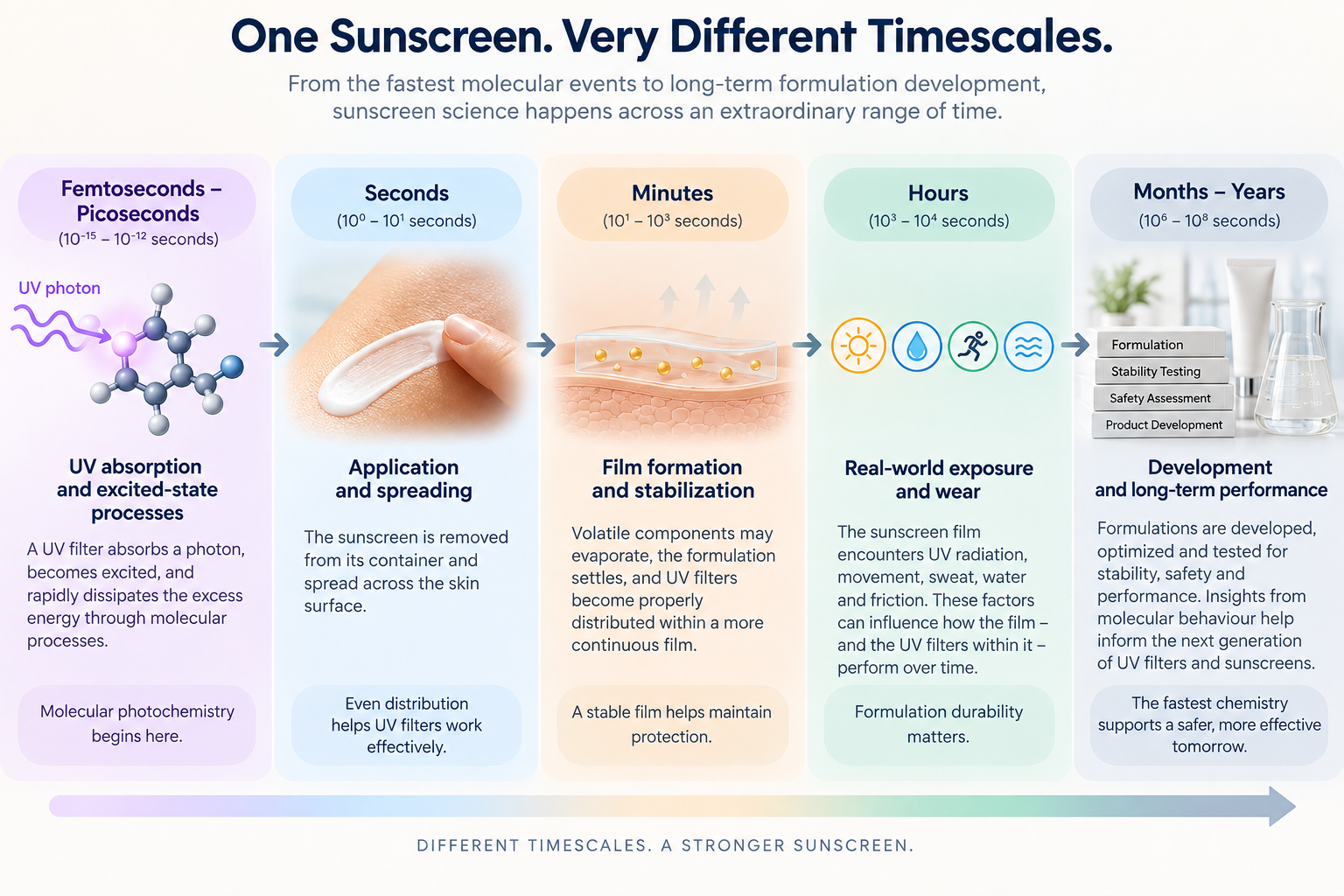
But zoom out from the molecule and an entirely different set of processes begins to matter. A sunscreen has to leave its container, spread across an irregular skin surface and form a sufficiently continuous film. The UV filters have to remain appropriately distributed within that film, and the film itself has to survive real-world wear.
Those processes occur over seconds, minutes and hours rather than trillionths of a second.
Recent research into sunscreen film formation makes this distinction particularly clear. Photoprotection depends not simply on the absorption properties of UV filters but also on their distribution and adhesion at the skin surface. Researchers have consequently argued that traditional measurements performed in simple solvent systems capture only part of what ultimately determines sunscreen performance.
A molecule can therefore have impressive photophysical properties without automatically becoming an impressive sunscreen.
The Molecule Is Not the Sunscreen
This may be the most important distinction in the entire discussion.
A UV filter has molecular or material properties. A sunscreen has formulation properties.
Solubility matters for many organic filters. Dispersion matters for particulate filters. Emulsion structure, rheology, compatibility, crystallization, film formation and stability can all influence what eventually happens when the product is spread over skin.
Then human behaviour enters the picture. Application amount, spreading, water exposure, friction and reapplication can alter the protective film further.
So while the first photochemical events after UV absorption may occur almost unimaginably quickly, sunscreen performance emerges from processes occurring across vastly different timescales.
That is where zinc oxide makes the story even more interesting.
Zinc Oxide Plays by Different Rules
Not every UV filter is an organic molecule undergoing the same type of molecular excited-state behaviour.
Zinc oxide is an inorganic semiconductor material. Its interaction with UV radiation therefore needs to be understood through the physics and chemistry of a particulate semiconductor rather than simply applying the molecular picture used for organic UV absorbers.
ZnO provides broad-spectrum UV attenuation and is regarded as photochemically stable, but its performance within sunscreen is still influenced by physical characteristics and formulation decisions. Particle characteristics, dispersion, agglomeration and surface modification can affect how ZnO behaves in a finished system. Recent research also continues to examine coatings and surface treatments as ways of controlling surface reactivity while improving formulation characteristics.
This is also why the familiar description of mineral sunscreens as tiny particles that simply “reflect” UV is incomplete. Inorganic filters such as ZnO interact with radiation through absorption as well as scattering, with the relative contributions depending on wavelength and particle characteristics.
Organic and inorganic UV filters therefore don’t have to follow identical microscopic pathways to contribute to the same macroscopic goal: reducing the amount of harmful UV radiation reaching skin.
What Happens After Absorption May Shape the Next UV Filter
Ultrafast spectroscopy isn’t just useful for explaining filters we already have.
Researchers developing new organic UV filters are looking for combinations of properties that extend beyond strong absorption. Broad spectral coverage, particularly into longer UVA wavelengths, photostability, safety, environmental behaviour and compatibility with practical formulations all have to be considered.
Understanding excited-state behaviour can help researchers investigate one part of that puzzle. If a candidate molecule absorbs UV strongly but enters undesirable photochemical pathways after excitation, that information can become visible much earlier in development.
But fast energy dissipation alone does not make a molecule a successful sunscreen ingredient.
It still has to work inside a formulation. It has to remain stable. It has to provide useful spectral coverage at practical concentrations. It has to satisfy safety and regulatory requirements. And eventually, the formulation containing it has to create a protective film that people can actually wear.
The fastest chemistry is only one layer of the problem.
Sunscreen Science Happens on More Than One Clock
Think about how many timescales exist inside a single application of sunscreen.
Within femtoseconds and picoseconds, excited molecules can begin dissipating absorbed energy. Over seconds, the sunscreen is spread across skin. Over minutes, volatile components may evaporate and the film develops. Over hours, that film encounters movement, sweat, water and additional radiation.
Behind all of that sit months or years of formulation development, stability testing and performance evaluation.
That’s what makes looking at a UV filter in the trillionths of a second after light absorption so fascinating. It reveals a piece of sunscreen science that is normally invisible, but it also reminds us how incomplete that piece would be on its own.
A sunscreen isn’t just a collection of ingredients that absorb radiation. It is a carefully engineered system in which molecular photochemistry, particle physics, formulation architecture and film behaviour eventually have to work together.
And some of that story begins before we could ever notice that time has passed.
________________________________________________________________________________________________________________
Frequently Asked Questions
What happens when a UV filter absorbs UV radiation?
When an organic UV filter absorbs a photon, the molecule can move from its ground electronic state into an excited state. It then needs to manage that excess energy through relaxation processes, ideally returning toward a stable state without undergoing undesirable photochemical change.
How fast does a UV filter respond to sunlight?
Some of the earliest processes following UV absorption occur on femtosecond and picosecond timescales. A femtosecond is one quadrillionth of a second. Ultrafast spectroscopy allows researchers to investigate molecular behaviour across these extremely short intervals.
What does photostability mean in sunscreen?
Photostability describes how well a UV filter maintains its relevant properties when exposed to radiation. If significant photochemical changes occur during repeated UV exposure, the filter’s absorption behaviour may change, which is why photostability is an important consideration in UV filter and sunscreen formulation development.
Can UV filters interact with each other in a sunscreen?
Yes, interactions between certain UV filters are possible. Research has observed processes such as energy transfer and quenching in specific filter combinations. However, these interactions depend on the particular molecules and formulation environment, so findings from one filter system should not automatically be applied to every sunscreen.
Does zinc oxide work the same way as an organic UV filter?
No. Zinc oxide is an inorganic semiconductor material, so its interaction with UV radiation differs from that of molecular organic UV filters. ZnO contributes to UV attenuation through absorption and scattering, while factors such as particle characteristics, dispersion and surface treatment can influence its behaviour in a finished sunscreen.
Why does the sunscreen formulation matter if the UV filter already works?
A UV filter’s properties are only one part of sunscreen performance. Solubility or dispersion, compatibility with other ingredients, film formation, distribution across the skin, stability and real-world application all influence how the finished sunscreen ultimately performs.