
You apply sunscreen in the morning, but the environment it meets rarely stays the same. Humidity rises. Skin begins to sweat. The sunscreen film encounters water, movement and friction.
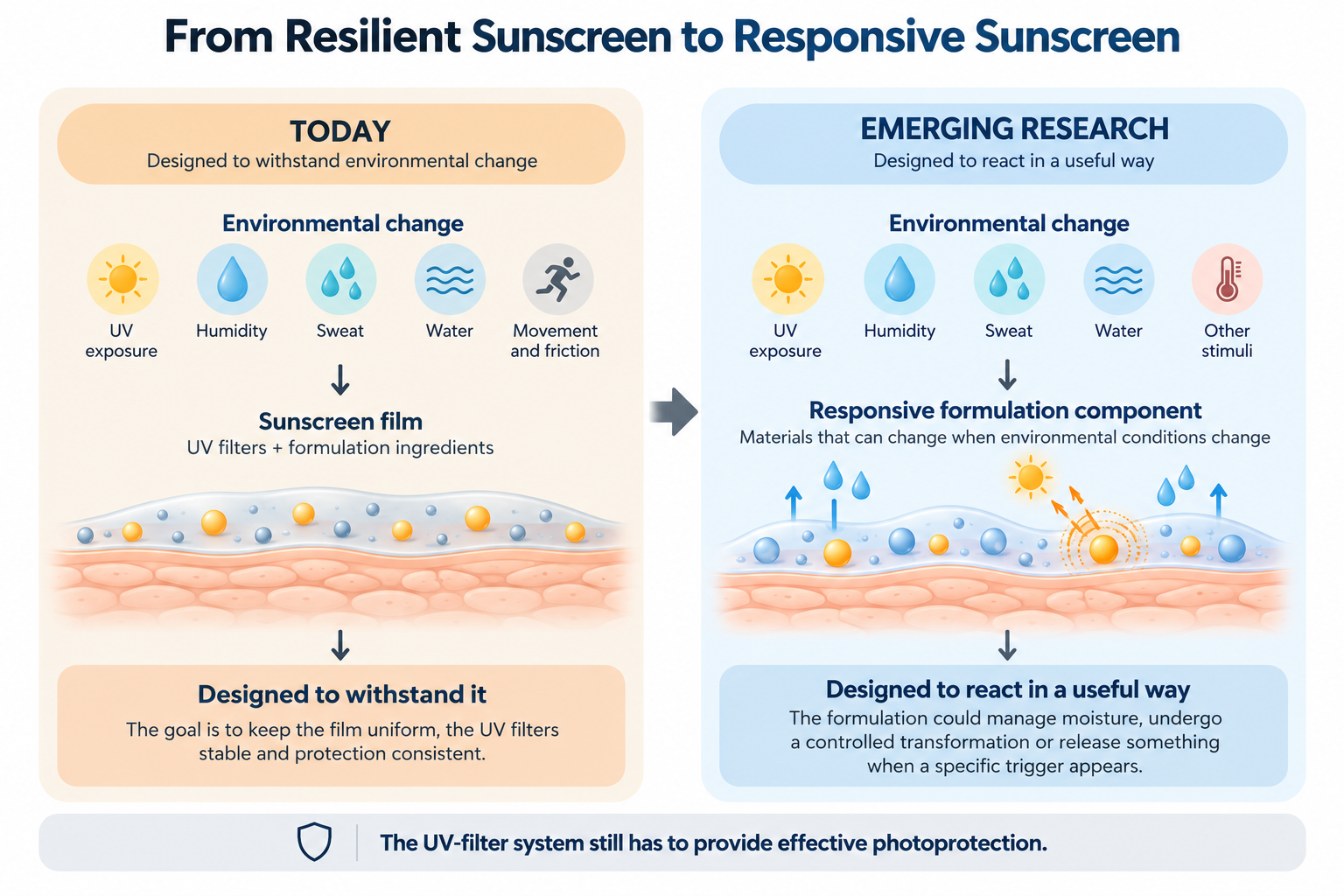
Meanwhile, UV exposure changes with the time of day, location, cloud cover and how long we stay outside. For decades, sunscreen formulation has largely approached these changes as challenges to overcome: build a film that stays uniform, keep the UV filters stable and maintain protection when conditions become less predictable.
But research is beginning to raise a different question: What if sunscreen could respond when its environment changes? That idea may sound futuristic. Yet some of the technologies that could shape the future of sunscreen are already moving in this direction.
Sunscreen Has Never Really Been Static
Once sunscreen is spread across the skin, it becomes a thin and surprisingly complex film. Within that film, UV filters have to remain appropriately distributed.
Oils, emulsifiers, polymers, powders and other ingredients influence how the formulation spreads, dries and ultimately behaves on the skin. With particulate mineral filters such as zinc oxide, dispersion is particularly important because particle distribution can influence the uniformity of the resulting protective layer.
And then real life begins. The film experiences changes in temperature and humidity. Sweat introduces moisture. Water can disturb it. Movement and friction can remove or redistribute material.
At the same time, the UV filters continue interacting with incoming radiation. Much of sunscreen development therefore focuses on making that film resilient.
The emerging idea of responsive formulation adds another possibility. Instead of designing every component simply to resist environmental change, could certain parts of the formulation be designed to change with it?
We Already Have Sunscreen Films That Respond to Their Environment
One of the clearest examples doesn’t actually begin with sunlight. It begins with humidity.
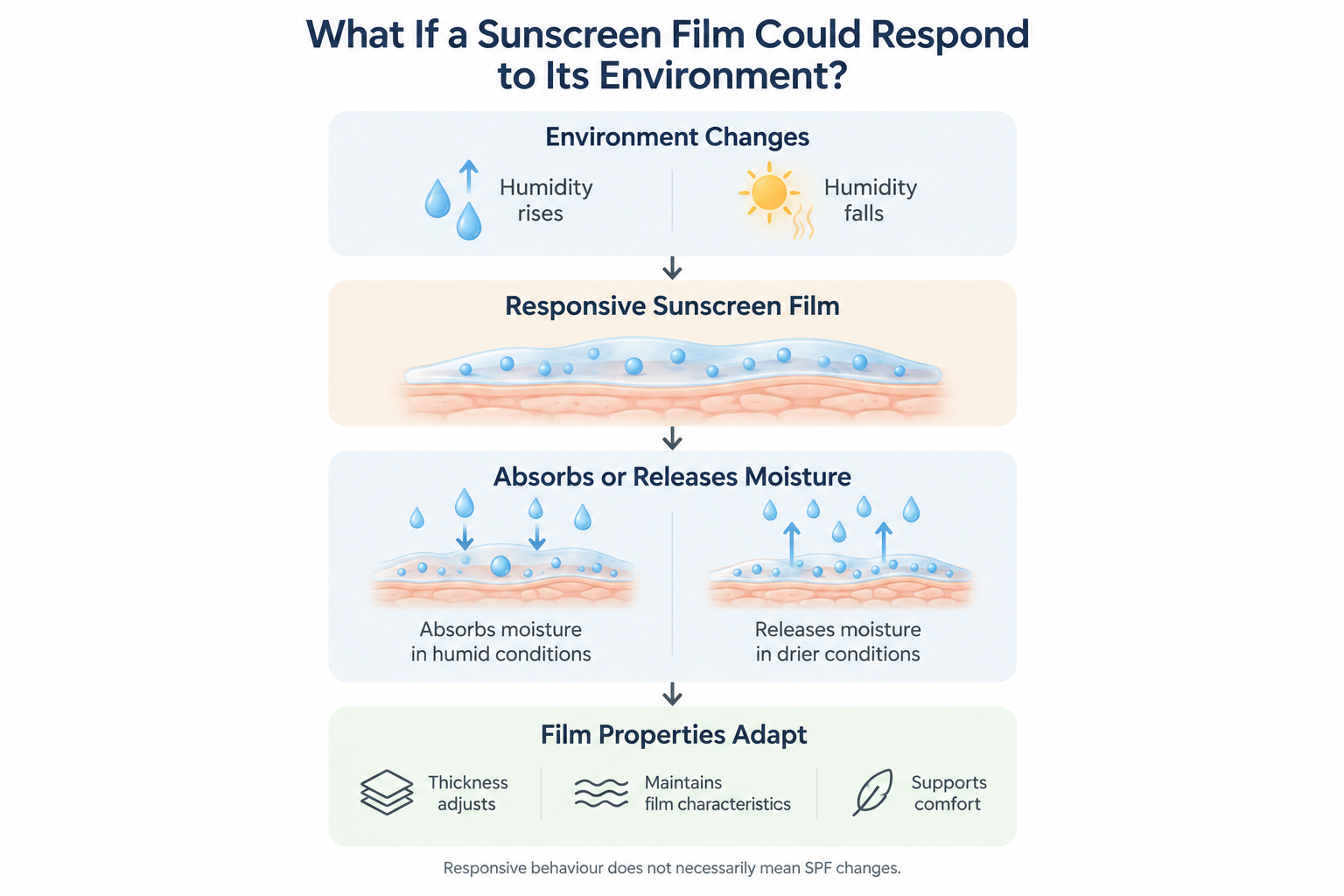
In 2025, Kao described a new UV-protection film technology designed to absorb and release moisture as environmental humidity changes. The formulation combines agar hydrogel capsules containing UV absorber with a highly water-retaining polymer.
When researchers increased relative humidity from 21% to 88%, the new film absorbed more than twice as much moisture as the conventional formulation used for comparison. After the film was wetted and subsequently dried, its thickness changed again as moisture was released.
In other words, the sunscreen film was not designed to remain physically identical under every condition. It was designed to respond.
And this isn’t simply a laboratory concept. Kao incorporated the technology into Bioré UV Aqua Rich Airy Hold Cream, launched in Japan in March 2025.
The commercial formulation uses a humidity-responsive agent so the film can absorb moisture in humid conditions and release moisture under drier conditions. That doesn’t mean the sunscreen increases its UV protection when humidity rises. The responsive behaviour concerns moisture management, film characteristics and comfort.
But it demonstrates something important for the future of sunscreen: a sunscreen film does not necessarily have to behave exactly the same way throughout the day.
What If Sunlight Itself Became the Trigger?
This is where the science becomes much more experimental. Light doesn’t only supply energy that UV filters need to manage. Photons can also initiate chemical changes in certain molecules.
Researchers are beginning to investigate whether that property could be deliberately engineered into sunscreen systems.
A 2025 study, for example, developed photoresponsive liposomes containing UV filters. The researchers incorporated an azobenzene-containing lipid that undergoes molecular rearrangement when exposed to UV radiation. That change was then used to trigger the release of encapsulated UV filters.
The important idea isn’t the particular carrier. It’s the sequence: UV arrives → a material changes → that change produces another function.
Suddenly, sunlight isn’t only the thing the sunscreen is trying to protect against. It has also become the trigger.
A Sunscreen That Responds to the UV Dose
Research published in 2026 pushed this idea further.
Scientists developed an experimental UV-responsive sunscreen system containing a compound called MPTB, described by the researchers as a “pre-UV filter.” Under UVB irradiation, MPTB was photoconverted into the UVA filter avobenzone.
But another process was happening at the same time. The molecular change destabilized the lipid carrier containing it, triggering the release of an encapsulated peptide.
Importantly, the researchers reported that the release increased in proportion to the UVB dose. The work progressed through in-vitro and ex-vivo experiments into a randomized clinical evaluation of a sunscreen containing the experimental system.
That makes the concept particularly interesting. More UV exposure produced a greater response from the experimental system.
This doesn’t mean we now have sunscreen that automatically “knows” how strong the sun is. Molecules aren’t sensing sunlight in the way an electronic sensor would. Instead, the incoming radiation itself drives a chemical process.
The distinction matters because it keeps the idea grounded in chemistry rather than making the technology sound more futuristic than it actually is.
This Is Not a Sunscreen That Changes Its SPF on Command
It is easy to take responsive sunscreen research one step too far. Imagine stepping into stronger sunlight and your SPF 30 instantly becoming SPF 50, or a sunscreen detecting UV intensity and automatically adding more protection exactly where it is needed.
That is not what these studies demonstrate.
The 2025 photoresponsive study investigated triggered release from an experimental liposomal system. The 2026 work investigated UVB-triggered photoconversion and active release from specialized lipid carriers.
Both represent specific experimental approaches rather than evidence that ordinary commercial sunscreens can dynamically increase their labelled SPF. That distinction becomes especially important when discussing the future of sunscreen.
A material can respond to UV without that response necessarily translating into better broad-spectrum protection, better wear or better performance in everyday use. The response still has to be useful.
Responding to Sunlight Is One Thing. Responding Well Is Another.
Imagine designing a formulation whose behaviour changes under UV. Immediately, the formulation questions multiply.
How much radiation is required before the response begins? Does it happen after seconds of exposure or after an hour? Does the magnitude of the response track UV dose reliably? What happens after repeated irradiation? Can the process reverse?
Then come the questions sunscreen formulators already know well. Does the system remain stable during storage? Does it interact with other ingredients? Does it affect rheology or film formation?
Can it survive water and sweat? Does it remain aesthetically acceptable on the skin? And eventually, the most important question: Does the response produce a meaningful improvement in the finished sunscreen?
A fascinating molecular mechanism is not automatically a better sunscreen.
The UV Filter Still Has to Do Its Job
Responsive formulation doesn’t remove the fundamentals of photoprotection. A sunscreen still needs an effective UV-filter system.
Those filters still need to be incorporated appropriately into the formulation and distributed across the skin in a sufficiently uniform film.
For mineral sunscreens containing zinc oxide, that brings the discussion back to familiar formulation challenges. Particle characteristics, dispersion quality, compatibility with the surrounding formulation and distribution within the final film all matter.
A humidity-responsive polymer cannot compensate for poor dispersion. A UV-triggered ingredient cannot magically correct an uneven film. That is why the future of sunscreen is unlikely to be defined by one clever ingredient.
It will still depend on the behaviour of the whole formulation.
Maybe the Future Isn’t Just a New UV Filter
When we imagine sunscreen innovation, it is tempting to focus on discovering the next UV filter. That will certainly remain important.
But responsive-material research suggests another route. Instead of changing only the molecule responsible for UV attenuation, formulators may increasingly be able to engineer what happens around it.
The film could manage moisture differently as humidity changes. A material could undergo a controlled transformation after absorbing radiation. A formulation component could release something when a particular environmental stimulus appears.
None of these ideas eliminates the need for effective UV filters. They potentially add another layer of functionality around them.
And that changes the question from “What new ingredient could we put into sunscreen?” to “What could we engineer the entire sunscreen system to do?”
The Future of Sunscreen May Be More Dynamic
Sunscreen has traditionally been expected to perform in a world that refuses to stay still. The sun changes. Humidity changes. Skin changes. The film experiences sweat, water, movement and wear.
So perhaps it isn’t surprising that researchers are beginning to explore formulations that are less static too.
We’re already seeing commercially deployed sunscreen films engineered to respond to humidity. Experimental research is exploring systems in which UV radiation itself triggers molecular transformations or controlled release.
Those approaches are at very different stages of development, and neither tells us exactly what sunscreen will look like ten years from now. But together they point toward an interesting possibility.
The future of sunscreen may not simply be about making a stronger protective film. It may also be about learning how to make that film respond intelligently to the environment it is protecting us from.
_______________________________________________________________________________________________________
Frequently Asked Questions (FAQs)
What could the future of sunscreen look like?
The future of sunscreen may involve more than developing new UV filters. Researchers are also exploring formulations and materials that can respond to environmental conditions such as humidity or UV exposure. These technologies are at very different stages of development, so responsive behaviour should not automatically be interpreted as improved sun protection.
Can sunscreen respond to sunlight?
Experimental research suggests that certain sunscreen systems can be designed so UV radiation triggers a chemical or material response. Recent studies have investigated UV-triggered molecular changes and controlled release, although these approaches remain experimental and are not representative of conventional sunscreens.
What is a responsive sunscreen film?
A responsive sunscreen film is designed so certain properties change when environmental conditions change. For example, humidity-responsive film technology has been developed to absorb or release moisture depending on surrounding humidity.
Can sunscreen automatically increase its SPF in stronger sunlight?
Current research does not show conventional sunscreen automatically increasing its labelled SPF when sunlight becomes stronger. UV-responsive experimental systems can undergo specific changes when exposed to radiation, but that is very different from an SPF 30 automatically becoming SPF 50.
Why does sunscreen film formation matter?
After application, sunscreen must form a sufficiently uniform protective layer across the skin. UV-filter distribution, dispersion, formulation composition, drying and environmental exposure can all influence that film and therefore the performance of the finished sunscreen.
Where does zinc oxide fit into the future of sunscreen?
Zinc oxide remains a broad-spectrum mineral UV filter, and its performance in a formulation depends on factors including particle characteristics, dispersion and distribution within the sunscreen film. Responsive formulation technologies would not remove these fundamentals. They could potentially add new functionality around an existing UV-filter system.