
If zinc oxide already covers UVA and UVB, adding another broad-spectrum filter can look redundant. That was my first reaction, too, when I started digging into BEMT. Zinc oxide earned its reputation precisely because it offers wide UV coverage, so what does a formulator actually gain by adding BEMT to the same sunscreen?
The honest answer isn’t “more protection.” BEMT (Bis-Ethylhexyloxyphenol Methoxyphenyl Triazine) is a highly photostable organic filter that also absorbs across UVA and UVB. On paper, that reads as overlap. In a real formulation, though, two broad-spectrum filters can do very different jobs, because formulators aren’t just checking a UVA/UVB box. They’re chasing specific SPF and UVA targets while juggling texture, stability, spreadability, and how much total filter the formula can carry. Framed that way, pairing BEMT with zinc oxide gets far more interesting.
Two Broad-Spectrum Filters Don’t Necessarily Do the Same Job
“Broad spectrum” makes filters sound more interchangeable than they are. It tells you protection spans UVA and UVB, not that every filter contributes equally at every wavelength. The shape of that absorption curve still matters.
BEMT absorbs strongly across UVA and UVB and is prized for photostability. Zinc oxide also delivers broad attenuation, but as a particulate mineral, its performance hinges on particle characteristics, dispersion, and how evenly it sits in the finished film. Both are “broad spectrum,” but they get there through completely different routes, which gives formulators room to let each filter specialize in what it does best, rather than asking one to carry the whole profile.
BEMT Gives the Formula Another Variable
It’s tempting to assume more protection just means more filter. In practice, pushing filter loading higher reshapes viscosity, spreadability, appearance, and stability, not just SPF. That’s especially true for zinc oxide, a solid particulate that has to be dispersed throughout the formula; adding more makes everything else harder to manage, particularly for a lightweight, elegant finish.
This is where BEMT earns its keep. Its strong UV absorption gives formulators another way to build toward the protection goal instead of leaning on the mineral component alone, though that doesn’t mean a set amount of BEMT swaps out a predictable amount of zinc oxide. SPF isn’t linear. What BEMT really offers is flexibility: a lever for testing different balances and watching what happens to SPF, UVA protection, viscosity, and feel, not just “another active.”
There’s a Catch: BEMT Has Its Own Demands
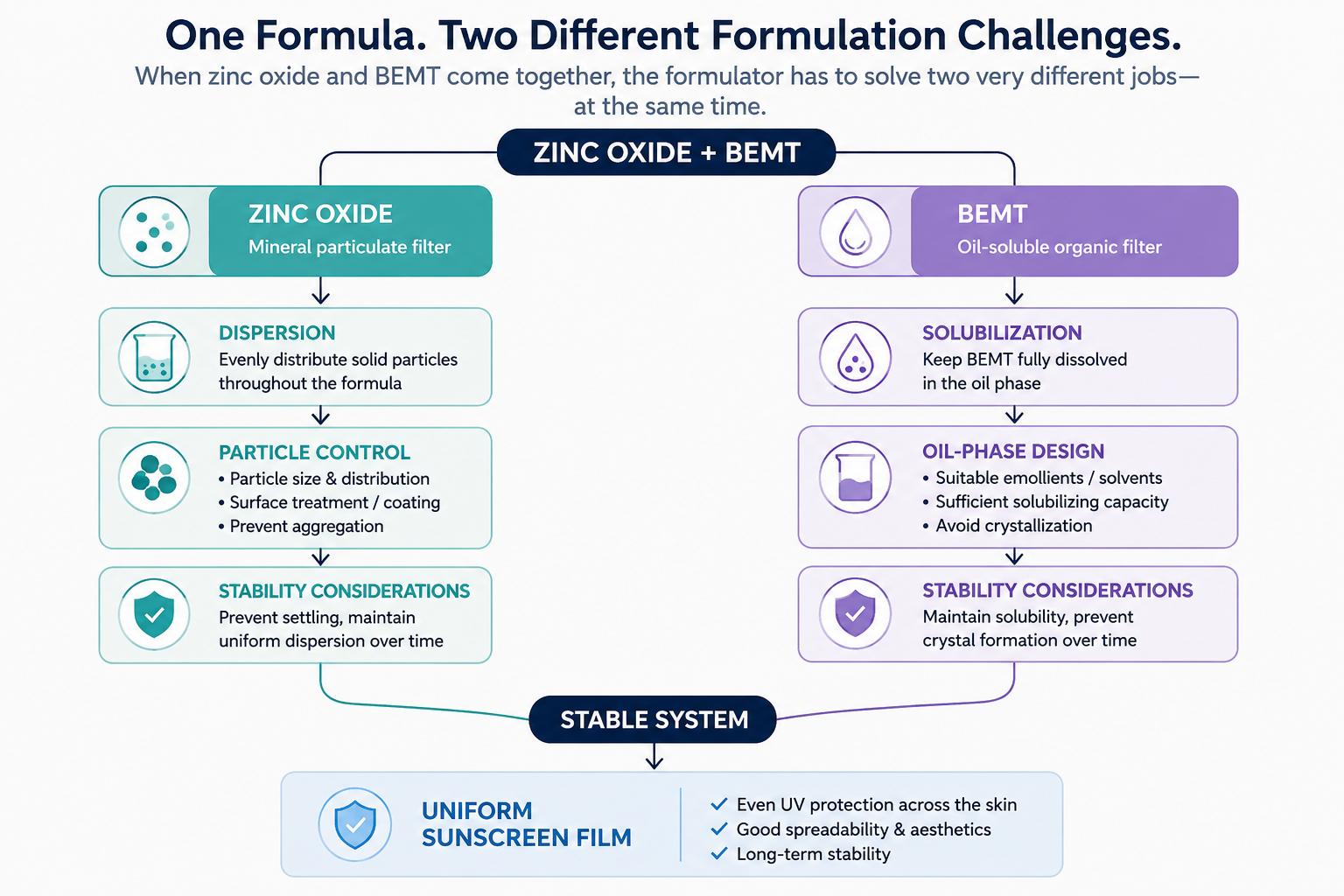
That flexibility isn’t free. BEMT is oil soluble, so the formula needs the right oil phase and solvent system to keep it dissolved. Get that wrong, and crystallization becomes a real risk, one that can undermine stability and performance.
Zinc oxide has to be dispersed as a particulate; BEMT has to be solubilized. The formulator is managing two fundamentally different behaviors in one product, and everything else still has to accommodate both, forming an even film and staying stable through shelf life. That’s why a zinc oxide-BEMT system is a formulation question, not a simple swap. The real question isn’t whether BEMT beats zinc oxide, but whether giving two different technologies distinct jobs produces a better-balanced sunscreen.
Could BEMT Change How Much Zinc Oxide a Formula Needs?
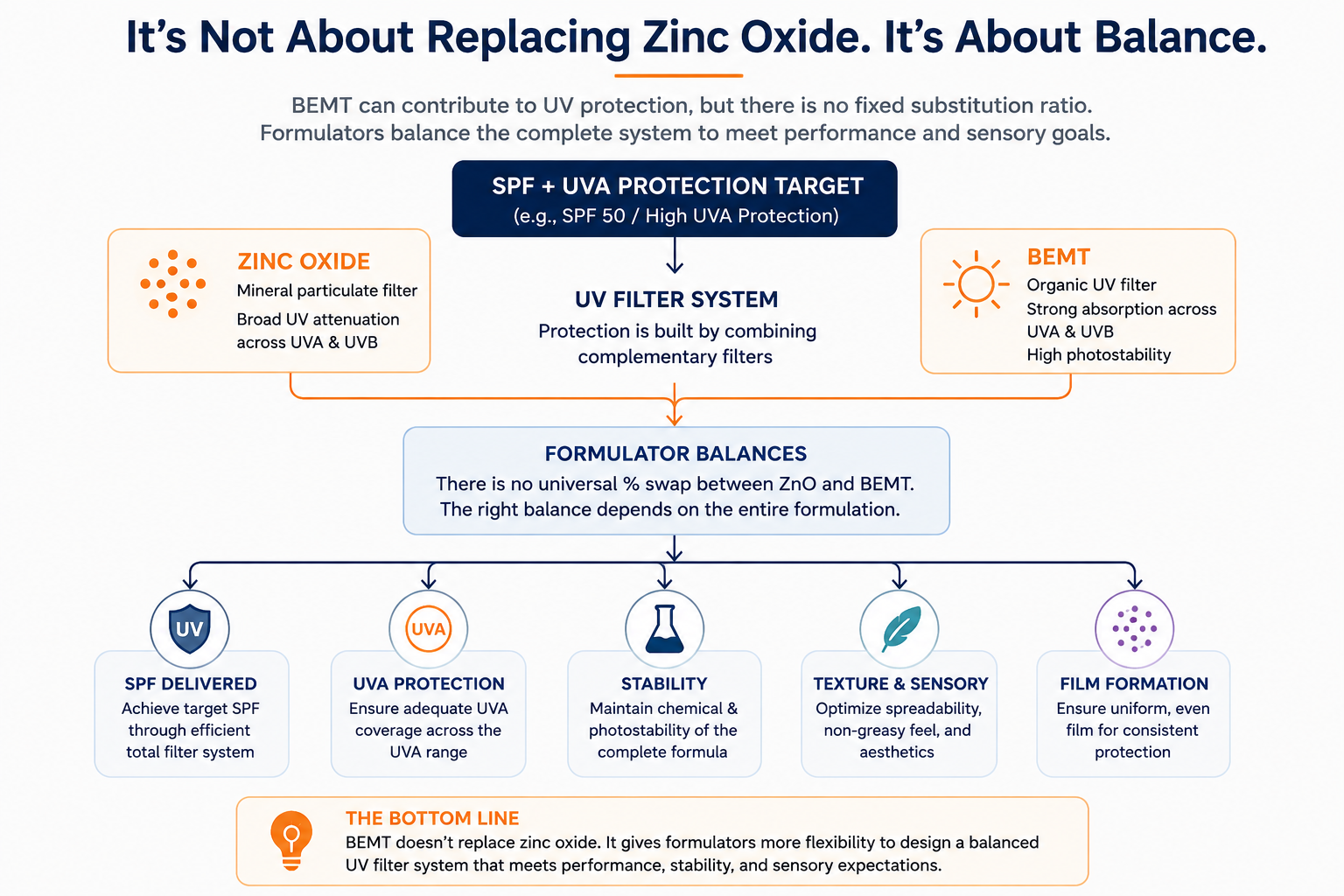
This is where it’s easiest to oversimplify. If BEMT contributes meaningfully to UV protection, it seems logical that adding it lets you dial back zinc oxide. In practice, it’s rarely that clean. SPF isn’t set by one filter’s percentage alone. Particle dispersion, filter combinations, the vehicle, and film uniformity all shape the number you measure. Two formulas with similar zinc oxide levels can perform differently, which is why you can’t reliably swap percentages on paper.
Still, BEMT opens a door. If it can efficiently contribute part of the required attenuation, zinc oxide doesn’t automatically need pushing harder as targets rise, which matters because zinc oxide loading affects more than protection. It’s a solid material in something that still needs to spread easily and feel good on skin.
The key word, though, is potentially. There’s no universal substitution ratio between the two. The only real answer comes from building the actual formula and testing it directly.
The Interesting Part Might Actually Be the Texture
BEMT lines up with where sunscreen formulation is already heading. Consumers want high protection without the heavy texture that’s traditionally come with high filter loads, and for mineral-led products, staying elegant while hitting ambitious targets is a real balancing act.
If BEMT can shoulder part of the UV-filtering load, formulators get another route besides simply adding more zinc oxide. That doesn’t guarantee a lighter product, since BEMT brings its own solubility demands, but it widens the possibilities for how the formula is built. To be clear, BEMT isn’t a texture-enhancing ingredient by itself; it doesn’t make zinc oxide vanish on skin. Any aesthetic gain comes from what the formulator does differently with the whole system. It’s not about cramming in filters, but using them smartly enough that protection, stability, and feel are designed together rather than competing.
Two Good Filters Don’t Automatically Make a Better Sunscreen
It’s tempting to look at zinc oxide and BEMT separately, see two capable broad-spectrum filters, and assume combining them must produce something better. Formulation chemistry doesn’t quite work that way.
Once different filters share a system, their interactions with each other and with everything else (particle surfaces, coatings, solvents, emulsifiers, antioxidants) start to matter. A combination that looks great in theory still has to earn its stability and protection data. Research into zinc oxide and organic filter mixtures backs this up: certain combinations have been shown to affect photostability under UV exposure. That doesn’t mean zinc oxide clashes with every organic filter, or that BEMT behaves like every filter studied, but it does mean formulators can’t assume two photostable ingredients stay well-behaved once mixed.
For BEMT and zinc oxide, that raises the stakes on design. Particle treatment, oil phase, the antioxidant system, and processing all become part of the equation. The pairing has to be judged as a complete system, not two impressive names on an INCI list.
Maybe “Mineral vs. Organic” Is the Wrong Question
Sunscreen conversations tend to split mineral and organic filters into rival camps, with consumers nudged to pick a side. From a formulation standpoint, that split can be limiting.
If the goal is strong UVA and UVB protection, solid stability, and a pleasant feel, the better question is what each technology brings to the whole system. Zinc oxide offers broad-spectrum mineral protection and decades of use; BEMT offers strong absorption and excellent photostability. Those strengths don’t have to compete. A hybrid approach lets each filter do what it’s genuinely good at, rather than expecting one to solve everything alone.
That’s not a case for putting BEMT in every zinc oxide sunscreen. Mineral-only formulas remain important, and plenty of markets call for staying entirely mineral. But where hybrid formulation is on the table, BEMT widens the number of ways to hit the same target, and more paths to a solution is often the real innovation.
BEMT Doesn’t Replace What Zinc Oxide Does Well
Equally worth saying: BEMT isn’t here to make zinc oxide obsolete. Neither filter needs to substitute for the other. Zinc oxide’s broad-spectrum protection is exactly why it’s stayed central to mineral formulation, and it still lets brands build around a mineral positioning that matters in parts of the market. For a strictly mineral-only product, adding BEMT simply wouldn’t fit the brief.
When a formula doesn’t need to stay mineral-only, though, formulators gain more freedom, with zinc oxide staying central while BEMT adds absorption across the spectrum. The goal isn’t maximizing either ingredient; it’s building the full protection profile efficiently in a product that can be manufactured, stays stable, and feels right.
The UVA Question Is More Interesting Than It Looks
This piece opens with UVA on purpose, because that’s where the question gets genuinely interesting. Zinc oxide already covers UVA, so adding another strong UVA performer can look pointless. But UVA isn’t one wavelength. It’s a broad band, and filters don’t perform evenly across it. The more useful question isn’t “is UVA covered,” but what shape that coverage takes.
Combining filters gives formulators more control over that shape. BEMT absorbs strongly in the UVA range while still contributing to UVB; zinc oxide covers the spectrum broadly through its particulate mechanism. Looking at how the two profiles complement each other tells you more than checking a “broad spectrum” label ever could. The goal is a finished sunscreen that hits its UVA and SPF targets, not proof that one filter can do it all.
And Then There’s Photostability
BEMT’s photostability is a big part of why it draws attention. A UV filter spends its working life absorbing the radiation it’s meant to guard against, so holding up under exposure matters. BEMT’s molecular structure resists degradation relatively well, giving formulators a dependable organic filter to build with.
But a photostable ingredient doesn’t guarantee a photostable formula. Surrounding ingredients, other filters, particle surfaces, and the overall environment all shape how the finished system performs. BEMT’s value isn’t a list of properties attached to one molecule. It’s what those properties let a formulator build once it’s part of a carefully engineered sunscreen.
So Why Would a Formulator Actually Add BEMT?
Having dug into it, I don’t think there’s one answer. A formulator might want another route to UVA and UVB protection, more flexibility balancing the filter system, a way to reach a demanding target without leaning on one filter’s concentration, or simply more room to fine-tune how the product feels.
BEMT hands them another tool for all of that. What it doesn’t hand them is a shortcut. Solubilizing BEMT is still work. Dispersing zinc oxide is still work. Proving the combined system stays stable and delivers the promised protection is still work. None of it disappears just because two capable filters are in the mix. BEMT isn’t fixing zinc oxide’s limitations; it’s expanding the formulation space around it.
The Bigger Opportunity May Be Formulation Freedom
Sunscreen formulation has always involved trade-offs between protection, filter loading, aesthetics, stability, and regulatory limits. Adding another highly photostable broad-spectrum filter doesn’t erase those trade-offs, but gives formulators another way to navigate them. That flexibility can lead to very different products: one staying zinc-oxide-led with BEMT in a supporting role, another splitting protection more evenly between mineral and organic filters. The right balance depends on the SPF target, UVA requirement, texture, market, and regulatory framework.
So I wouldn’t call BEMT the missing piece mineral sunscreen was waiting for. That oversells it. It’s more accurate to call it another piece of formulation technology, one that gives developers more options whenever the brief allows a hybrid approach.
Final Thoughts
So, zinc oxide does UVA well. Why would a formulator add BEMT?
Because sunscreen development was never about proving how much one ingredient can do alone. It’s about designing a complete system that hits the required protection while staying stable, manufacturable, and pleasant to use. BEMT brings strong UVA and UVB absorption, high photostability, and another way to spread the workload. Zinc oxide brings its own broad-spectrum performance and the qualities that have made it a mainstay mineral filter. Together, they open possibilities neither offers alone. That possibility still comes with work attached, though: BEMT has to stay solubilized, zinc oxide has to stay properly dispersed, and the finished system still has to form a consistent film, pass stability testing, and deliver the numbers on the label.
Maybe that’s why this combination is more interesting than the usual mineral-versus-organic debate lets on. The question was never whether BEMT or zinc oxide is better. For a formulator, the far more useful question is what becomes possible once you know how to use both.
_________________________________________________________________________________________________________
Frequently Asked Questions
What is BEMT in sunscreen?
BEMT stands for Bis-Ethylhexyloxyphenol Methoxyphenyl Triazine, a broad-spectrum organic UV filter also known as bemotrizinol. It absorbs across both UVA and UVB wavelengths and is particularly valued by formulators for its high photostability.
Why combine BEMT with zinc oxide if zinc oxide is already broad spectrum?
The purpose isn’t simply to add more UV filters. BEMT gives formulators another way to build and balance the overall UV protection system. Because zinc oxide and BEMT have different characteristics, using them together can provide greater flexibility when targeting SPF, UVA protection, stability and the desired sensory profile.
Can adding BEMT allow formulators to use less zinc oxide?
Potentially, but there isn’t a universal substitution ratio between BEMT and zinc oxide. The protection achieved depends on the concentrations used as well as dispersion, solubilization, film formation and the rest of the formulation. Any reduction in zinc oxide would therefore need to be validated through testing of the finished sunscreen.
Does adding BEMT automatically make a zinc oxide sunscreen lighter?
No. BEMT isn’t a texture enhancer, and simply adding it won’t make a sunscreen lighter. However, using multiple UV-filter technologies can give formulators more flexibility when designing the overall filter system, which may create additional options for optimizing texture and sensory performance.
Is a zinc oxide and BEMT sunscreen still a mineral sunscreen?
Not in the strict mineral-only sense. Zinc oxide is a mineral UV filter, while BEMT is an organic UV filter. A sunscreen containing both would generally be considered a hybrid UV-filter system, although terminology and product claims can vary between markets.