Five years ago, buying a zinc oxide sunscreen usually meant making a trade-off, and most of us just accepted it as the price of admission.
You picked it for reliable mineral UV protection, especially if your skin was sensitive and reacted badly to chemical filters. But you also expected a formula that felt thicker than it should, took too long to blend in, and turned your morning routine into more of a chore than it needed to be.
That experience was so common people simply learned to live with it. If you wanted something lightweight and elegant, you looked elsewhere. If you specifically wanted zinc oxide, you accepted the compromises that came with it.
Today, that assumption doesn’t really hold up anymore.
Some of the newest zinc oxide sunscreens feel remarkably different. They spread more easily, sit comfortably under makeup, and sink into the skin in a way that would’ve been hard to imagine not that long ago. In a lot of cases, they feel closer to a lightweight moisturizer than the dense, chalky mineral sunscreens many of us grew up with.
So I started wondering what had actually changed. My first instinct was to assume someone had invented a whole new version of zinc oxide, the texture difference is obvious enough that it feels like the ingredient itself must have been reinvented. But the more I dug into it, the more I realized that wasn’t the story at all.
The biggest changes haven’t happened inside the zinc oxide particle. They’ve happened all around it. Formulators have spent years quietly improving the systems that carry, disperse, stabilize, and apply zinc oxide to the skin. Those advances rarely show up on an ingredient list, yet they completely change how the finished product feels in your hand and on your face.
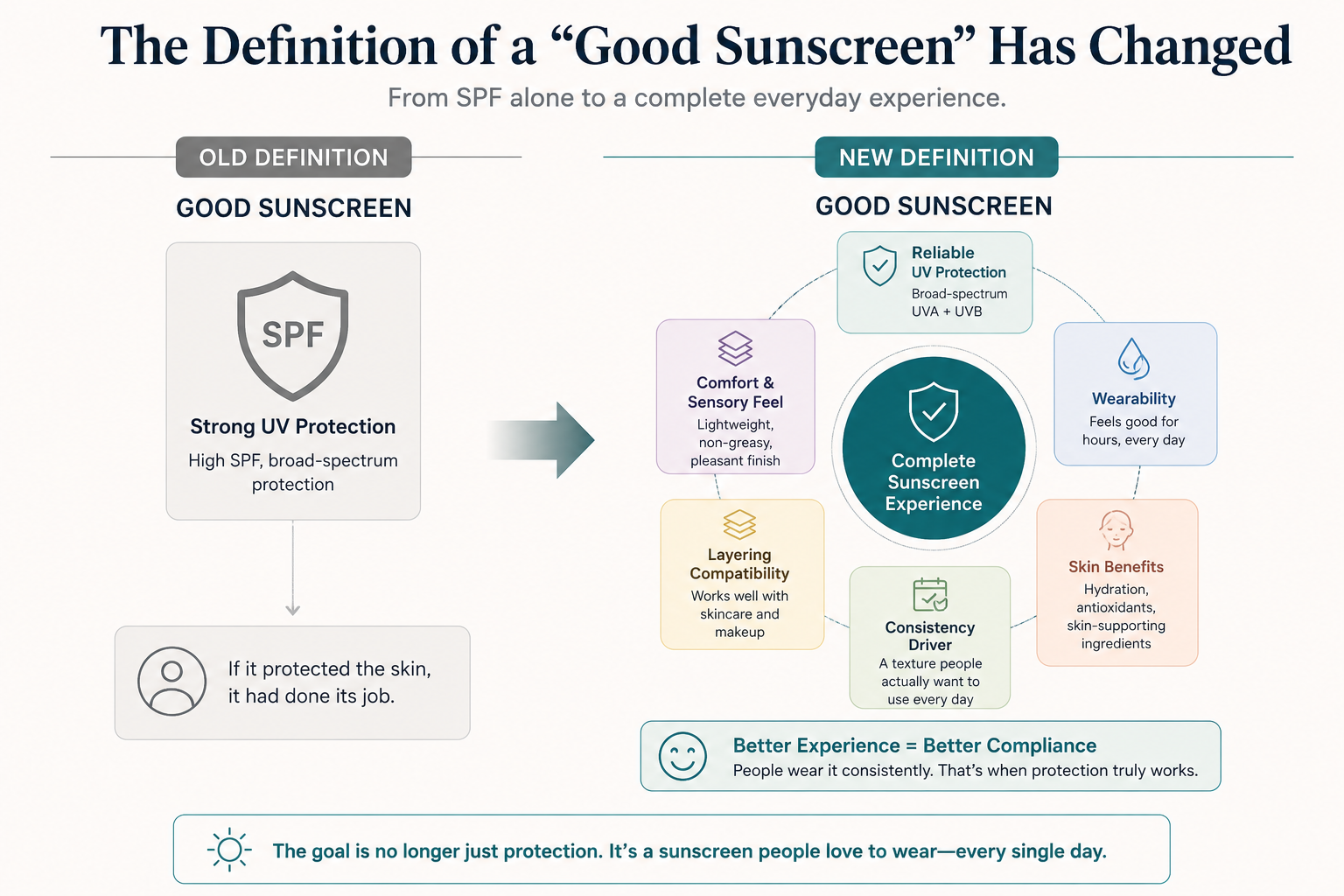
What I found genuinely interesting is that the industry’s own definition of a “good sunscreen” has shifted too.
Not that long ago, success was measured almost entirely by protection. If a formulation hit its target SPF and stayed stable on the shelf, it had done its job. Today, that’s really just the starting point. A sunscreen also has to feel elegant, layer well underneath the rest of a skincare routine, work under makeup, and be comfortable enough that people genuinely want to reach for it every single day.
That shift in thinking might be the single biggest reason your zinc oxide sunscreen feels so different today compared to a few summers ago. The ingredient itself is still doing exactly what it’s always done. The science surrounding it, though, has evolved in ways most of us never actually see.
And once I started understanding those changes, I realized the story wasn’t really about zinc oxide at all. It was about how formulators quietly redefined what wearing sunscreen should feel like.
When Formulators Started Designing for Wearability
One thing that kept coming up while researching this topic was how much the conversation around sunscreen has quietly changed. It isn’t only about chasing a higher SPF number anymore. The focus has widened to something more practical: how does the product actually feel once it lands on someone’s skin?
That might sound like a small shift, but I think it’s one of the biggest reasons modern zinc oxide sunscreen feels so different. Protection only works if people actually apply enough of it and keep using it day after day. If a formula feels greasy or clashes with the rest of your skincare routine, even excellent UV protection loses a lot of its value, simply because people stop reaching for it consistently.
I found it interesting that formulators now talk about “wearability” almost as much as performance. They’re asking questions that probably weren’t front and center a decade ago. Does the sunscreen glide smoothly instead of dragging? Does it absorb without leaving a sticky finish? Does it layer comfortably over serums and sit well under makeup, and still feel pleasant hours later?
Those questions have quietly reshaped how these products get developed. Instead of treating texture as something consumers only notice after a formula is finished, texture has become part of the design process from the start. Every decision, from the emulsion system to the emollients and polymers chosen, feeds into the overall experience of wearing the sunscreen.
I think that’s exactly why today’s zinc oxide sunscreens often feel less like standalone sun protection products bolted onto your routine, and more like natural extensions of the skincare you’re already doing. They aren’t asking you to compromise anymore. They’re built to fit seamlessly into habits you already have.
Looking back, I don’t think the biggest improvement over the past five years has been making zinc oxide more effective at blocking UV rays. It’s been making zinc oxide easier to live with day to day. And when it comes to daily sun protection, that might genuinely be the more important achievement of the two. 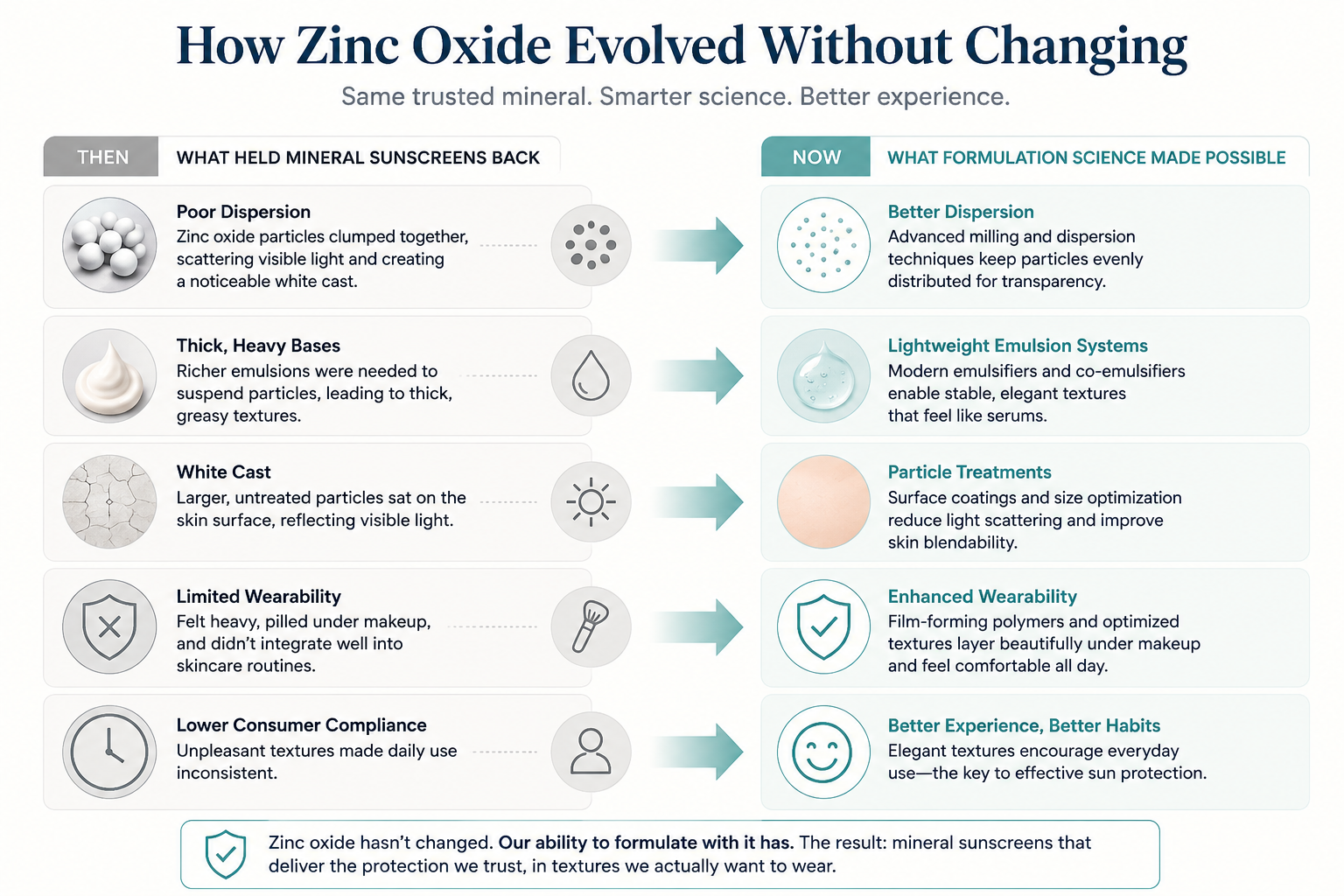
The Real Breakthrough Happened Where Most People Never Look
When people talk about better sunscreens, the conversation almost always circles back to ingredients. A new UV filter gets approved somewhere, a different active starts trending online, or a brand slaps a shiny new ingredient across the front of the bottle.
But honestly, I don’t think that’s where the biggest progress has actually happened.
The more I read into modern formulation science, the more I realized many of the biggest improvements have come from supporting ingredients that almost never get any real attention. They’re not the ones featured in glossy advertisements, yet they’re doing much of the quiet work that makes a sunscreen feel refined rather than clunky.
Take dispersion, for instance. Zinc oxide particles need to be spread evenly throughout a formulation before they ever reach your skin. If they aren’t distributed properly, they clump into tiny clusters, making the product harder to spread and less uniform during application. Modern dispersion technologies are far better at keeping those particles separated, resulting in formulations that feel smoother and more consistent from the first pump to the last.
The same story applies to the emulsion systems holding everything together. Today’s formulators have access to far more sophisticated emulsifiers and stabilizers than they did a few years back, which help maintain a lightweight texture without sacrificing shelf stability.
I was also surprised by how much attention now goes to what happens after the sunscreen has already been applied. It’s not enough for a formula to spread easily on first contact, it also needs to settle into a uniform, comfortable film that stays put all day. That takes careful balancing of polymers, emollients, and film-forming ingredients so it never feels heavy or tacky.
None of these changes would stand out if you only glanced at an ingredient list. Two different zinc oxide sunscreens can share many of the same ingredients on paper while delivering completely different experiences on your skin. The real difference usually comes down to how those ingredients are combined and fine-tuned during formulation, not which ones make the list.
I think that’s what makes the last five years so interesting to look back on. This evolution wasn’t driven by one revolutionary ingredient making headlines. It’s been driven by dozens of smaller, less glamorous improvements that, stacked together, have quietly transformed how zinc oxide sunscreen feels to use every single day.
It Was Never Just About Making Sunscreen Lighter
For a long time, I assumed making a zinc oxide sunscreen feel lighter was simply a matter of reducing thickness. If the formula spread more easily and absorbed a bit faster, surely that meant the problem had basically been solved.
The more I looked into it, the more I realized it really wasn’t that simple.
A lightweight sunscreen still has to do everything a sunscreen is supposed to do. It needs to form an even, protective layer across the skin, stay stable across different temperatures and climates, play nicely with other skincare products, and hold onto its performance for hours of wear. Simply making a formula thinner, without considering all of that, could easily compromise the user experience rather than improve it.
That’s exactly why modern zinc oxide sunscreens are the result of careful balancing rather than aggressive simplification. Formulators aren’t trying to strip out everything that gives a sunscreen its structure. They’re deliberately selecting ingredients that provide stability, spreadability, and comfort all at once. Every adjustment has to support multiple goals instead of just solving one problem in isolation.
I also found it interesting that today’s formulations are expected to hold up in situations that weren’t always front of mind for brands before. They need to layer over hydrating serums without pilling. They should sit under foundation without separating. They should feel comfortable in humid climates while still offering enough moisture in drier ones. A sunscreen is no longer really the final step someone applies in isolation. It’s one piece within a much bigger skincare routine, and it has to behave accordingly.
That reality has changed how formulation teams define success. Instead of only asking whether a sunscreen hits its SPF target on a lab test, they’re increasingly asking whether people will still genuinely enjoy wearing it after weeks, or even months, of daily use. Comfort, compatibility, and consistency have become just as important as raw protection numbers.
Looking at what’s actually available today, I think that’s where the real progress lives. Zinc oxide sunscreens haven’t become more popular because people suddenly changed their minds about mineral UV filters overnight. They’ve become easier to adopt because the formulations have finally been designed around real, messy daily routines instead of ideal laboratory conditions.
The Future of Zinc Oxide Sunscreen Looks Different Too
After spending so much time looking at how much zinc oxide sunscreen has changed over the past few years, I couldn’t help wondering where it goes from here. If the biggest improvements so far have come from better formulation rather than some brand-new active ingredient, it seems fair to guess the next wave of innovation will follow that same path.
I don’t think we’re heading toward a future where sunscreen becomes more complicated to use. If anything, the opposite seems true. Formulators appear increasingly focused on making high-performance products feel simpler, almost invisible, in daily use. The goal isn’t to constantly remind people they’re wearing sunscreen. It’s to make sun protection fit so naturally into a routine that applying SPF becomes almost automatic, like brushing your teeth.
We’re already seeing early signs of that shift. Modern zinc oxide sunscreens are increasingly being developed alongside moisturizers, barrier-supporting ingredients, and cosmetic products, rather than as a completely separate category sitting off on its own. Instead of asking consumers to bolt on another step, brands are designing formulations that work seamlessly alongside the products people already use every morning.
I also suspect we’ll keep seeing improvements most people never notice directly. Better film-forming systems, more sophisticated particle treatments, and quiet advances in formulation technology won’t necessarily show up on the front of the packaging. Yet they’ll keep making these sunscreens easier to spread, more comfortable to wear, and more compatible across skin types and climates.
Maybe that’s the biggest lesson I took away from digging into this topic. We tend to associate innovation with discovering something entirely new and flashy, but that’s rarely what actually happened here. Zinc oxide has been a trusted, well-understood ingredient for decades. The real innovation has come from figuring out how to get the very best out of an ingredient that was already exceptionally good to begin with.
When I pick up a zinc oxide sunscreen today, I don’t just see another SPF product. I see years of quiet formulation science patiently solving problems most consumers never even knew existed. And honestly, that’s exactly why these products feel so different now compared to five years ago.
Final Thoughts
When I first sat down to think through this topic, I assumed the answer would be pretty straightforward. I expected to find that zinc oxide itself had been changed or upgraded somehow, making modern sunscreens lighter and more pleasant almost by default.
That’s not what I found at all.
The biggest transformation has happened in the science surrounding the ingredient, not the ingredient itself. Better formulation strategies, smarter dispersion systems, more sophisticated film-forming technologies, and a much stronger focus on wearability have all come together to create products that feel completely different from the mineral sunscreens a lot of us remember.
I also think this reflects a broader shift across the skincare industry as a whole. Today’s consumers don’t really separate sunscreen from the rest of their routine the way people used to. They expect it to apply as smoothly as their moisturizer, layer comfortably with the rest of their skincare, and feel good enough that using it every day doesn’t require any extra mental effort. Formulators have responded by building products that deliver real protection without asking people to compromise on comfort.
For me, that’s honestly the most interesting part of this whole story.
Five years ago, conversations around zinc oxide sunscreen usually focused on what you had to tolerate in exchange for reliable mineral protection. Today, the conversation has shifted toward what you no longer have to sacrifice at all. You can genuinely have broad-spectrum protection, a lightweight feel, and an enjoyable application experience, all in the very same product.
I don’t think that happened because zinc oxide suddenly turned into a different ingredient overnight. It happened because formulators kept quietly refining everything around it, year after year, until the experience finally caught up to match the performance.
And if the pace of innovation over the last few years is any real indication, today’s zinc oxide sunscreens probably aren’t the finish line either. They’re simply the best version we’ve managed to build so far.
Frequently Asked Questions
Why does zinc oxide sunscreen feel lighter than it used to?
Modern zinc oxide sunscreens feel lighter because formulation science has advanced significantly. Better dispersion technologies, improved emulsion systems, sophisticated film-forming ingredients, and optimized textures have made it possible to create lightweight formulas without compromising UV protection.
Has zinc oxide changed over the last five years?
Not really. Zinc oxide remains the same trusted mineral UV filter. What has changed is how formulators work with it. Advances in formulation techniques and supporting ingredients have improved spreadability, wearability, and the overall user experience.
Why do newer zinc oxide sunscreens blend more easily?
Newer formulations use improved particle dispersion and optimized formulation systems to keep zinc oxide distributed more evenly throughout the product. This helps sunscreens spread more uniformly across the skin and creates a smoother, more comfortable application.
Why are more skincare brands launching zinc oxide sunscreens?
Consumers increasingly expect sunscreen to fit naturally into their daily skincare routine. As formulation technologies have improved, brands have been able to develop zinc oxide sunscreens that offer broad-spectrum protection while delivering lightweight textures, better cosmetic elegance, and compatibility with makeup and other skincare products.
Is zinc oxide sunscreen suitable for everyday use?
Yes. Zinc oxide sunscreen provides broad-spectrum protection against both UVA and UVB rays and is widely used in daily facial sunscreens. Modern formulations are designed to be lightweight, comfortable, and easy to incorporate into an everyday skincare routine.