

Consumers now expect mineral sunscreens to do everything at once: broad-spectrum protection, a lightweight and transparent finish, pleasant aesthetics, and compatibility with the rest of their skincare routine. For a formulation scientist, that combination of expectations is a genuinely difficult brief. Zinc oxide is the obvious active to build around. It is the only single UV filter that delivers inherent broad-spectrum protection across both UVA and UVB wavelengths while remaining exceptionally photostable, and it enjoys wide regulatory acceptance, including FDA GRASE status in the United States.
For a chemist who wants a defensible, low-controversy active, the choice practically makes itself.
The formulation work is another matter. A zinc oxide sunscreen is one of the more technically demanding projects in cosmetic science because particle size, surface treatment, dispersion quality, emulsion architecture, rheology, pH, and processing conditions all interact to determine final SPF, cosmetic elegance, and shelf stability. Change one parameter and the behavior of the whole colloidal system shifts, sometimes by enough to turn a promising formula into a whitening, unstable, or under-performing one.
Zinc Oxide as a UV Filter: Performance Basics
Most sunscreens reach broad-spectrum protection by blending several UV filters, because organic (chemical) filters tend to absorb over fairly narrow ranges. Covering both UVB and UVA usually means stacking ingredients.
Zinc oxide is different. It is the only FDA-approved mineral UV filter that provides continuous protection across nearly the entire ultraviolet spectrum, from roughly 280 nm through 400 nm.
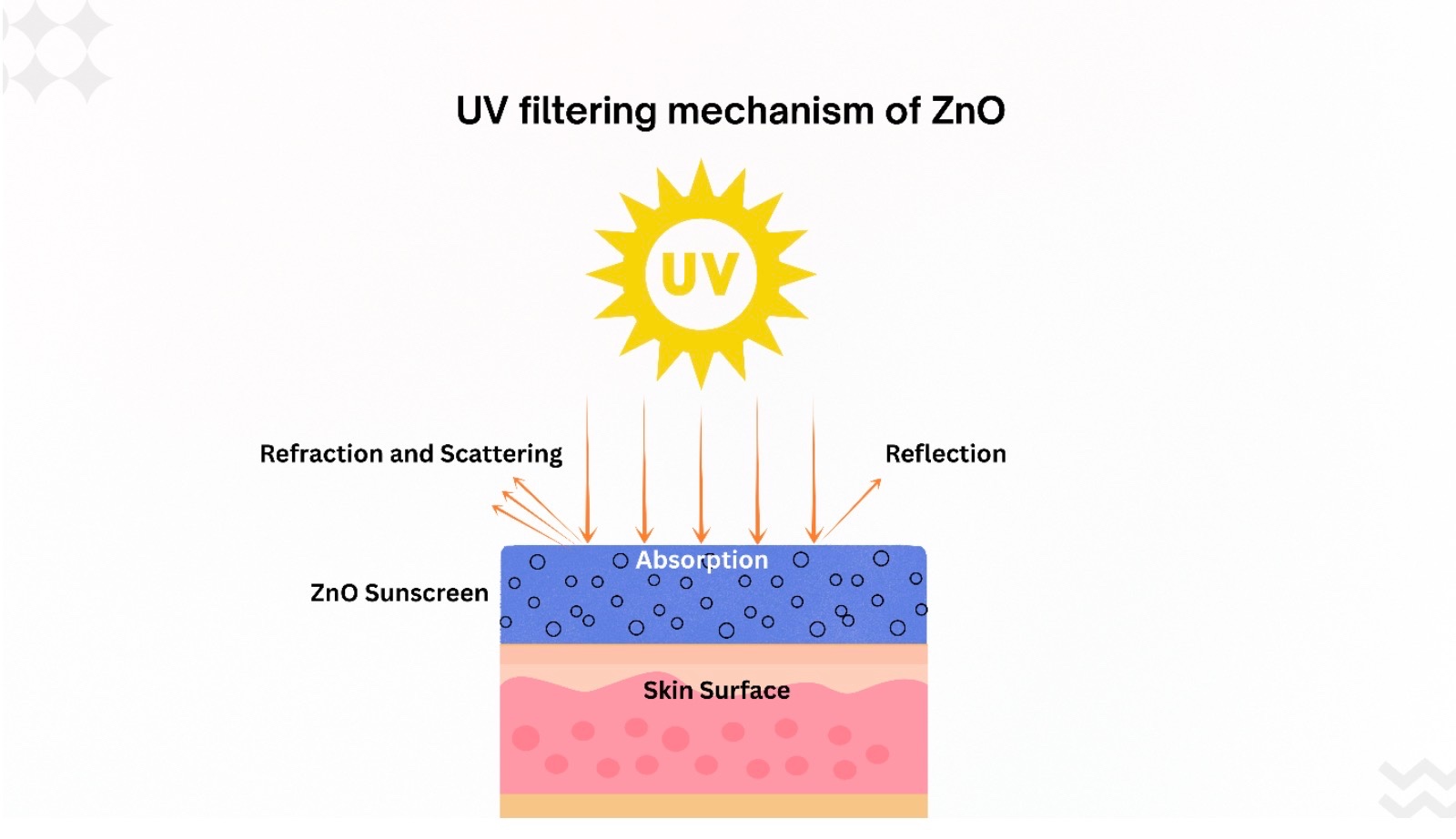
It works through two mechanisms. The first is absorption: the inorganic crystal lattice absorbs UV photons, exciting electrons from the valence band to the conduction band, then dissipates that energy as heat. The second is physical blocking, in which the crystalline particles refract, scatter, and reflect incoming UV radiation away from the skin. Together, these mechanisms give zinc oxide durable, photostable protection without significant molecular degradation.
That said, zinc oxide is less efficient in the UVB range than several organic filters. Reaching SPF 50+ with ZnO as the sole active typically takes 20 to 25 percent loading, and at those levels you inherit a familiar set of problems: high viscosity, poor spreadability, white cast, higher raw material cost, harder dispersion, and a greater risk of particle agglomeration. Much of mineral sunscreen development is really an exercise in squeezing more efficiency out of the zinc you already have. That 20 to 25 percent threshold ends up shaping nearly every downstream decision on texture, cost, and processing.
Where ZnO earns its reputation is the UVA-I region (340 to 400 nm). Titanium dioxide absorbs UVB very efficiently but falls off sharply in UVA-I, which is why zinc oxide remains the premier mineral active for formulas built around UVA claims.
| Parameter | ZnO | TiO2 |
| Primary spectral coverage | UVB, UVA-II, and UVA-I (280–400 nm) | UVB and UVA-II (280–350 nm) |
| UVA-I performance (340–400 nm) | Excellent, continuous protection | Poor; drops off significantly |
| SPF efficiency per % active | Moderate (requires 20–25% for SPF 50+) | High (excellent UVB scattering) |
| FDA maximum permitted limit | 25% | 25% |
Regulatory standing is the other pillar. In the United States, the FDA recognizes zinc oxide as a Category I (GRASE) sunscreen active at concentrations up to 25 percent in over-the-counter products [1], and similar maximums are accepted across many international markets. For companies pursuing globally marketed mineral sunscreens, that consistency is worth a great deal: it lets one core formula travel with relatively little regulatory rework.
Particle Size: The Central Variable in ZnO Formulation
No single variable influences zinc oxide performance more than particle size. It touches SPF efficiency, UVA protection, transparency, whitening, skin feel, dispersion behavior, rheology, regulatory classification, and ultimately whether consumers will actually wear the product. Choose the wrong size class and performance drops even when the zinc concentration stays the same.
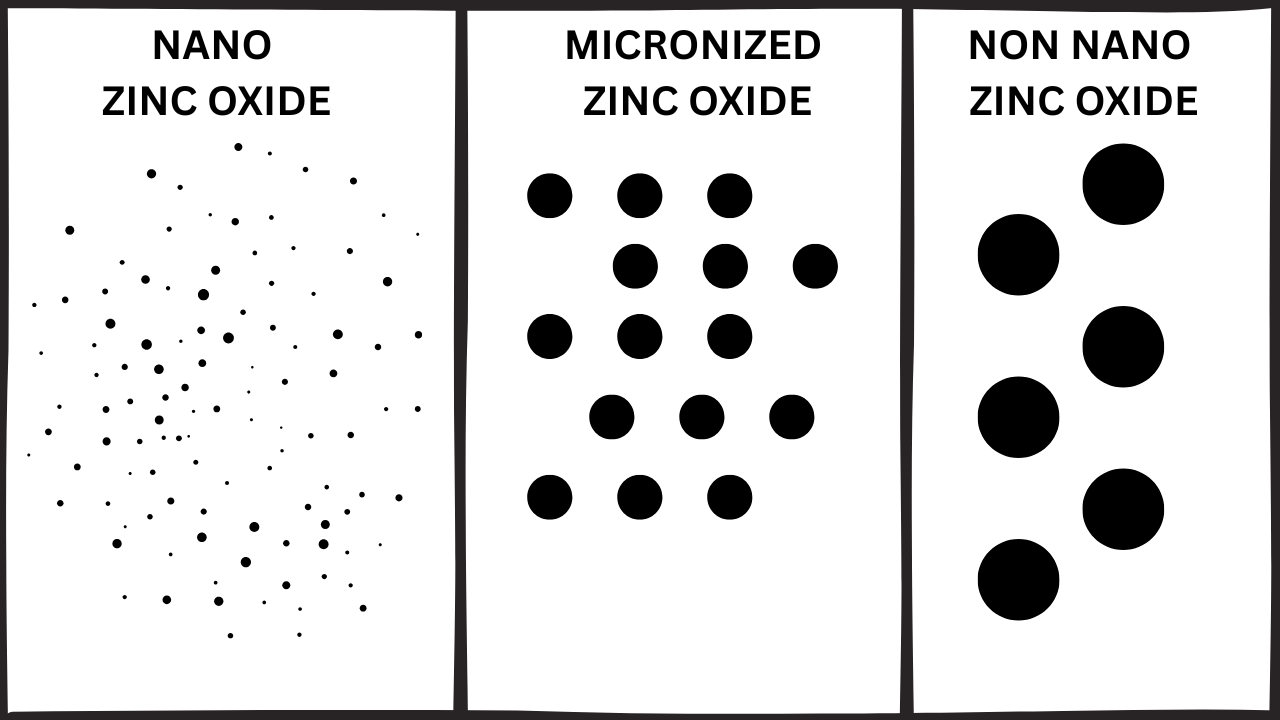
Commercial cosmetic-grade zinc oxide falls into three broad size classes.
Non-nano (conventional) grades, above roughly 100 nm, run whiter and more opaque on skin, with a larger share of their SPF contribution coming from light scattering. They are the default for brands operating under strict clean-beauty standards or retailer guidelines that exclude nanotechnology outright.
Nano grades, below 100 nm, deliver markedly better transparency and generally higher UV absorption per unit mass, along with better spreadability and aesthetics. The trade-off is ongoing regulatory attention around skin penetration, even though current evidence does not support penetration through intact skin.
Micronized grades, typically 200 to 400 nm, sit in between: less whitening than conventional particles, better scattering than nano, good processability, and solid SPF. For many commercial formulations, they are the practical compromise between aesthetics and UV performance.
In practice, the grade decision comes down to a trade-off between transparency and opacity: nano for elegance, non-nano for scattering power and clean-beauty compliance, micronized for a middle ground.
As a rule, smaller particles give more SPF per gram thanks to increased surface area and absorption efficiency, but the relationship is not linear, and particle size never acts alone. Surface treatment chemistry, dispersion quality, oil phase selection, film-forming polymers, emulsion type, and the uniformity of the final film on skin all pull on the number. Two formulas at identical zinc concentrations can test dramatically differently for no reason other than particle engineering and formulation design.
The regulatory picture on particle size is uneven across regions. Australia’s TGA framework does not currently distinguish nano from non-nano zinc oxide within its therapeutic goods requirements; both are acceptable actives. The EU, by contrast, actively monitors nano zinc oxide as a distinct category. The FDA’s proposed monograph currently draws no line by particle size and establishes no separate safety categories, but this deserves close monitoring, because any change in the FDA’s position would ripple straight through product pipelines.
Surface Treatments: Function and Selection
Selecting a zinc oxide grade involves much more than picking a particle size. Surface treatment is the variable formulators most often overlook, and it can matter just as much.

Raw, uncoated zinc oxide is a poor performer. Its high surface energy drives agglomeration; it is amphoteric, and it is photocatalytically active, generating reactive oxygen species (ROS) under UV exposure that degrade co-formulated organic compounds, preservatives, and lipids. Surface treatments exist to mask that surface energy, and a good one buys you dispersion stability, reduced agglomeration, better SPF delivery, tunable hydrophobicity, longer shelf life, and improved spreadability and feel.
The treatment you pick also decides which formula architectures are viable at all.
| Surface treatment | Function | Application |
| Triethoxycaprylylsilane | Produces a hydrophobic surface that disperses easily in silicone and mid-to-low-polarity oil phases. | Highly versatile; widely used in both water-in-oil (W/O) and oil-in-water (O/W) emulsions. |
| Dimethicone / methicone | Creates a smooth, hydrophobic silicone-like coating that improves skin feel and slip. | Best in silicone-rich matrices such as cyclopentasiloxane or dimethicone fluid bases. |
| Silica (SiO₂) coating | Forms a protective barrier that minimizes surface reactions while preserving UV protection. | Well suited to hybrid formulas; better compatibility with antioxidants, less discoloration in storage, improved shelf life. |
| Alumina (Al₂O₃) coating | Reduces photocatalytic activity while improving dispersibility and reducing particle-to-particle attraction. | Improves the hydrophilic/hydrophobic balance and overall dispersibility. |
| Amino acid treatments | Naturally derived surface modification, such as L-lysine, for brands avoiding synthetic treatments entirely. | COSMOS-certified formulations, natural product lines, silicone-free systems, eco-conscious brands. |
If the brief calls for a clean-beauty or silicone-free product, silane- and silicone-based treatments are simply off the table, which narrows the supplier search to natural alternatives. In that case, ask for performance data on those specific grades. Amino-acid and other non-silicone treatments do not always behave like their conventional counterparts in dispersion and stability testing, and it is far cheaper to find that out on the datasheet than in month three of a stability study.
Dispersion Quality: The Most Common Formulation Failure Point
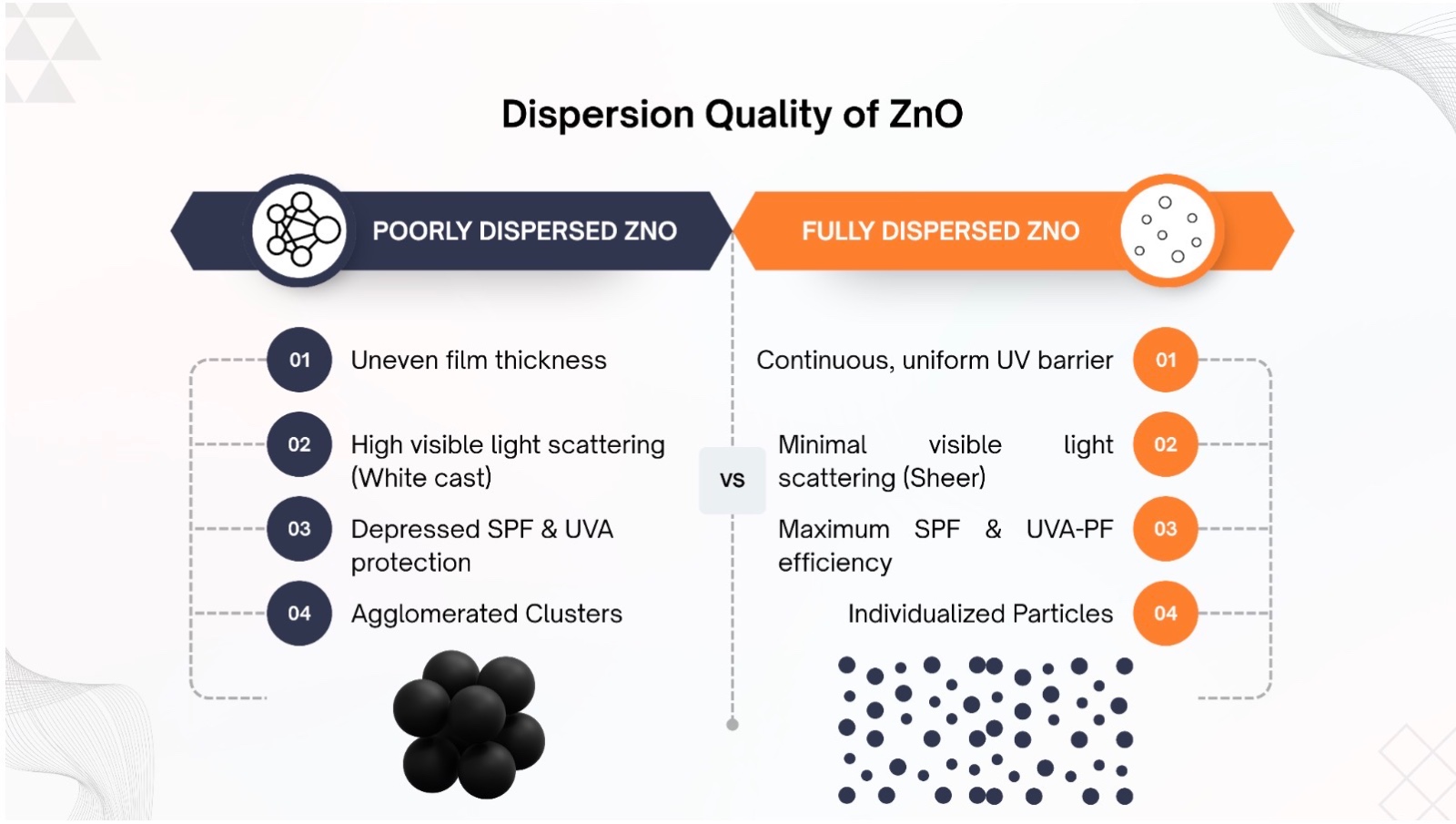
Particle size gets the attention during ingredient selection, but dispersion quality decides more of the finished product. Dispersion quality describes the physical state of the particles in the final formula: the degree to which zinc oxide particles are fully individualized and evenly distributed throughout the product.
Poorly dispersed zinc behaves like much larger particles. Agglomerates scatter light in the visible spectrum, so white cast goes up, and they leave microscopic gaps in the UV film on skin, so effective SPF goes down. Batch-to-batch consistency suffers right along with them. Dispersion, more than particle size, is the variable most likely to sink an otherwise well-designed formula, and the one most often shortchanged during scale-up.
The first practical decision is whether to buy pre-dispersed zinc oxide or disperse in-house. Pre-dispersions typically carry 50 to 70 percent zinc in a carrier such as caprylic/capric triglyceride, C12–15 alkyl benzoate, isododecane, silicone fluids, or water. They shift most of the processing burden onto the raw material supplier and come with consistent de-agglomeration built in, though you still owe them compatibility testing to confirm the carrier liquid and its dispersants align with your target emulsion matrix.
Many large manufacturers prefer to disperse in-house for the formulation flexibility and lower raw material cost. Doing it well requires real equipment: high-shear mixers, rotor-stator homogenizers, three-roll mills, or bead mills. It also requires validation. Measure the particle size distribution of the dispersion by dynamic light scattering (DLS) or laser diffraction, and confirm complete de-agglomeration before committing to large-scale production.
Zinc oxide brings one more complication to the table: it is mildly alkaline. At 15 to 25 percent loading, it typically pushes the finished formula toward pH 7–8, and that shift has consequences. Traditional organic-acid preservatives such as benzoic acid, sorbic acid, and salicylic acid lose effectiveness above pH 6, so preservation has to come from pH-tolerant systems; phenoxyethanol paired with ethylhexylglycerin is a common choice and considerably more forgiving than parabens. Many thickening polymers are also pH-sensitive and can destabilize at elevated pH, which shows up during storage as reduced viscosity, poor suspension stability, phase separation, or texture drift.
High zinc levels can interfere with acidic actives as well: alpha hydroxy acids, beta hydroxy acids, vitamin C derivatives, ferulic acid systems, and peptides. If the product concept pairs mineral filters with any of these, compatibility testing belongs in the stability protocol from day one, alongside a deliberate pH-buffering strategy matched to a preservative system that stays effective across the final 6.5–8 range.
Formulation Architecture: W/O vs. O/W Considerations for ZnO
The emulsion system is one of the most consequential choices in zinc oxide development. It shapes dispersion, SPF performance, water resistance, rheology, manufacturing complexity, and long-term stability. Neither system is inherently superior; they solve different problems.
In a water-in-oil (W/O) emulsion, the oil phase is continuous, so hydrophobically treated zinc oxide stays locked in the outer layer. These systems are inherently water-resistant, lay down a uniform and cohesive film on application, and carry a richer, heavier, more protective feel, which makes them the natural home for sport and water-resistant products.
In an oil-in-water (O/W) emulsion, the water phase is continuous, and the oil-dispersed zinc sits inside the internal droplets. The payoff is a lighter, faster-absorbing, more cosmetically elegant daily-wear sunscreen. The processing demands more care, though. Even with an aqueous continuous phase, the zinc must be thoroughly dispersed in the oil phase before emulsification, and shortcuts at that stage show up later as reduced SPF, increased whitening, sedimentation, and storage instability. How the zinc ends up distributed within the emulsion also affects how the sunscreen forms its protective film during application, and with it both in vitro and in vivo SPF.
| Characteristic | W/O emulsion | O/W emulsion |
| Skin feel | Rich, protective | Light, elegant |
| Water resistance | Excellent | Moderate |
| Manufacturing complexity | Higher | Moderate |
| ZnO compatibility | Excellent | Good (requires careful processing) |
| Consumer preference | Sports, outdoor use | Daily facial use |
| Typical application | SPF 50+, water-resistant products | Daily moisturizers and hybrid sunscreens |
Rheology is its own battle. Above roughly 15 percent zinc oxide, the sheer surface area of suspended mineral thickens the bulk noticeably, and formulas can become difficult both to spread and to fill. Suspending polymers such as carbomers, polyacrylates, and cellulose derivatives help prevent settling without piling on bulk viscosity, and the oil phase composition, the balance of emollients, waxes, and dispersants, does much of the rest.
Because zinc oxide is less efficient per unit concentration than many organic filters, supporting ingredients earn their keep. Butyloctyl salicylate is sometimes described as a UVB booster in mineral-only formulas; to be clear, it is not an approved UV filter active and must never be positioned as one in labeling or claims. What it actually is: a highly effective emollient that improves particle wetting, enhances film formation, and optimizes UV absorption.
Film-forming polymers, such as VP/eicosene copolymer, polyurethane dispersions, and acrylate copolymers, have become similarly important in modern mineral development. They do not absorb UV themselves. Their job is holding the zinc oxide film together on skin after application, which raises both SPF and water resistance. For O/W formulas specifically targeting a water-resistance claim, this is a selection variable that deserves real attention.
Selecting a Zinc Oxide Supplier: What Formulators Should Specify
Supplier selection deserves the same rigor as formulation strategy. Two zinc oxide materials carrying similar INCI names can behave completely differently thanks to differences in manufacturing process, particle engineering, surface treatment, and quality control. Never buy on the trade name alone. Insist that the technical data sheet formally specifies the following:
| Parameter | Why it matters |
| Particle size distribution (D50, D90) | Gives a fuller picture of particle consistency and expected dispersion behavior than a single average. |
| BET surface area | A useful window into particle fineness and expected UV absorption efficiency. |
| Moisturecontent/losss on drying (LOD) | Residual moisture can trigger pre-reaction or degradation of hydrophobic coatings. |
| Heavy metal specifications (lead, arsenic, cadmium) | Verification against USP or equivalent cosmetic limits is standard industry practice. |
| Surface treatment type and percentage | Confirms consistent surface energy properties from lot to lot. |
| Photocatalytic activity data | Demonstrates that the protective coating actually does its job. |
Before stability testing begins, get the regulatory package in hand: a Certificate of Analysis for every production lot, the Safety Data Sheet, a cosmetic-grade specification sheet, USP or equivalent quality documentation, REACH compliance documentation for the European Union, and ARTG ingredient notification documentation for the TGA.
Because small shifts in particle size distribution translate directly into SPF variability, request and test multiple distinct production lots before locking the formula. And look past the datasheet to the supply chain itself. Most cosmetic zinc oxide is processed in China and the United States, so establish lead times, minimum order quantities, and container storage requirements early enough that they never become the bottleneck.
Finally, for brands chasing genuine differentiation, some manufacturers offer custom zinc oxide through toll calcination or proprietary particle engineering. When every competitor is buying the same standard grades, that route can be a meaningful competitive advantage.
Frequently Asked Questions
1. What concentration of zinc oxide is typically required to achieve SPF 50?
Zinc-only sunscreens generally need 20 to 25 percent zinc oxide to reach SPF 50 or higher. The exact figure depends on particle size, dispersion quality, film formers, and the rest of the formulation.
2. Is nano zinc oxide more effective than non-nano zinc oxide?
Nano grades generally offer higher UV absorption efficiency and better transparency because of their smaller particle size. Final SPF, though, depends on the whole system: dispersion quality, surface treatment, and film formation all weigh in.
3. Why are surface-treated zinc oxide grades preferred in cosmetic formulations?
Surface treatments reduce agglomeration, improve dispersion, enhance compatibility with oils and silicones, suppress photocatalytic activity, and improve both stability and sensory performance.
4. Which emulsion system is better for ZnO: W/O or O/W?
Neither wins outright. W/O systems give a richer, more protective feel with excellent water resistance, which suits sport products; O/W systems give the light, fast-absorbing elegance that daily-wear sunscreens need. Match the system to the application and the claims.
5. Does zinc oxide affect the pH of sunscreen formulations?
Yes. Zinc oxide is mildly alkaline and can push the formula toward pH 7–8, which affects preservative efficacy, polymer performance, and compatibility with pH-sensitive ingredients.
6. What supplier specifications matter most when selecting cosmetic-grade zinc oxide?
Particle size distribution, BET surface area, heavy metal limits, surface treatment type and level, photocatalytic activity data, regulatory documentation, and demonstrated batch-to-batch consistency.
7. Why is dispersion quality so critical in zinc oxide sunscreens?
Poor dispersion means agglomeration, and agglomeration means lower SPF, more whitening, uneven film formation, and inconsistent performance from batch to batch. Full de-agglomeration is what lets the zinc actually deliver the protection it is capable of.