
The Science Behind Sunscreen Formulation
If you compare the ingredient lists of two bottles of the same sunscreen released a few years apart, you might notice something surprising. The SPF is still 50. The packaging looks almost identical. The brand is still making the same promises. Yet the formula itself has changed.
This happens more often than most people realise. Many sunscreen companies quietly update products that are already successful. Sometimes the change comes with a “New Formula” label slapped on the front. Other times, most consumers never notice at all. Either way, it raises an obvious question. If the sunscreen already worked, why change it?
Before I looked into this, I assumed reformulation usually meant something was wrong with the original product. Maybe it wasn’t stable enough. Maybe customers complained about the texture. Those situations do happen, but they only explain part of the story.
The real picture is a lot more interesting. A modern sunscreen isn’t just a mix of UV filters and moisturisers thrown together. It’s a carefully balanced formulation where every ingredient affects several others. Change one component, and you might unintentionally change the texture, the stability, how well it spreads, or even how evenly the protective film sits on the skin. What looks like a simple ingredient swap on paper can turn into months of lab work.
The more I looked into how sunscreen companies actually develop these products, the more I realised reformulation is rarely about fixing something broken. More often, it’s about protecting the performance people already expect while quietly adapting to everything changing behind the scenes. New raw materials come onto the market. Manufacturing gets better. Consumer expectations shift. Even if the SPF number never changes, the science inside the bottle keeps evolving.
That changed how I think about sunscreen. I used to picture a formulation as something built once and left alone for years. Now I see it as something constantly being refined, so the product people buy tomorrow performs just as well, or a little better, than the one they trusted yesterday.
So the next time you spot the words “New Formula” on your go to sunscreen, it might not mean the old version was flawed. It might just mean the company hasn’t stopped improving something that already worked.
Changing One Ingredient Can Change the Entire Formula
One of the biggest misconceptions I had going into this was that ingredients could be swapped one at a time without touching anything else. If an emollient became hard to source, surely formulators could just drop in a replacement, right?
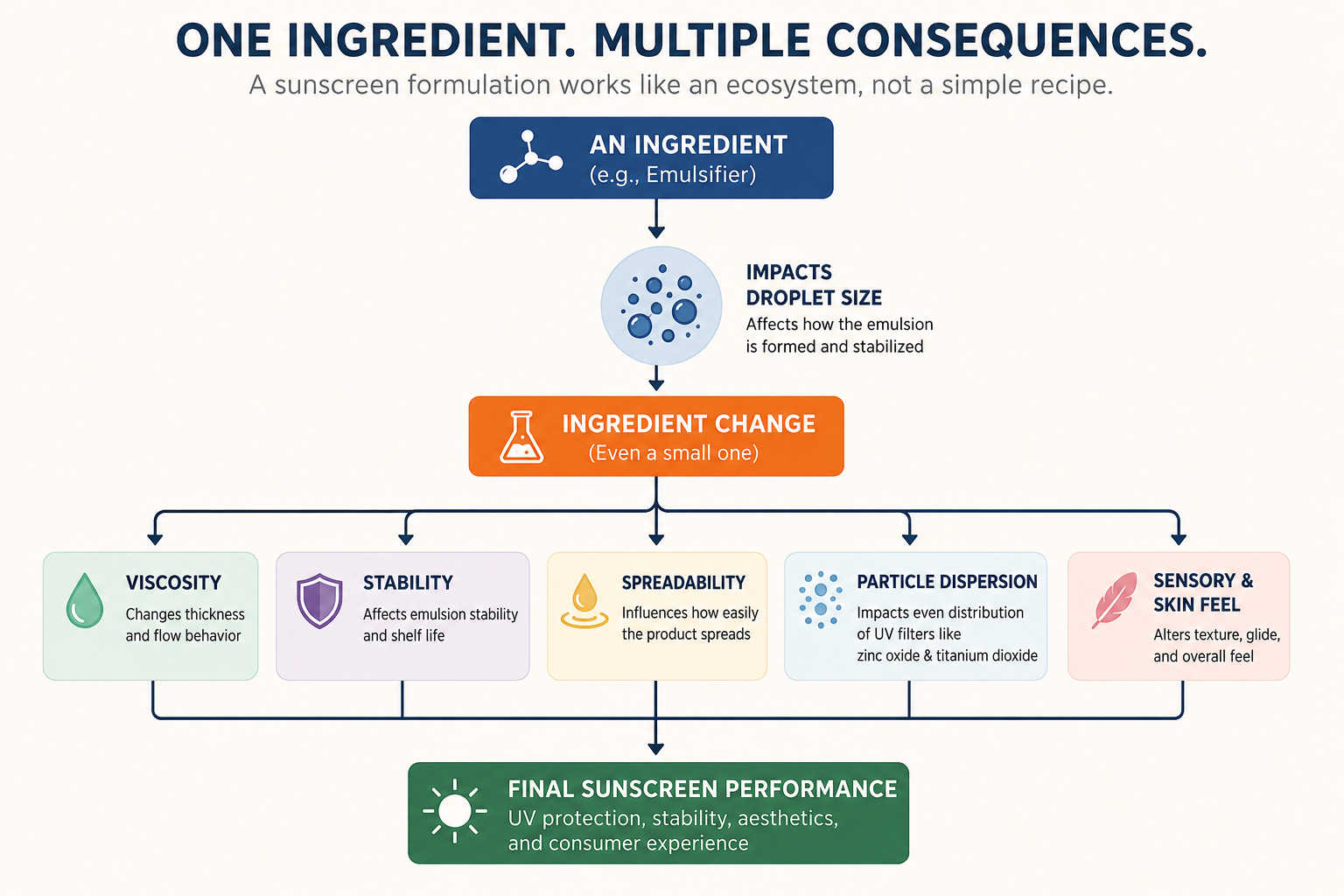
It turns out it rarely works that simply. A sunscreen formulation behaves a lot more like an ecosystem than a recipe. Every ingredient plays a specific role, but it also interacts with several others at the same time. An emulsifier affects droplet size and long term stability. A film former changes how evenly the sunscreen spreads across skin. Rheology modifiers control viscosity, which then changes how easy the product is to apply.
That’s why formulators almost never look at ingredients in isolation. A small adjustment somewhere can create unexpected problems somewhere else. Improve the spreadability and you might lose viscosity. Switch out an emollient and the whole sensory feel might shift. Every decision creates a ripple effect through the rest of the formula, which is also why reformulation usually takes far longer than people expect. The hard part isn’t finding a replacement ingredient, it’s putting the whole formulation back into balance once that change has been made.
What surprised me the most is how invisible a lot of this work is to the average consumer. The ingredient list might look nearly identical, and the SPF claim stays exactly the same, but behind the scenes a formulation team might have spent months fine tuning ratios and processing conditions, all so the sunscreen still feels and performs like the one people already trust.
The more I read about this, the clearer it became that sunscreen companies don’t really think in terms of single ingredients. They think in systems. Their job is to protect the delicate balance that lets the whole formulation perform the same way from the first application to the last.
A Formula That Works in the Lab May Not Work in the Factory
I used to assume that once a sunscreen performed well in the lab, the hard part was done. If the SPF target was met and the product looked stable, surely scaling it up was just a matter of making bigger batches, right? Formulation scientists would probably laugh at that.
Developing a sunscreen in a lab and manufacturing it commercially are two completely different challenges. In a lab, formulators can control small batches down to the gram. Commercial production is a different world. A formula that behaves perfectly in a five kilogram batch can act completely differently when it’s made in the thousands of kilograms, using industrial mixers and continuous production lines.
The reason is actually pretty simple. Properties like emulsion stability, particle dispersion, viscosity, and texture aren’t only shaped by the ingredients themselves. They’re also shaped by how those ingredients are processed. Mixing speed, shear force, how fast something heats or cools, even the order ingredients get added, all of it can change the final structure of the product.
This matters a lot for mineral sunscreens especially. Zinc oxide and titanium dioxide need to be spread evenly through the formula to create a consistent film on the skin. Poor dispersion leads to clumping, uneven texture, and a formula that just feels worse to use. Keeping that same level of dispersion once you move from lab equipment to full scale manufacturing lines is genuinely difficult.
Packaging adds another layer most people never think about. A thicker formula might work fine in a tube but struggle in an airless pump. Sometimes what looks like a simple packaging redesign actually forces part of the formula to be rebuilt from scratch.
The more I dug into this, the more it became clear that manufacturing isn’t really the final step of formulation. In a lot of ways, it’s another stage of it. The goal is to reproduce the exact same quality, stability, look, and feel millions of times over, no matter where or when it’s being made, and that consistency is one of the most overlooked achievements in this industry.
Sometimes the Best Reason to Reformulate Is That Science Moves On
One thing became really clear while I was reading through formulation research. Sunscreen companies aren’t always reacting to a problem. A lot of the time, they’re reacting to progress.
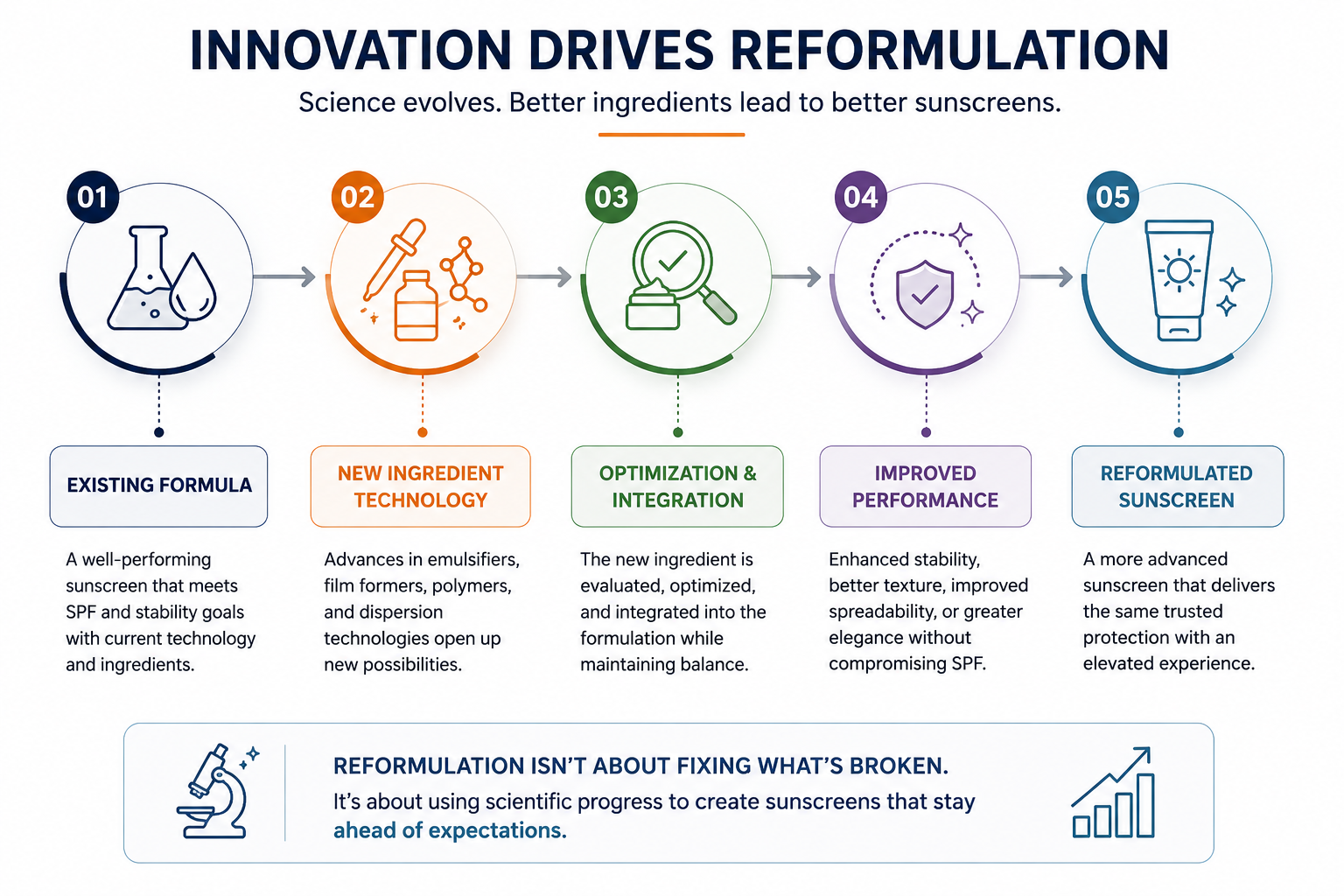
The science behind sunscreen formulation never really sits still. Ingredient manufacturers keep developing new emulsifiers, film forming polymers, and dispersion technologies that solve problems formulators have dealt with for years. Something that didn’t exist five years ago might now offer better stability, a lighter feel on skin, or a much simpler manufacturing process.
That creates a genuine dilemma for formulation teams. Say you already have a sunscreen that works well and has loyal customers. Do you leave it alone, or take advantage of new technology that could make it feel nicer or hold up under more conditions? There’s no universal answer. Every reformulation is a trade off between potential upside and potential risk. People want their favourite sunscreen to feel familiar, but they also want it to keep getting better.
New ingredients don’t just slot in either. Something can perform amazingly in lab testing and still need months of work before it fits an existing formula, playing well with every other ingredient and surviving commercial manufacturing. A lot of the time, the ingredient itself is the easy part. Fitting it into a balanced formula is where the real work happens.
This changed how I think about product updates in general. We tend to assume reformulation means something failed, but a lot of the best reformulations happen because formulators found a better way to hit the same goal. That’s a big part of why the sunscreen industry looks so different today compared to a decade ago, not because of one giant breakthrough, but because of hundreds of small improvements that added up over time.
The Best Reformulations Are the Ones You Never Notice
After spending time on this topic, I’ve realised the most successful reformulations are usually the ones nobody talks about. People keep buying the product and expect the exact same experience they’ve always had. In a lot of ways, that quiet consistency is the real measure of success.
It’s easy to underestimate how hard that is to pull off. Reformulating a sunscreen isn’t about swapping an ingredient and hoping for the best. Every change gets tested against dozens of performance criteria. The product still has to deliver the same UV protection, stay stable on the shelf, and feel the way people expect it to feel. Doing all of that while introducing new ingredients or technology is much harder than it looks from the outside.
What stood out to me is that formulation teams are usually trying to preserve familiarity, not chase novelty. Most people don’t want their favourite sunscreen to feel like a brand new product every few years. They want the version they already trust, just with the reassurance that it reflects current formulation science.
This is probably why reformulation deserves to be seen as part of a product’s natural life cycle, not a red flag. Much like software gets updates for performance and compatibility, sunscreen formulas get refined over time to reflect better raw materials and shifting consumer expectations. The point was never to reinvent the product. It’s to make sure it keeps meeting the standard people expect.
Final Thoughts
When I first started looking into this, I figured reformulation was something sunscreen companies only did when a product wasn’t performing well. The deeper I went, the more that assumption fell apart.
A successful sunscreen isn’t just a collection of ingredients mixed once and left alone forever. It’s the result of countless decisions around chemistry, processing, manufacturing, stability, and what consumers expect. As all of those things shift, the formulation usually has to shift with them, and that doesn’t mean the original product was flawed. Most of the time, it means the company is working to make sure the sunscreen keeps delivering the same protection, even as everything around it changes.
So the next time I spot “New Formula” on a sunscreen I’ve used for years, I won’t assume the company messed something up. I’ll see it as proof of a team quietly keeping pace with science, technology, and manufacturing.
Maybe that’s the real story behind sunscreen reformulation. The products people trust most aren’t successful because they never change. They’re successful because the people behind sunscreen formulation know exactly when they should.
Frequently Asked Questions (FAQs)
Why do sunscreen companies reformulate products?
Sunscreen companies reformulate products for many reasons beyond fixing problems. Changes in raw materials, advances in ingredient technology, manufacturing improvements, consumer preferences, sustainability goals, and formulation innovations can all make it worthwhile to update an existing product while maintaining the same level of protection.
Does a new sunscreen formula mean the old one was bad?
Not necessarily. In many cases, reformulation is part of normal product development. Companies often update formulations to improve stability, texture, manufacturing efficiency, or compatibility with newer ingredients without changing the product’s core performance.
Can changing one ingredient affect the whole sunscreen?
Yes. A sunscreen formulation is an interconnected system where ingredients influence one another. Replacing a single emulsifier, emollient, or polymer can affect stability, viscosity, spreadability, sensory feel, and even manufacturing behaviour, which is why reformulation often requires extensive optimisation.
Why don’t sunscreen companies keep the same formula forever?
Scientific understanding, ingredient technologies, manufacturing capabilities, and consumer expectations continue to evolve. Updating a formulation helps companies maintain product quality and deliver the performance consumers expect while incorporating newer technologies and improved formulation strategies.
Why do reformulated sunscreens often feel different?
Even small formulation changes can influence texture, spreadability, absorption, or finish on the skin. While companies usually aim to preserve the overall user experience, improvements in formulation technology or ingredient selection can make a sunscreen feel lighter, smoother, or more cosmetically elegant without changing its SPF rating.