A sunscreen formula can be developed under controlled conditions, pass stability testing, reach its target SPF and deliver the intended sensory profile. Then it leaves the lab.
One batch might spend a humid summer in Mumbai. Another could sit in dry, air-conditioned air before being carried into intense heat, applied at sea level, taken into the mountains, moved through a hot distribution network, or shifted between a bathroom, a car and a beach bag.
The sunscreen formula hasn’t changed. The environment around it has.
Geography can change UV exposure, temperature, humidity, perspiration and water exposure, while the formulation is still expected to stay stable, spread consistently and build an effective protective film.
This doesn’t mean an SPF 50 becomes SPF 30 across a border. SPF is set under standardized conditions, and geography doesn’t rewrite the label. The real question is whether a sunscreen system holds its character when conditions change. For mineral sunscreens especially, that leads beyond the UV filter itself.
A Sunscreen Formula Doesn’t Experience Climate as One Variable
“Hot climate” sounds like one condition, but it isn’t. Temperature affects viscosity and emulsion behavior. Humidity changes evaporation and wear on skin. Perspiration introduces water and salts beneath the film, UV exposure shifts with latitude and altitude, and swimming can disturb a film that has already formed.
A sunscreen formula encounters several stresses at once, each acting on a different part of the system. Performance depends on more than the UV filters listed: they must stay incorporated, distribute during application, and form a uniform film across irregular skin.
For zinc oxide formulations, the mineral exists as dispersed solid particles, so particle distribution and the structure maintaining it are integral to the formulation. The challenge isn’t keeping zinc oxide in the bottle but distributing it effectively on skin. Geography is less about where a sunscreen is sold and more about what stresses it was designed to tolerate.
Heat Doesn’t Just Make Sunscreen Feel Heavier
Sensory change is usually noticed first as temperature rises, but for a formulator, viscosity isn’t just a sensory measurement. Rheology governs how a product leaves its package, spreads and forms a film, and in mineral systems, it also keeps particles suspended.
This creates a balancing act: enough structure for stability, but still spreadable into an even layer. Temperature compounds this, which is why accelerated stability studies expose emulsions to elevated heat rather than comfortable lab conditions alone.
Heat doesn’t automatically destabilize a properly developed sunscreen formula tested against defined storage conditions. What it reveals is how interconnected the system is: rheology, dispersion, emulsion stability and application behavior can’t be treated separately.
With Zinc Oxide, Distribution Matters Twice
Zinc oxide distribution matters at two stages: particles must be distributed effectively through the formulation, since poor dispersion risks agglomeration and compromises UV performance, and the finished product must then distribute evenly across skin.
These are related but distinct problems. A well-prepared dispersion doesn’t guarantee a uniform film after application; the complete formula still determines spreading across skin. Heat, perspiration, water and movement act on the film as a whole, not on an isolated particle.
A mineral sunscreen formula must keep its filter stable in the container and build a film where it stays evenly distributed in use. Dispersion gets zinc oxide into the right place inside the formula; film formation gets the formula into the right place on skin. Both matter.
Sweat Attacks the Film From the Wrong Direction
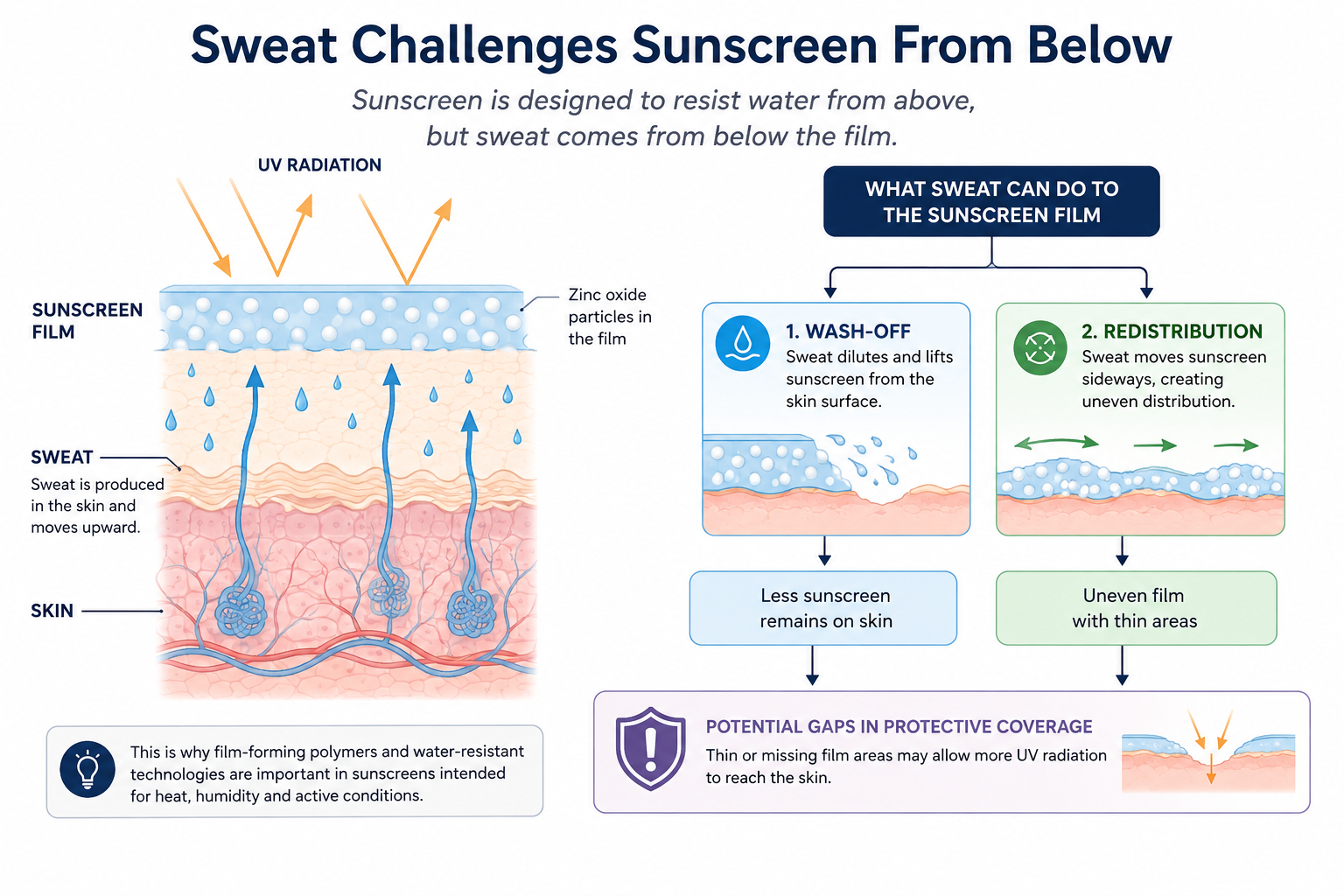
Water resistance is often imagined as sunscreen versus water from above. Perspiration is more complicated: sweat originates underneath the film and moves through or around a layer already set, causing both wash-off and redistribution, so protection can be compromised even when the film hasn’t visibly disappeared.
Redistribution creates uneven regions, which matters most for particulate filters like zinc oxide. Film-forming polymers improve substantivity and water resistance, but more isn’t automatically better: changing the film former can also alter rheology and spreading.
A sunscreen formula built for hot, humid use isn’t a standard formula with water resistance added on. The formulator must balance film integrity against spreadability and the UV-filter system, which is where the geography problem becomes a formulation problem.
Humidity Creates a Different Formulation Challenge
Temperature and humidity usually arrive together but pose different problems. A sunscreen formula can stay physically stable in its package while feeling very different on warm, humid skin. Stability testing confirms specifications hold, but doesn’t predict comfort when evaporation slows and perspiration rises.
This pulls sensory design into technical territory: emollients, rheology modifiers, powders, emulsifiers and film formers shape slip, tack, drying and after-feel, without compromising dispersion or emulsion structure.
For high-protection mineral sunscreens, reducing perceived heaviness isn’t just about lowering viscosity. A thinner formula still needs stable zinc oxide dispersion and a well-distributed film. The goal isn’t the lightest sunscreen formula, but one whose structure suits its intended conditions of use.
The UV Challenge Changes With Location Too
The radiation a sunscreen protects against isn’t geographically constant. Solar UV exposure varies with latitude, altitude, solar elevation, cloud cover, ozone and surface reflection. Higher elevations mean less atmosphere to attenuate UV, and snow reflects a substantial amount back toward exposed skin.
This doesn’t call for different SPF scales by altitude, but conditions of use still matter. A daily facial sunscreen and one built for extended outdoor activity may share a labelled SPF while facing very different demands around substantivity and reapplication. SPF measures erythema-producing radiation under standardized conditions, while a finished product also has to deliver broad-spectrum protection and hold its film through real use. Geography changes the exposure challenge; formulation determines how the product meets it.
The Geography Problem Can Start Before Application
A sunscreen formula must also survive the supply chain: manufactured in one location, transported through another, stored somewhere with a different climate, encountering elevated and fluctuating temperatures before reaching a consumer.
This is why stability programs deliberately challenge formulations rather than simply storing them at room temperature, evaluating appearance, pH, viscosity and particle characteristics after controlled stress. For emulsions, this reveals changes in the oil-water structure; for mineral sunscreens, sedimentation or agglomeration in the dispersed phase.
Hybrid systems add complexity: a formula combining zinc oxide with an oil-soluble filter such as BEMT must keep a dispersed particulate system stable while keeping the dissolved filter solubilized, since temperature affects each component differently within the same sunscreen formula. This doesn’t mean every hot-climate journey damages a product; commercial formulas are developed against defined stability requirements. It shows why geography matters before the product meets UV radiation.
One SPF Number Can Hide a Lot of Formulation Engineering
By the time SPF 30 or 50 appears on a package, the complexity behind it is invisible: the dispersion work on the mineral filter, the emulsifier system, the rheology modifiers, the film formers, and the iterations needed to make them work.
SPF isn’t simply the sum of UV filters present; the vehicle surrounding them matters because sunscreen must become a film before it can protect. Film uniformity is critical: thinner regions or microscopic gaps can transmit disproportionately more UV, so a formulation that distributes more consistently can outperform one with a less uniform film, even with similar UV-filter systems. This makes the sunscreen formula itself part of the protection technology.
Maybe There Is No Universal “Perfect” Sunscreen Texture
Sunscreen innovation is often framed as a march toward thinner, lighter, more invisible products, but geography complicates the idea that one texture is universally superior. A fluid sunscreen can feel great in heat, but fluidity alone says nothing about dispersion stability, film uniformity or water resistance. A richer formula may suit a different product brief entirely.
The more useful target is appropriate aesthetics: encouraging adequate application while maintaining the physical characteristics the product needs, balancing emolliency, dry-down, substantivity, viscosity and film formation differently for different products. A sunscreen formula doesn’t need to know if it’s headed to Mumbai, Miami or the mountains, but the formulator developing it probably should.
The Same Sunscreen Film Has to Survive Very Different Days
A sunscreen film doesn’t stay untouched after application. It faces perspiration, sebum, water, movement and contact with clothing, with intensity depending on how and where it’s used. Initial film formation and film durability are separate challenges: a formula may spread beautifully at first, but once parts of the film move or wash away, UV filters may no longer sit where they should.
Water-resistant formulations depend on more than resisting dissolution: film-forming systems, emulsion structure and skin affinity affect how much of the layer remains. For mineral sunscreen formulators, film integrity is central, since zinc oxide particles don’t perform independently of the layer carrying them, so film behavior during wear deserves as much attention as initial dispersion.
A Formulator Is Really Designing for a Use Environment
“Develop an SPF 50 mineral sunscreen” sounds specific but leaves plenty unanswered: everyday facial use or prolonged outdoor exposure? Water resistance needed? Fluid, lotion or cream? Worn under makeup? Constant heat and perspiration, or occasional?
These answers shape the sunscreen formula throughout, including the rheological system, film-former selection, and the dispersion approach for a target zinc oxide loading, while maintaining acceptable aesthetics. Hybrid sunscreens with an oil-soluble filter such as BEMT add solubility requirements alongside zinc oxide’s dispersion needs. “Where will this sunscreen be used?” is a genuinely technical question.
Climate Doesn’t Act on One Ingredient at a Time
It’s easy to isolate ingredients, asking whether zinc oxide is photostable or whether a polymer improves water resistance, but a finished sunscreen experiences heat, humidity and wear as one complete system. Change temperature and rheology shifts; change the film former for substantivity and application drag may rise; adjust the oil phase for feel and the dispersed mineral phase may need rebalancing elsewhere.
Environmental robustness rarely comes from one “climate-proof” ingredient. It comes from balancing the whole system. For zinc oxide sunscreens, dispersion technology sits at the centre: particle wetting, surface treatment, carrier selection and continuous-phase rheology shape how manageable the mineral filter is, and its behavior connects to everything around it. The formula is the system; geography just changes the conditions imposed on it.
Should Sunscreens Be Formulated Differently for Different Climates?
There’s no simple yes or no. Fundamental requirements don’t change: a sunscreen must deliver its claimed protection, remain stable through its shelf life, meet regulatory requirements, and not depend on ideal weather.
What can change is the brief. A formula for frequent heat, humidity and perspiration may emphasize dry-down and sweat or water resistance more heavily; a daily facial product elsewhere might prioritize a different balance of emolliency and skin feel. This doesn’t mean geography dictates the UV-filter system, or that a formula built for one market performs poorly elsewhere. Climate is one practical input into what the finished product should feel like and tolerate. Formulators aren’t designing sunscreen for a map; they’re designing for conditions of use.
Geography Is Really a Stress Test
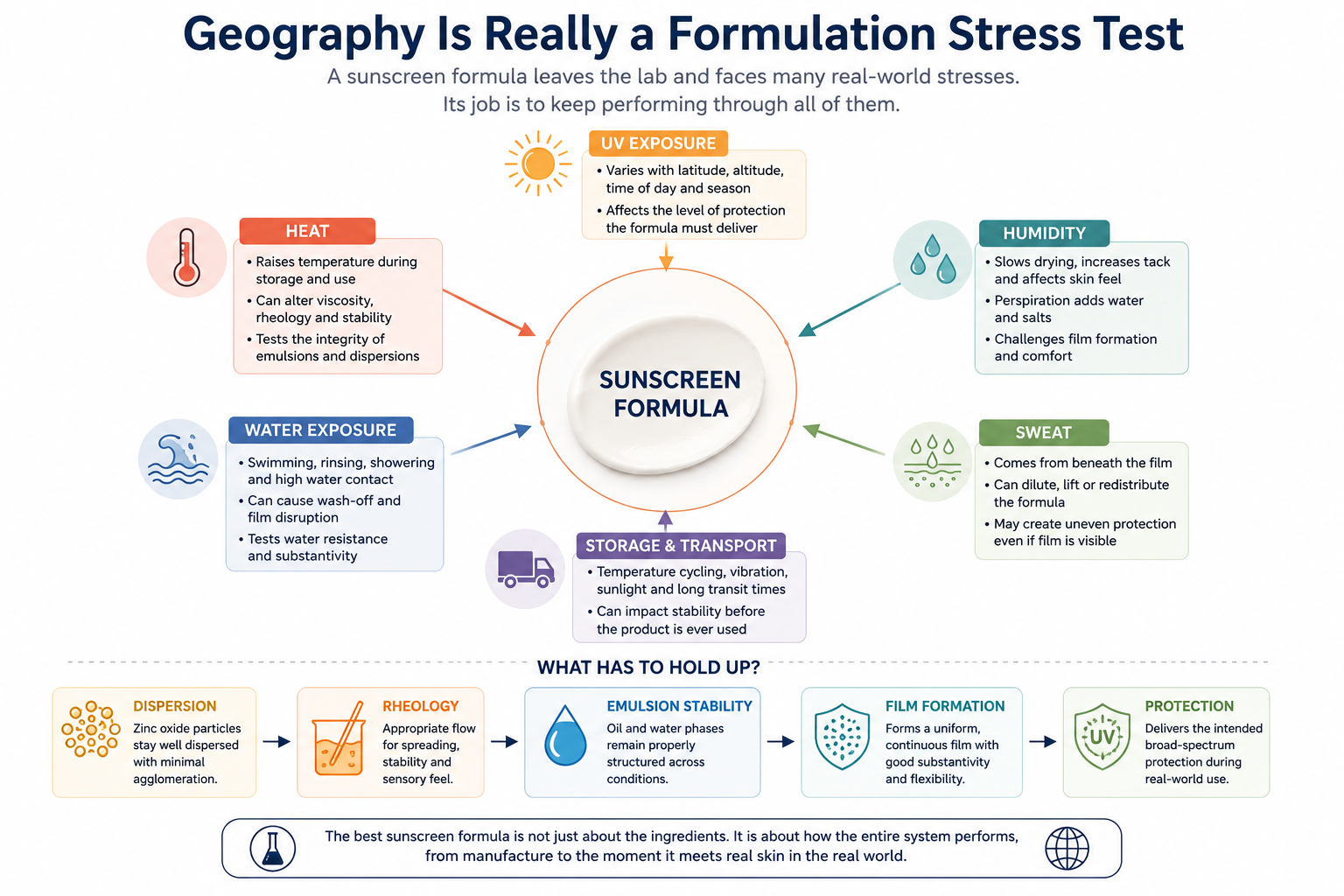
Put the same sunscreen formula into different environments and different questions emerge: can the emulsion tolerate storage conditions? Does rheology stay appropriate? Does it spread into a consistent film? How does that film behave once perspiration begins beneath it, or after water exposure or physical disruption?
None of this is answered by SPF numbers or UV-filter percentages alone. It requires viewing sunscreen as a physical system, especially for mineral formulations, where zinc oxide must be incorporated as a well-managed dispersed phase within a larger architecture of rheology, emulsification, film formation and sensory design. A sunscreen that performs well isn’t just a list of effective ingredients; it’s a system that stays functional from manufacturing through application and wear. Geography doesn’t create that challenge; it simply makes it harder to ignore.
Final Thoughts
A sunscreen formula can carry one ingredient list, one SPF claim and one appearance on the shelf while encountering remarkably different environments. Heat challenges physical properties; humidity and perspiration change conditions around the film; water and movement disrupt its distribution; altitude and latitude shift the UV environment it must guard against; and transportation and storage stress the product before application even begins.
The answer isn’t a different sunscreen for every point on the map. It’s understanding which conditions matter for the intended product and designing accordingly. Zinc oxide dispersion, rheology, emulsion stability, film formation, substantivity and sensory properties all contribute to how a mineral sunscreen formula behaves as a complete system.
So maybe a sunscreen formula doesn’t literally have a geography problem. It has an environment problem, and geography is simply where all of those formulation variables meet the real world.
___________________________________________________________________________________________________________
Frequently Asked Questions
Does climate change the SPF of a sunscreen?
Climate does not directly change the labelled SPF of a sunscreen, which is established under standardized testing conditions. However, environmental factors such as heat, perspiration, water exposure and physical movement can affect the sunscreen film during real-world use. This is why film integrity, water resistance and appropriate application remain important.
Why does temperature matter in a sunscreen formula?
Temperature can influence physical properties such as viscosity, rheological behavior and emulsion stability. In mineral sunscreens, the formulation must also maintain a well-managed dispersion of zinc oxide particles. Formulators therefore evaluate sunscreen stability under controlled temperature conditions to understand how the complete system behaves over time.
How does humidity affect sunscreen formulation?
Humidity can influence the conditions in which sunscreen dries and is worn, particularly when high humidity is accompanied by increased perspiration. Formulators need to balance sensory properties such as tack, dry-down and spreadability with technical requirements including stability, film formation and water resistance.
Why is zinc oxide dispersion important in different environmental conditions?
Zinc oxide is a particulate mineral UV filter, so it needs to be effectively dispersed throughout the formulation. Good dispersion helps control particle distribution, stability and the behavior of the mineral phase. Once applied, the complete sunscreen formula must then distribute those particles within a sufficiently uniform film across the skin.
Can sweat reduce sunscreen protection even if the sunscreen is still visible?
Potentially, yes. Perspiration can contribute to both wash-off and redistribution of a sunscreen film. This means sunscreen does not necessarily need to disappear completely for the uniformity of the protective layer to be affected, which is one reason film-forming and water-resistant technologies are important in products intended for demanding conditions.
Should sunscreens be formulated differently for different climates?
Not necessarily as completely different products, but the intended conditions of use can influence the formulation brief. Products designed for frequent heat, humidity, perspiration or water exposure may prioritize different balances of rheology, substantivity, sensory properties and film formation than products developed around other use conditions.