
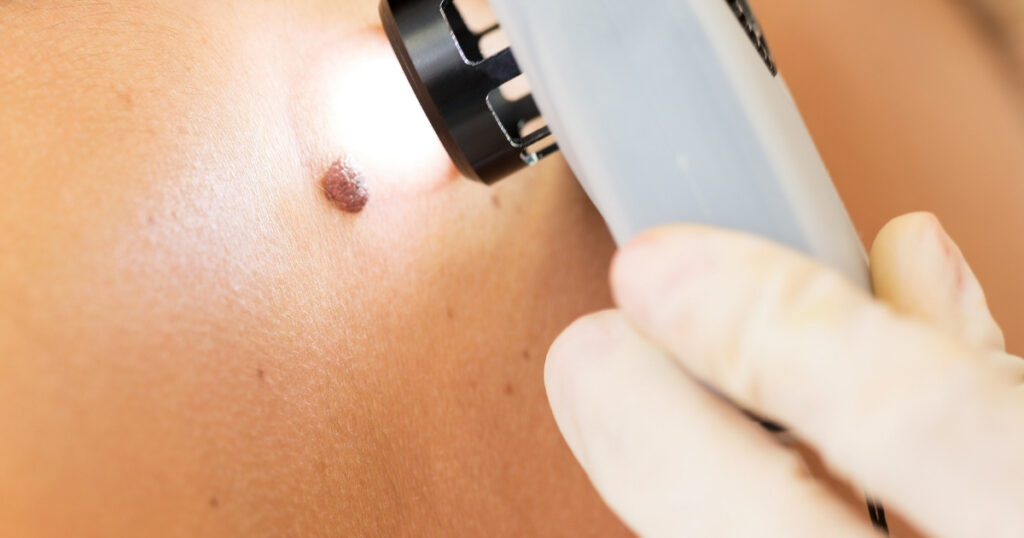
Melanoma research just hit a genuinely remarkable milestone.
In August 2026, Moderna and Merck announced positive Phase 3 results for an experimental, individualized mRNA therapy called intismeran autogene, given alongside pembrolizumab. In patients whose high-risk melanoma had already been surgically removed, the combination improved recurrence-free survival and distant metastasis-free survival compared with pembrolizumab alone.
Calling it a “melanoma vaccine” makes for an easy headline, but the science is more interesting than that label suggests. This isn’t a vaccine meant to stop healthy people from ever developing melanoma. It’s an individualized cancer therapy, built from the unique mutations inside a patient’s own tumor, designed to train the immune system to recognize and attack cancer cells carrying those mutations.
Full Phase 3 data haven’t been presented yet, so there’s still a lot to learn. But it’s the first positive Phase 3 readout for an individualized neoantigen therapy, and for an mRNA-based cancer treatment.
It raises a question for those of us who work much earlier in the sun-damage story. If medicine is now sophisticated enough to build a therapy around the exact mutations inside a melanoma, what do we know about preventing the damage that leads to those mutations in the first place?
Melanoma Begins Long Before Treatment Ever Starts
The link between ultraviolet radiation and melanoma is well established. In 2025, researchers from the International Agency for Research on Cancer estimated that 83% of new cutaneous melanoma cases worldwide in 2022 were attributable to UV exposure, roughly 267,000 of an estimated 332,000 cases.
That doesn’t mean every melanoma comes from sunlight. Genetics play a role, subtypes carry different risk profiles, and some forms aren’t strongly tied to UV. But for cutaneous melanoma globally, UV remains one of the most important preventable risk factors we know of.
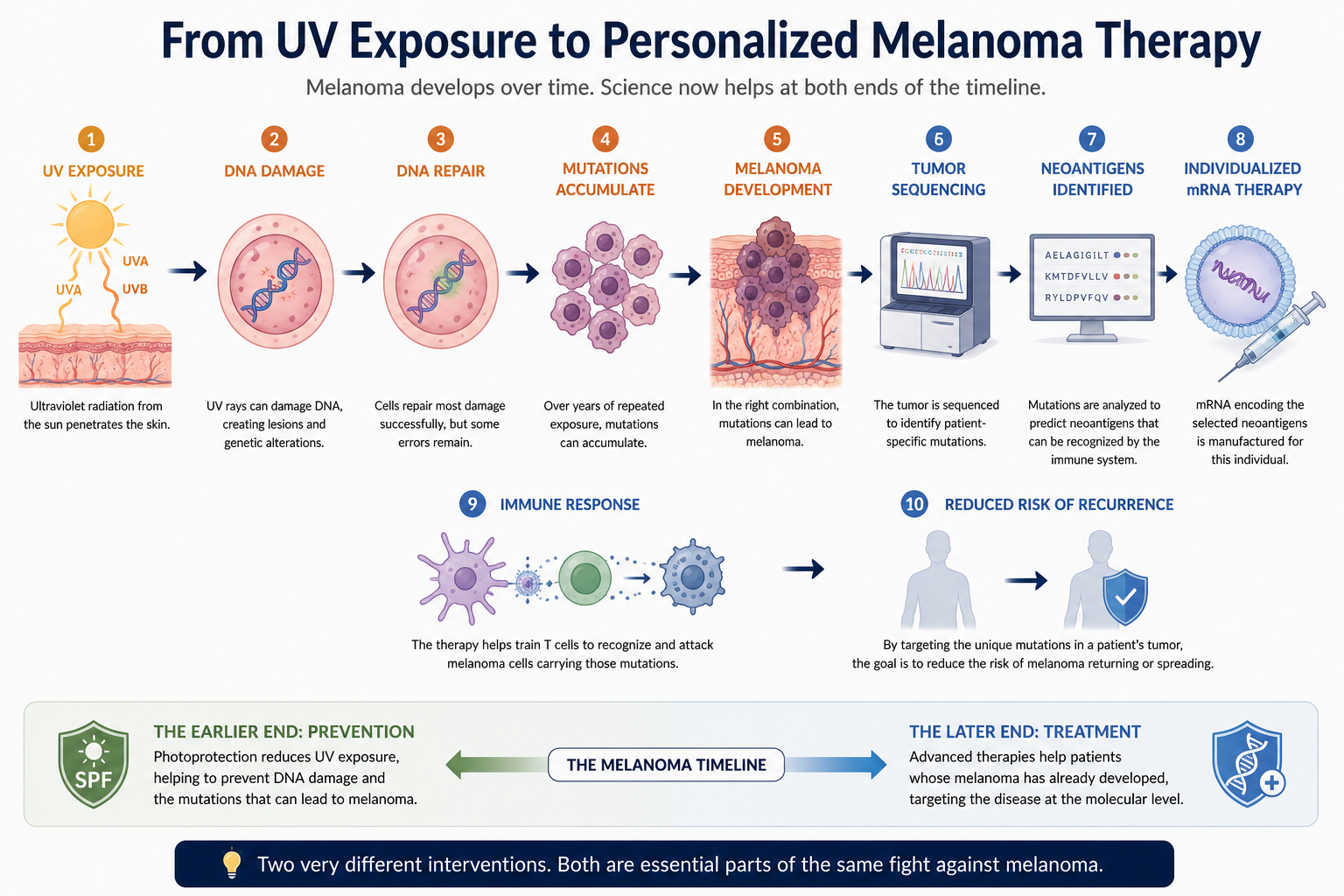
The biology is simple to sketch: UV reaches skin cells and damages DNA, and repair systems usually fix it well. But repair isn’t perfect. Damage that slips through can turn into mutation, and over years, mutations accumulate. In the wrong combination, they can help drive melanoma.
That’s a striking contrast with the Moderna story. At one end, scientists sequence the mutations already inside someone’s melanoma to build a therapy just for them. At the other end is something far less futuristic: reducing unnecessary UV exposure before that damage happens at all.
Sunscreen Sits at a Very Different Point in the Story
It’s tempting to frame this as a tidy “prevention beats treatment” argument, but that isn’t quite fair to the science. Intismeran is an adjuvant treatment for people who already have high-risk melanoma and have already had surgery. Sunscreen belongs to a broader photoprotection strategy meant to cut UV exposure long before any of that happens. They sit at completely different stages of the same disease.
The evidence on sunscreen and melanoma risk isn’t as clean as “wear sunscreen, prevent melanoma,” either. A 2025 review found real limitations across studies, even though higher-quality evidence does support a protective role. A separate 2025 meta-analysis found no statistically significant link comparing broad groups of “ever” versus “never” sunscreen users, which says a lot about how hard real-world sunscreen behavior is to study.
Application amount, coverage, and reapplication all matter. Someone who applies sunscreen and then spends hours longer in intense sun isn’t in the same position as someone using it as part of a broader routine. Sunscreen isn’t a license for unlimited UV exposure. It’s one tool for cutting it down, which raises a more interesting formulation question: what exactly are we asking a sunscreen to protect against?
UVA and UVB Don’t Damage Skin the Same Way
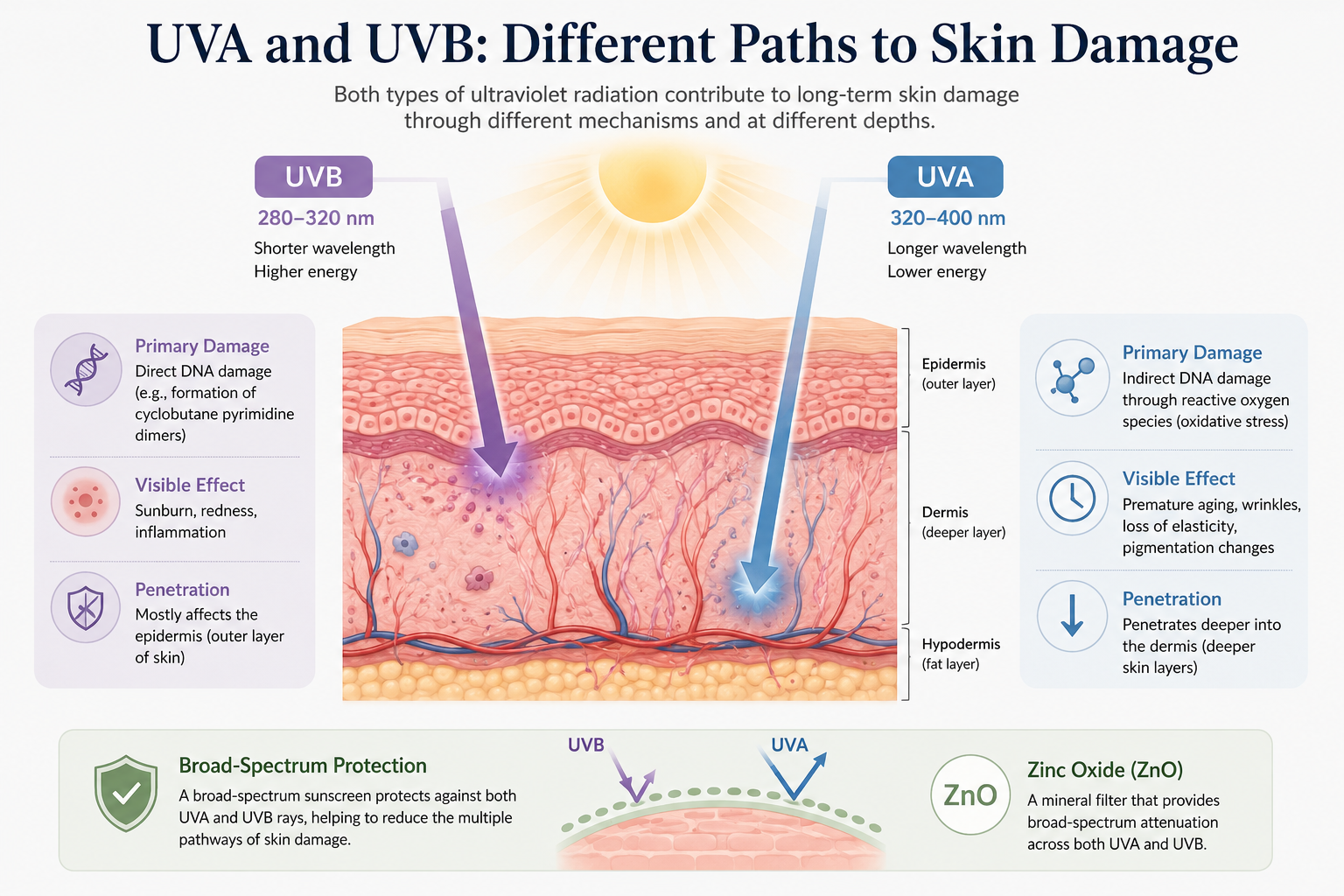
UVB carries higher energy at shorter wavelengths and is strongly linked to direct DNA damage. UVA penetrates deeper and contributes through oxidative processes, though the old “UVB burns, UVA ages” shorthand oversimplifies things, since the effects overlap quite a bit.
Both matter for long-term photodamage, which is why good formulation was never just about chasing a high SPF number. SPF is weighted heavily toward erythema protection, mostly a UVB effect. Broad-spectrum protection asks a bigger question: how well does a product protect across both UVA and UVB?
Zinc oxide is especially valuable for mineral formulators because it attenuates across both regions. But an effective filter is only step one. Particle characteristics, dispersion, concentration, and the film it forms on skin all shape real-world performance, which brings the melanoma conversation surprisingly close to formulation science.
The Sunscreen Film Is Where Protection Becomes Real
A sunscreen can have an excellent filter system and still depend heavily on what happens after it leaves the bottle. Once applied, the formula has to spread across an uneven surface and build a continuous film. Skin has pores, fine lines, and texture variations, and sunscreen behaves differently depending on its rheology. Thin spots matter because UV transmission doesn’t drop evenly as film thickness decreases, so small gaps in coverage can have an outsized effect.
This shows up especially with particulate filters like zinc oxide. The formulator has to achieve an effective dispersion before application, and the formula then has to distribute those particles evenly across skin. Broad-spectrum protection isn’t just a property of an ingredient; it’s something the whole formulation has to deliver on real skin.
That might sound removed from melanoma biology, but the connection is direct. If photoprotection is supposed to reduce damaging UV reaching skin, uniformity and film formation aren’t cosmetic details. They’re part of how the system performs.
The SPF Number Doesn’t Tell the Whole Story
SPF mainly reflects protection against UV-induced erythema under standardized conditions. It doesn’t capture UVA protection, how evenly someone applied the product, or what the film looked like hours later.
That’s why broad-spectrum performance matters just as much as the SPF figure, especially once we move past redness and toward cumulative damage. UVA and UVB contribute through overlapping but different mechanisms, so looking only at sunburn gives an incomplete picture. For formulators, the real challenge isn’t chasing the biggest SPF number. It’s building a system that delivers real spectral protection while staying stable and forming an effective film during actual use.
Zinc Oxide Has to Do More Than Just Be Present
Calling zinc oxide a broad-spectrum mineral filter is accurate, but it skips over the formulation work needed to turn that property into a finished product. Those particles need to be wetted and dispersed effectively, and their tendency to clump has to be kept in check. A poorly managed dispersion can create problems that adding more zinc oxide won’t fix.
Then there’s application. A well-dispersed concentrate is only the starting line; the final formula still has to spread and build a film where the filter is properly distributed. Dispersion science and film science are two halves of the same protection story, part of why melanoma and sun protection shouldn’t stop at “wear SPF.” The science reaches all the way into how the sunscreen is engineered.
Protection Also Has to Survive Real Life
Standardized testing exists because protection needs to be measured under controlled conditions. People don’t live under controlled conditions. We sweat, swim, rub our faces, apply makeup, and spend hours outside, so the film right after application can look very different by day’s end.
Water and sweat strip away or redistribute that layer. Friction disrupts coverage. Inadequate application leaves thin spots from the start, and skipping reapplication lets protection fade further. None of that makes lab-tested SPF meaningless, it just means labeled protection and actual protection are connected by how the product gets applied and maintained.
Formulation helps: film-forming technology, water resistance, and sensory design all shape how sunscreen spreads and feels. But it can’t compensate for every behavior. That’s why advice always extends beyond sunscreen alone, to shade, clothing, hats, and avoiding unnecessary exposure during peak UV hours.
The Most Advanced Sunscreen Is Still the One People Actually Use
Sunscreen has to be wearable. A technically brilliant formula does little good sitting unused in a cabinet. White cast, heaviness, greasiness, and poor compatibility with makeup discourage people from applying enough, a big reason sunscreen development leans so heavily on sensory experience alongside raw protection.
For mineral sunscreens, that’s driven work around zinc oxide dispersion, particle engineering, and surface treatments, not to make it “feel nicer” for its own sake, but to create products people will actually work into everyday life. The newest cancer therapies are extraordinarily sophisticated. Photoprotection looks almost ordinary by comparison. But prevention only works at population scale when people can realistically build it into daily routine, so making sunscreen easier to spread and use consistently is part of solving the problem, not separate from it.
Treatment Is Becoming Personal. Prevention Still Has to Work at Scale
Intismeran autogene is built using genetic information from an individual’s own tumor, letting researchers pick tumor-specific neoantigens and encode them into a therapy meant to help the immune system spot cancer cells. That’s an extraordinary direction for treatment.
But photoprotection has to work across millions of people with different skin types, climates, and habits. There’s no personalized sunscreen built from someone’s DNA. Formulators instead build products offering reliable broad-spectrum protection while staying stable and practical for everyday use. These aren’t competing approaches, they show how different the problem becomes depending on where you intervene: once melanoma exists, medicine can dig into one tumor’s molecular details; before it develops, cutting UV exposure remains a broad public-health challenge.
We’re Getting Better at Both Ends of the UV Story
It’s easy to assume melanoma science has moved far beyond something as familiar as sunscreen. In reality, progress is happening at very different points along the same timeline.
Our understanding of UV damage has gotten more detailed, from DNA photodamage and oxidative stress to the mutation signatures behind melanoma. Sunscreen science has moved forward too. Modern formulation is about how filters get dispersed, how evenly a product forms a film, and how that film holds up under real conditions.
Zinc oxide makes this visible. The ingredient isn’t new, but our ability to formulate with it keeps advancing, giving developers more room to balance protection with aesthetics and wearability. One field is learning to recognize the molecular fingerprint of a tumor. Another is learning to build better barriers between UV and living skin.
A Vaccine Doesn’t Make UV Exposure Any Less Important
A successful treatment doesn’t erase the factors that led to the disease in the first place. The positive Phase 3 result concerns people who already had high-risk melanoma and complete surgical removal, aiming to lower the risk of recurrence or spread. That’s fundamentally different from preventing UV damage in the first place.
It’s also why “melanoma vaccine” deserves some care. Someone reading the headline could picture a future shot that keeps healthy people from ever getting melanoma. That isn’t what this therapy does. It doesn’t make shade, protective clothing, or sunscreen any less relevant. If anything, it shows just how long the melanoma timeline really is.
From a Photon to a Personalized Therapy
At one end of that timeline is a single photon of ultraviolet radiation reaching the skin, potentially contributing to molecular damage. Cells often repair it, but some changes stick around, and over repeated exposure, mutations can accumulate until, much further down the path, a melanoma develops.
At the other end, researchers sequence an individual tumor and use its mutations to manufacture a therapy built for that one patient. The technological distance between those two moments is enormous, yet they belong to the same story. For those of us in photoprotection, the job starts much earlier and is much narrower: reduce the damaging UV reaching skin when a product is used correctly.
What This Breakthrough Really Changes
The Moderna and Merck result doesn’t change the basic reason we protect skin from excessive UV. What it changes is what may become possible once melanoma has already developed, which is significant enough on its own. Detailed results still need to be presented, and regulatory review will decide how the therapy reaches clinical practice.
But as a milestone, it lets us look at melanoma from both directions: oncology becoming remarkably personalized on one end, and decades of research pointing to UV exposure as a major, modifiable risk factor on the other. Between those ends sits an enormous amount of science, DNA repair, immunology, genetics, public health, and photoprotection. Sunscreen only occupies one part of that picture. But it’s an important part.
Final Thoughts
A personalized mRNA therapy for melanoma would have sounded like science fiction not long ago. Today, one has produced a positive Phase 3 interim result. That deserves attention.
But the most interesting thing about the announcement may not be that it changes the sunscreen conversation. It’s that it shows how far melanoma science now stretches, from environmental exposures tied to disease risk all the way to treatments built around the mutations inside one person’s tumor.
For sunscreen formulators, the job stays much earlier in that timeline: building products that reduce UV exposure effectively, provide real broad-spectrum protection, form dependable films, and stay comfortable enough that people will actually use them.
Zinc oxide dispersion, UV-filter selection, film formation, and sensory performance can sound like small details next to personalized cancer immunotherapy. They aren’t solving the same problem. But they’re a reminder that with melanoma, some of the most advanced science happens after disease develops, while some of the most valuable work still begins long before it ever does.
Frequently Asked Questions
Is there really a vaccine for melanoma?
The therapy discussed here, intismeran autogene, is often described as a melanoma vaccine, but it is not a preventive vaccine for healthy people. It is an individualized mRNA cancer therapy created using mutations identified in a patient’s tumor and is being studied alongside pembrolizumab after high-risk melanoma has been surgically removed.
What does UV radiation have to do with melanoma?
UV radiation can damage DNA in skin cells. Most of this damage is repaired, but some can persist as mutations. Over time, accumulated mutations can contribute to melanoma development, although genetics and other factors also influence individual risk.
Can sunscreen prevent melanoma?
Sunscreen can reduce exposure to harmful UV radiation, but it should not be treated as a guarantee against melanoma. Evidence supports sunscreen as part of a broader photoprotection strategy that also includes shade, protective clothing and sensible sun-exposure habits.
Why do both UVA and UVB protection matter?
UVA and UVB affect skin through different but overlapping biological mechanisms. UVB is strongly associated with direct DNA damage, while UVA contributes substantially through oxidative processes. This is why broad-spectrum protection matters beyond simply achieving a high SPF.
Why is zinc oxide used in broad-spectrum sunscreens?
Zinc oxide is a mineral UV filter that attenuates radiation across both UVA and UVB wavelengths. Its performance in a finished sunscreen also depends on factors such as particle characteristics, dispersion, formulation stability and how effectively the product forms a uniform film on skin.
Does the new melanoma therapy make sunscreen less important?
No. They intervene at completely different stages. The investigational therapy is designed for patients who have already developed high-risk melanoma, while sunscreen is used much earlier as part of a strategy to reduce UV exposure. Neither replaces the other.