
For decades, sunscreen development has revolved around a familiar question: how effectively can we reduce the amount of ultraviolet radiation reaching the skin?
But the surface we are protecting is not just skin cells.
It is also home to bacteria, fungi, viruses and other microorganisms that collectively form the skin microbiome. These microbial communities live within an environment shaped by sebum, sweat, moisture, pH, temperature and everything we put on our skin.
That includes sunscreen.
Until recently, the relationship between sunscreen and the skin microbiome received relatively little attention. Now researchers are beginning to ask two questions at once: what does UV exposure do to the microorganisms living on our skin, and what happens to those communities when we apply products designed to reduce that radiation?
In 2026, several studies brought those questions much closer to sunscreen science.
Your Skin Has an Ecosystem
The skin microbiome is not a uniform coating of microorganisms spread evenly across the body.
Different environments support different microbial communities. An oily area such as the forehead creates very different conditions from a dry forearm or a moist skin fold. Even between individuals, microbial composition can vary considerably.
Common residents include members of genera such as Staphylococcus, Cutibacterium, Corynebacterium and Micrococcus. Rather than simply occupying space on the skin, these microorganisms interact with their surroundings and with the host itself.
That relationship has made the microbiome increasingly important in skincare research. Changes in microbial communities have been studied in connection with skin barrier function, immune responses and conditions including acne and atopic dermatitis.
And now photobiology is entering the picture.
Because microorganisms living at the skin surface experience sunlight too.
UV Doesn’t Reach Skin Cells Alone
When skin is exposed to sunlight, we usually describe what happens to human cells.
UVB can directly damage DNA. UVA contributes substantially through oxidative processes. Repeated exposure can contribute to inflammation, photoaging and carcinogenesis.
But microorganisms sitting on and within the upper layers of skin are exposed to that environment as well.
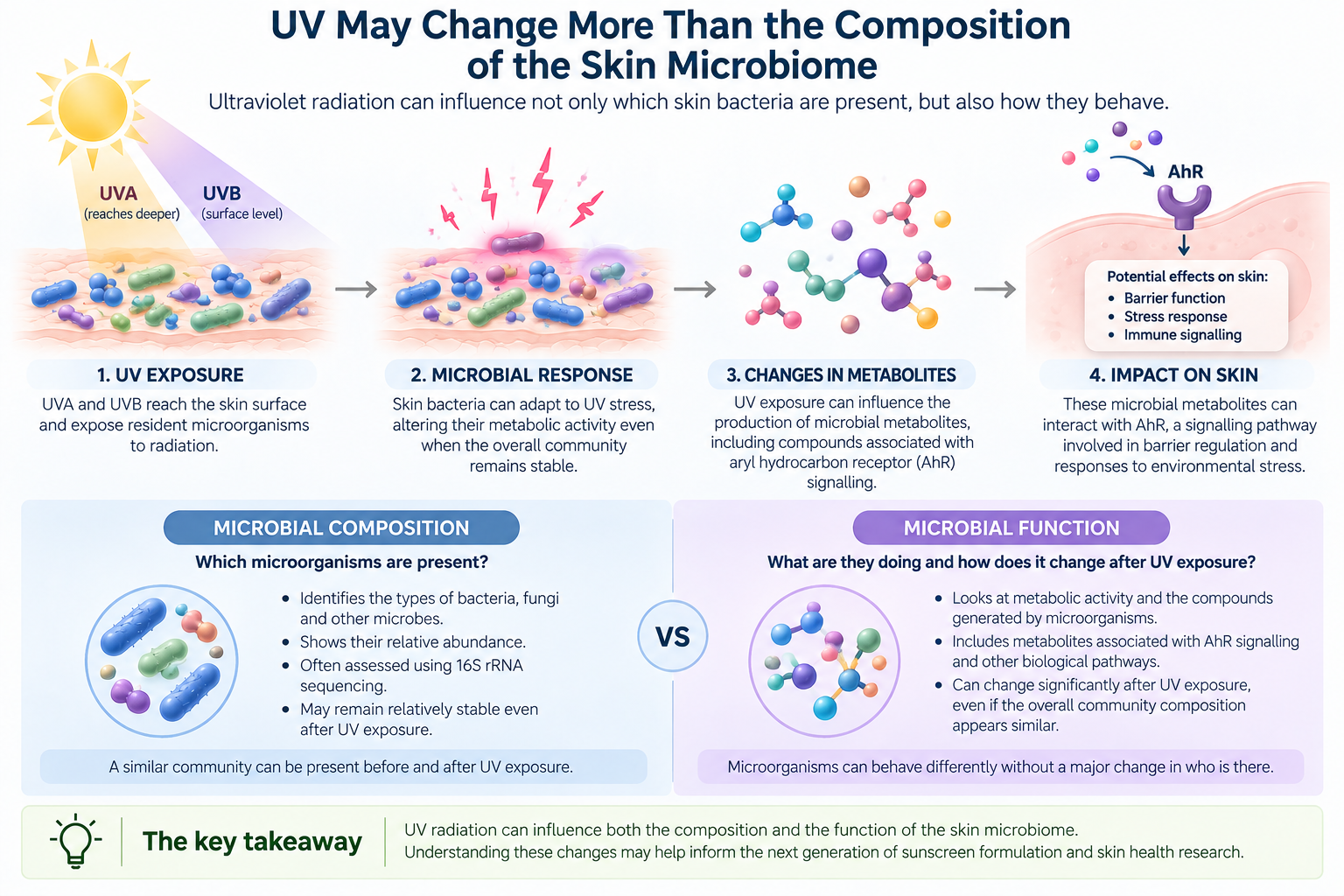
Emerging research suggests that UV radiation can alter microbial abundance, metabolism and community structure. Even more interestingly, the relationship may work in both directions. Some skin microorganisms produce pigments, antioxidants and metabolites that could influence how the surrounding skin responds to environmental stress.
A 2026 review proposed the concept of a “host-protective UV-resistome”: a collection of microbial functions that may contribute to the skin’s response to solar radiation.
That doesn’t mean our microbiome is a biological sunscreen.
The science is much younger than that statement would suggest. But it does raise an intriguing possibility: photoprotection may eventually need to consider the microbial ecosystem at the skin surface alongside the human cells underneath it.
UV Can Also Change What Skin Bacteria Do
There is another layer to this relationship.
Scientists are increasingly interested not only in which microorganisms survive UV exposure, but in whether radiation changes their behaviour.
Research published in 2026 examined how UV exposure affected metabolites produced by skin commensal bacteria. The researchers found that irradiation could reshape microbial metabolism, including compounds associated with aryl hydrocarbon receptor, or AhR, signalling.
AhR is involved in several biological processes relevant to the skin, including responses to environmental stress and barrier regulation.
That means a microbial community could appear relatively stable in terms of which organisms are present while still behaving differently after UV exposure.
This distinction is important.
Traditional microbiome analysis often focuses heavily on microbial composition: which organisms are there, and in what relative abundance? But if UV changes the molecules those organisms produce, microbial function may shift without a dramatic rearrangement of the overall community.
The emerging question is therefore moving from “Who lives on the skin?” toward “What are those microorganisms doing when the skin is exposed to sunlight?”
Then We Put Sunscreen on Top of That Ecosystem
This is where things become particularly interesting for formulators.
Sunscreen is applied directly across the microbial ecosystem we are trying to understand. Recommended use involves a substantial layer of product across exposed skin, often followed by reapplication during continued sun exposure.
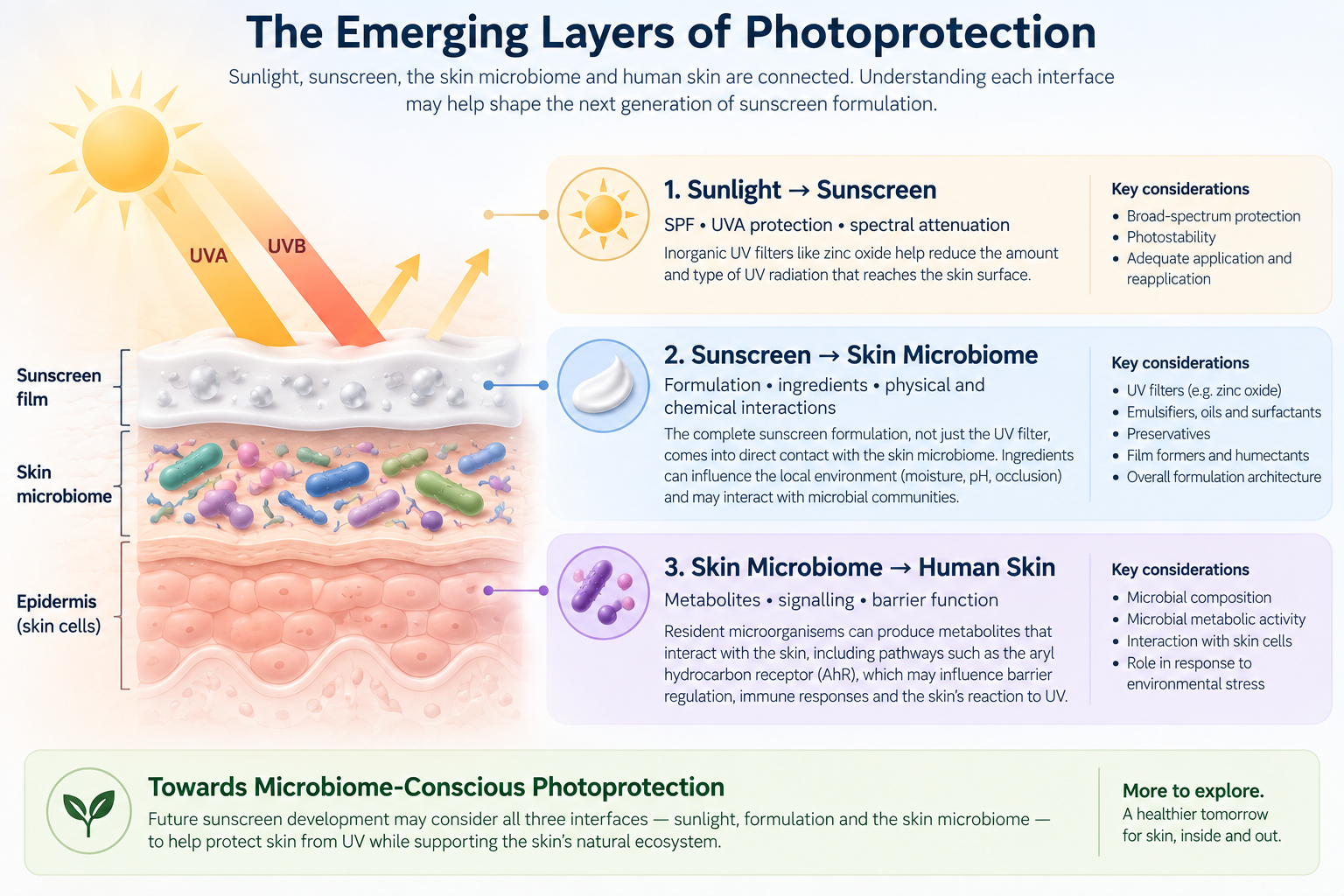
That means the skin microbiome comes into contact with the complete sunscreen formulation.
UV filters are part of that environment, but so are emulsifiers, oils, surfactants, preservatives, film formers, humectants and other ingredients. The formulation can also change conditions at the skin surface by altering moisture, occlusion and, most obviously, the amount of UV radiation reaching it.
So there are really two effects worth separating.
A sunscreen could indirectly influence the microbiome because it changes the microbial community’s exposure to UV.
And components of the sunscreen formulation could interact directly with microorganisms living on the skin.
Until recently, there was surprisingly little human evidence showing what actually happens after sunscreen application.
In 2026, Researchers Put Mineral Sunscreen to the Test
A 2026 study investigated two mineral sunscreen formulations on the skin microbiomes of 20 healthy volunteers.
One formulation contained titanium dioxide. The other contained zinc oxide.
Researchers applied the products to areas of the forearm at 2 mg/cm² and collected samples before application and again after 1, 6 and 24 hours. They then used 16S rRNA sequencing to examine the bacterial communities present.
The researchers looked at both alpha diversity, which describes diversity within a microbial community, and beta diversity, which compares community composition between samples.
Neither changed significantly after sunscreen application.
There were some fluctuations among low-abundance bacterial genera, but the researchers considered these likely transient. Overall, the resident bacterial communities remained remarkably stable during the 24-hour experiment.
The team also exposed five representative skin bacterial species to the formulations under laboratory conditions. Again, they found no significant reduction in bacterial viability during the experiment.
For mineral sunscreen formulators, that’s an interesting result.
But it needs to be interpreted carefully.
One Day of Stability Doesn’t Answer the Whole Question
It would be easy to turn the study into a much larger claim:
Mineral sunscreen doesn’t affect the skin microbiome.
We don’t know that.
The researchers tested two specific formulations, on 20 people, following a single application and over a period of 24 hours. Their results tell us what happened under those particular conditions.
They don’t tell us what happens after daily application for six months. They don’t establish how every zinc oxide sunscreen behaves. And they don’t tell us whether different formulation architectures might produce different microbial interactions.
There is another important limitation.
Sequencing can tell researchers a great deal about which bacteria are present and their relative abundance, but microbial composition is only one dimension of a microbiome.
Microorganisms can remain present while changing what they are doing.
Their metabolism, gene expression and production of biologically active compounds may change without producing a dramatic shift in community composition.
That is particularly relevant given the emerging evidence that UV itself can alter bacterial metabolism.
A microbiome that looks similar before and after an intervention is therefore not necessarily behaving identically.
Human Skin Is Giving Us Another Clue
Another 2026 human study approached the relationship from the opposite direction.
Instead of asking whether sunscreen changes microbes, researchers investigated whether changing the microbial environment could alter the way human skin responds to UV radiation.
Areas of skin where resident microbiota had been reduced through disinfection were compared with areas where the microbiota remained intact. The sites were then exposed to solar-simulated UV radiation.
Researchers observed differences in biological responses associated with apoptosis, inflammatory-cell infiltration and epidermal proliferation.
That doesn’t establish that specific skin bacteria provide meaningful UV protection. And it certainly doesn’t mean the microbiome can replace sunscreen or other forms of photoprotection.
What it does provide is human evidence that microorganisms on the skin may participate in the biological response to UV.
The surface underneath a sunscreen film, in other words, isn’t passive.
Zinc Oxide Makes the Question More Interesting
Zinc oxide sits in an unusual position in this discussion.
In sunscreen, its primary job is photoprotection. As a particulate inorganic UV filter, zinc oxide attenuates radiation across the UV spectrum when appropriately incorporated into a formulation and distributed across the skin.
But ZnO is also a material whose interactions with microorganisms have been studied extensively outside sunscreen.
Under some experimental conditions, zinc oxide particles can exhibit antimicrobial activity. The magnitude of that effect can depend on factors including particle characteristics, surface chemistry, concentration, the microorganism being tested and the surrounding environment.
That makes it dangerous to jump from:
“ZnO can demonstrate antimicrobial behaviour in a laboratory experiment”
to:
“zinc oxide sunscreen disrupts the skin microbiome.”
The 2026 human sunscreen study illustrates why that leap doesn’t work. The zinc oxide-containing formulation tested there produced no measurable disruption of overall bacterial diversity or community composition during the study period.
Those findings aren’t necessarily contradictory.
A cultured bacterial species exposed directly to ZnO under controlled conditions is not the same biological system as a complex microbial community living on human skin underneath a finished sunscreen.
The ingredient doesn’t exist in isolation once it becomes sunscreen.
It exists inside a formulation.
A Sunscreen Formula Is More Than Its UV Filter
For formulators, this may be one of the most important lessons emerging from the research.
Consider two sunscreens containing the same percentage of zinc oxide.
One might use a particular surface-treated ZnO in a specific dispersion medium. Another might use different particle characteristics, surface chemistry, emollients, emulsifiers, preservatives and rheology modifiers.
From the front of the bottle, both may simply appear to be zinc oxide sunscreens.
At the microscopic level, they are very different systems.
Preservatives are an obvious consideration because they are specifically designed to control microbial growth inside a cosmetic formulation. But pH, surfactants, solvents, emollients, water activity and other characteristics could also influence the environment created at the skin surface.
The ZnO itself introduces another set of variables.
Particle characteristics and surface treatments influence wetting, compatibility, dispersion and interactions within the formulation. Those properties can also affect how particles interact with biological systems.
So asking whether zinc oxide is “good” or “bad” for the skin microbiome may ultimately be too simplistic.
A much more useful question is:
What does this zinc oxide, in this dispersion, inside this finished formulation, do under realistic conditions on human skin?
That is harder to answer.
But it is much closer to how sunscreen actually exists in the real world.
“Microbiome-Friendly” Is a Bigger Claim Than It Sounds
Microbiome language is already common in skincare marketing.
Scientifically, however, defining a “microbiome-friendly” sunscreen is difficult.
Should the product leave microbial diversity unchanged? Should particular organisms remain stable? Should microbial metabolism remain unaffected? How large does a change need to be before it becomes biologically important?
Then there is time.
A measurement one hour after application answers a very different question from a study examining several months of daily use.
Even maintaining an absolutely unchanged microbial community may not necessarily be the correct endpoint. The skin microbiome is naturally dynamic, responding to washing, sweat, cosmetics, climate, age, body site and many other factors.
This is why the 2026 mineral sunscreen study is valuable without being definitive.
It gives us evidence that the two formulations tested did not significantly disrupt overall bacterial community structure during the study period.
It does not give every mineral sunscreen a universal “microbiome-friendly” label.
Before that terminology becomes a meaningful technical category, researchers and industry will need clearer agreement about what should be measured, for how long and what constitutes a meaningful change.
Could Photoprotection Become Microbiome-Conscious?
Historically, sunscreen development has focused on measurable endpoints such as SPF, UVA protection, photostability, water resistance and product stability.
Modern formulation has added further priorities: transparency, sensory performance, film behaviour, compatibility with makeup and everyday wearability.
The skin microbiome could eventually add another dimension.
That doesn’t mean formulators should suddenly redesign sunscreen around bacteria. The evidence isn’t mature enough for that.
But researchers are already discussing microbiome-conscious photoprotection as an emerging direction.
If microbial metabolites influence oxidative stress, inflammatory signalling or barrier responses following UV exposure, understanding how photoprotective products interact with those pathways could eventually become relevant to sunscreen development.
It creates three increasingly interesting interfaces:
sunlight → sunscreen film
sunscreen film → human skin
sunscreen formulation → skin microbiome
The first two have occupied sunscreen scientists for decades.
We are only beginning to understand the third.
Final Thoughts
For most of sunscreen’s history, the microorganisms living underneath the protective film were barely part of the formulation conversation.
That is beginning to change.
Research emerging in 2026 has provided human evidence that the skin microbiome may influence aspects of the skin’s response to UV radiation. Other work suggests UV can change the metabolic behaviour of skin bacteria. And we now have direct human data examining what happens to microbial communities after application of specific mineral sunscreen formulations.
None of this means sunscreen needs a new microbiome claim tomorrow.
It means we are beginning to understand that the surface being protected is considerably more biologically complex than we once treated it.
For mineral sunscreen formulators, that makes the emerging research particularly interesting. Zinc oxide still has to provide effective UV attenuation, remain appropriately dispersed, contribute to a stable protective film and deliver acceptable aesthetics.
Now researchers have another interface to investigate: how that finished formulation interacts with the microorganisms already living on the skin.
The skin microbiome isn’t replacing SPF, UVA protection or any established measure of sunscreen performance.
It is simply entering the sunscreen conversation.
__________________________________________________________________________________________________________
Frequently Asked Questions
What is the skin microbiome?
The skin microbiome is the community of microorganisms that live on and within the skin, including bacteria, fungi and viruses. Its composition varies across different areas of the body and can interact with skin barrier function, immune responses and the surrounding environment.
Does UV radiation affect the skin microbiome?
Emerging research suggests that UV exposure can influence microbial communities and alter the metabolic activity of some skin bacteria. Recent human research also suggests that resident microorganisms may influence aspects of how the skin itself responds to UV radiation.
Does sunscreen disrupt the skin microbiome?
There isn’t enough evidence to make a universal claim about all sunscreens. A 2026 human study found no significant changes in overall bacterial diversity or community composition during the 24 hours following application of the two mineral sunscreen formulations tested. Longer-term effects and differences between formulations still need further study.
Does zinc oxide harm beneficial skin bacteria?
Zinc oxide can demonstrate antimicrobial activity under certain experimental conditions, but this does not mean a finished zinc oxide sunscreen necessarily disrupts the skin microbiome. Particle characteristics, surface treatment, concentration, formulation composition, microorganism and testing conditions can all influence the interaction.
What does “microbiome-friendly sunscreen” mean?
There is currently no single universally accepted definition or test that makes a sunscreen “microbiome-friendly.” Researchers can measure factors such as microbial diversity, community composition, individual organisms and microbial function, but more work is needed to determine which changes are biologically meaningful.
Could the skin microbiome become part of future sunscreen formulation?
Potentially. Researchers are beginning to explore microbiome-conscious photoprotection, including how UV affects microbial activity and how photoprotective formulations interact with microorganisms on the skin. The field is still emerging, so microbiome considerations would complement rather than replace established measures such as SPF and UVA protection.