
I used to think about zinc oxide primarily through the numbers. Particle size, concentration, surface treatment and dispersion quality were the obvious things to examine when trying to understand how a mineral sunscreen might perform.
But the more I explored zinc oxide research, the more I realised that one characteristic receives surprisingly little attention outside materials science. We spend considerable time discussing how large zinc oxide particles are, but much less time discussing what they actually look like.
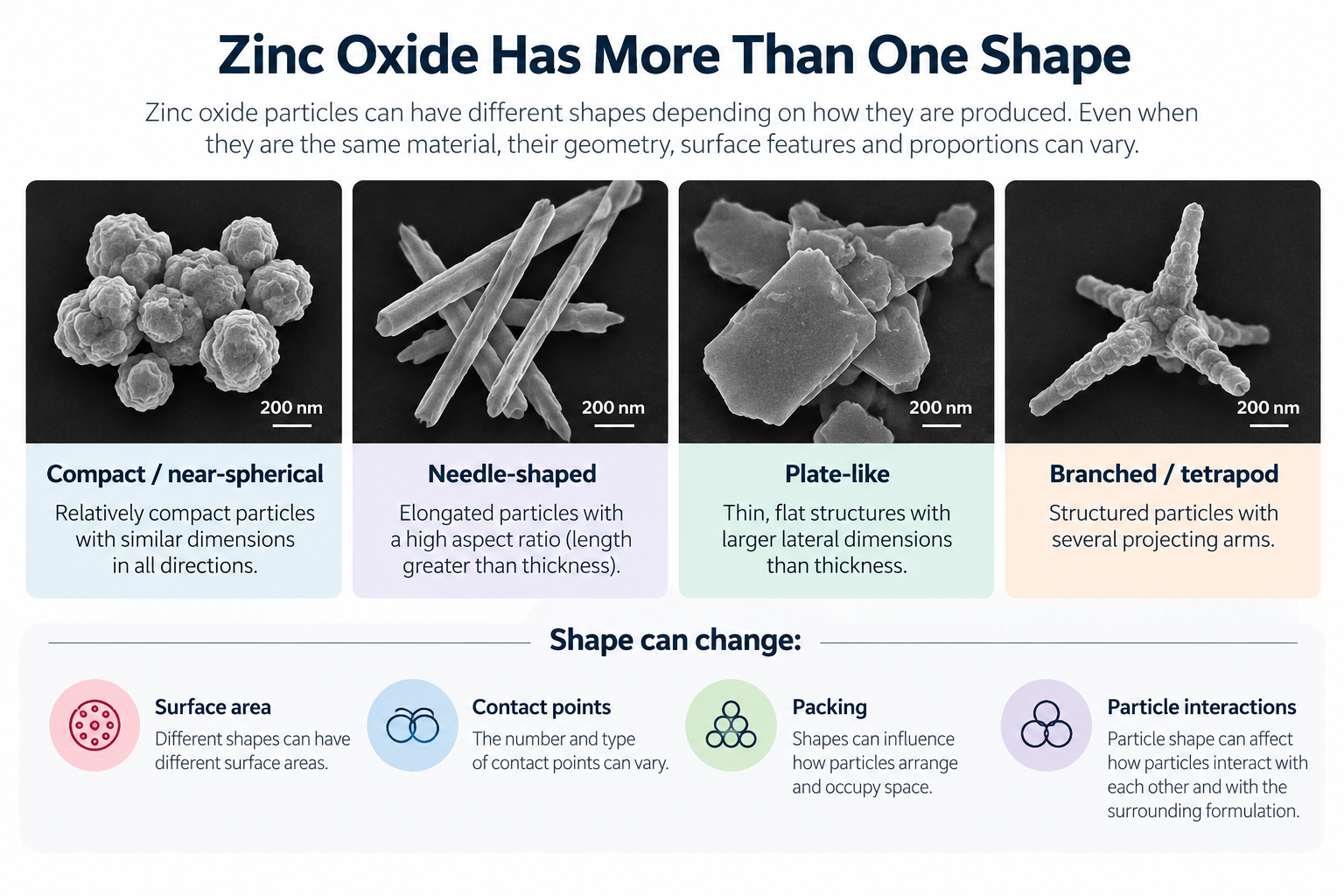
And zinc oxide particles don’t all look alike. Depending on how they are produced, they can resemble needles, flat plates, compact grains or even tiny structures with several projecting arms.
Under a microscope, two materials identified by the same ingredient name can look remarkably different. That raises a question I find particularly interesting: if the chemistry is still zinc oxide, can changing the shape of zinc oxide particles change how a sunscreen performs?
The research suggests that it can. But the answer becomes much more interesting when we look beyond the individual particle.
Zinc Oxide Has More Than One Shape
When we talk about zinc oxide in sunscreen formulation, particle size usually dominates the conversation. It influences discussions about UV attenuation, visible-light scattering, white cast and whether a material falls within particular nanomaterial definitions.
Shape is a different characteristic. Scientists call it particle morphology, and it describes the physical structure of a particle, including its geometry, surface features and proportions.
A relatively compact particle has a different geometry from an elongated one. A thin plate has a different surface arrangement from a branched structure. Even when two particles have similar characteristic dimensions, their surface areas, aspect ratios and contact points can differ.
These differences matter because zinc oxide doesn’t remain as isolated particles when it enters a sunscreen. It becomes part of a much larger system containing oils, emulsifiers, dispersants, polymers and other ingredients.
What happens during that process may depend partly on the shape of zinc oxide. And that is where morphology starts becoming a formulation question rather than simply something interesting to look at under a microscope.
The Study That Made Me Look at Zinc Oxide Differently
One of the most interesting examples I found came from a 2023 study investigating non-nano zinc oxide powders for UV-protection cosmetics.
The researchers weren’t simply trying to make zinc oxide particles smaller. They wanted to understand whether changing the particles’ geometry could influence their behaviour in cosmetic formulations.
By adjusting synthesis conditions, they produced several morphologies, including needle-shaped particles, flat plate-like structures and particles with vertical wall-like features.
What caught my attention wasn’t simply the variety of shapes. It was what happened when the researchers started combining them.
They investigated different mixtures of needle-shaped and vertical-wall-type zinc oxide. Among the combinations tested, a 1:1 mixture demonstrated particularly effective UV attenuation.
The researchers associated this behaviour with improved particle distribution and reduced agglomeration, suggesting that combining different morphologies helped prevent particles from clustering excessively.
That was the part I found most revealing. The interesting result wasn’t necessarily that one particle shape blocked more UV than another. It was that different shapes appeared to work together in a way that influenced how the particles were distributed.
Of course, this was a particular experimental system, and the particles differed in more than geometry alone. We cannot conclude that mixing any two zinc oxide shapes will automatically improve UV protection.
But it introduces an important possibility: particle morphology may influence sunscreen performance through its effect on the dispersion itself.
The Shape of a Particle Can Change How It Meets Its Neighbours
This is where I think particle morphology becomes especially relevant to formulators. Imagine filling a container with small, relatively compact objects, then filling another with elongated objects or structures that have several projecting arms.
Even without changing the material they’re made from, the way those objects touch, arrange themselves and occupy space can be different. Something similar can happen with zinc oxide particles.
Compact particles may form one type of contact network, while elongated or branched particles may interact through a different arrangement of surfaces and contact points. Those interactions can influence how particles associate with one another and respond to the surrounding liquid.
However, the relationship isn’t straightforward. An elongated particle doesn’t automatically disperse better than a compact one. Surface chemistry, dispersant selection, particle concentration and mixing conditions can all change the outcome.
A 2024 study comparing coated and uncoated zinc oxide formulations illustrates how changes in surface characteristics can influence formulation behaviour, including texture, rheology and stability.
That’s why I wouldn’t look at a microscopy image and immediately predict how well a zinc oxide material will disperse. The image tells us something about the particles, but it doesn’t tell us everything about how those particles will behave in an emulsion.
What Happens When Zinc Oxide Particles Start Clustering?
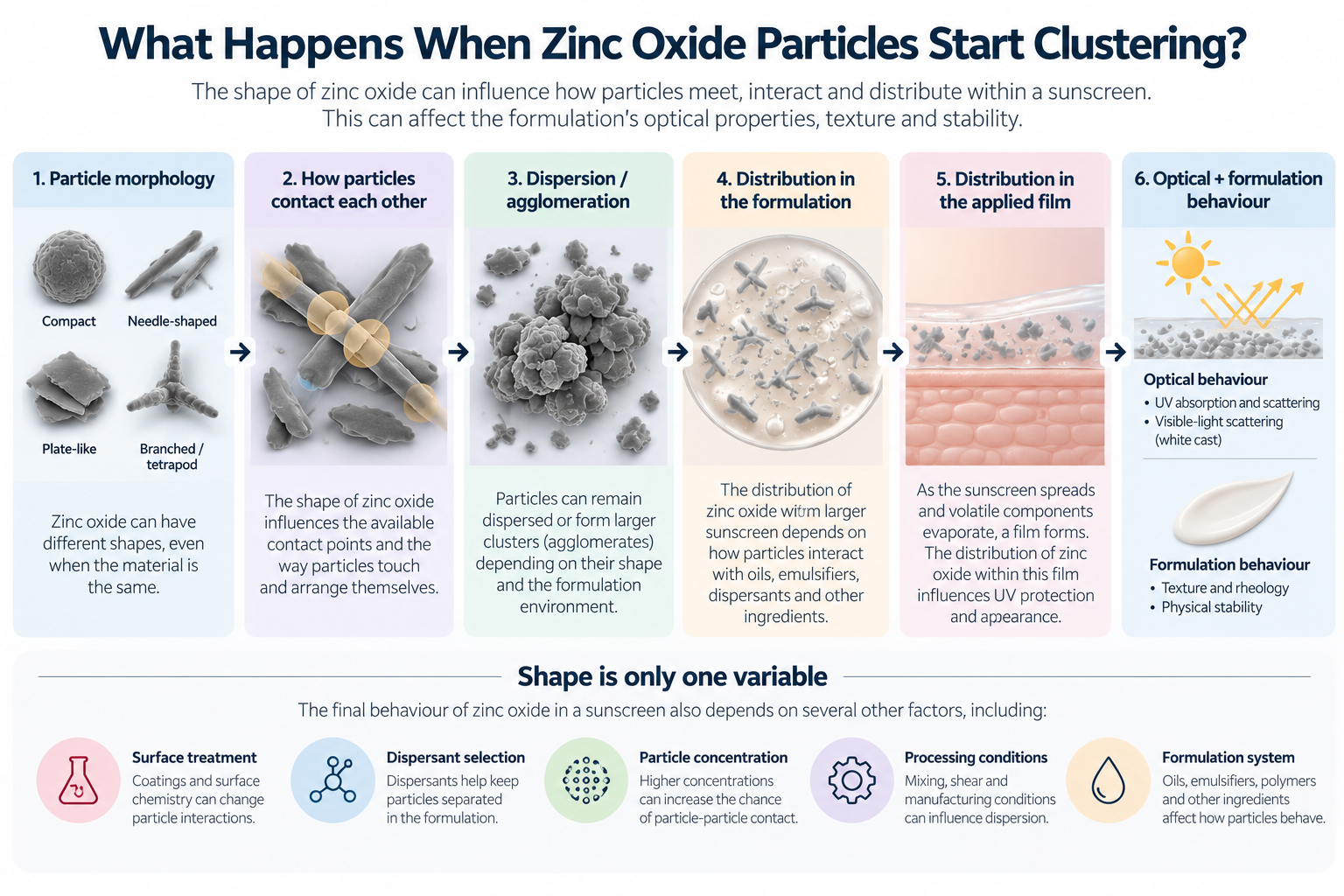
Agglomeration is one of the reasons I find this discussion so relevant. When zinc oxide particles come together into larger clusters, their collective behaviour can differ from that of the individual particles.
The resulting structures can affect the optical characteristics, rheology and physical stability of a dispersion. This is also why primary particle size and the size of the dispersed particle population shouldn’t be treated as interchangeable measurements.
Particle morphology adds another variable to that relationship. A particle’s shape influences its available contact geometry, but whether it actually agglomerates depends on the surrounding formulation too.
A particularly interesting 2025 study used cryo-transfer electron tomography to examine sunscreen creams. Instead of relying entirely on measurements of isolated ingredients, the researchers visualised the three-dimensional distribution of zinc oxide, titanium dioxide, silicone oil and emulsified water within a moisture-containing sunscreen.
For me, this is where the conversation becomes more useful than simply comparing microscope images. The question isn’t whether one shape looks more uniform. It’s whether that morphology helps the zinc oxide remain appropriately distributed under the conditions in which the sunscreen is manufactured, stored and applied.
What If Zinc Oxide Looked Like a Four-Armed Star?
A study published online in December 2025 investigated an unusual zinc oxide morphology. The researchers developed flame-synthesized zinc oxide tetrapods.
Tetrapods are structures with four projecting arms, giving them a geometry quite different from the relatively compact particles commonly used to illustrate zinc oxide in sunscreen discussions.
The researchers compared these nanostructured materials with conventionally synthesized zinc oxide nanoparticles. They then incorporated the materials into sunscreen formulations and evaluated their optical, colloidal and cosmetic properties.
What I found particularly interesting was that the tetrapod-containing sunscreen demonstrated UVB absorption and SPF performance comparable to the conventional zinc oxide formulation at equal ZnO mass. In other words, changing the morphology didn’t automatically produce a higher SPF.
But the study also reported favourable results from colloidal stability and white-cast evaluations of the tetrapodal material. That distinction matters because formulators have to consider much more than a single SPF measurement.
The study doesn’t establish that branched zinc oxide is universally better than conventional zinc oxide, and the materials investigated were nanostructured. But it challenges the assumption that the only meaningful outcome of particle engineering is stronger UV attenuation.
Does Shape Change How Zinc Oxide Interacts With Light?
So far, we’ve been looking at how particle shape might influence dispersion and particle interactions. But there’s another part of the story.
Zinc oxide protects against UV radiation primarily through absorption, with scattering also contributing to its optical behaviour. The way a particle interacts with incoming light depends on several characteristics, including its dimensions, optical properties and surrounding environment.
A 2026 computational study investigating the effects of particle size, morphology and electromagnetic interactions explored this relationship using zinc oxide and titanium dioxide structures.
The researchers modelled spherical, elongated and bar-shaped particles to understand how geometry influenced their calculated optical responses. They also examined interactions between neighbouring particles, showing that optical response could depend on individual particle geometry and how nearby materials interact electromagnetically.
Of course, these were simulations rather than measurements of finished commercial sunscreens. They help explain the underlying physics, but they don’t establish that a particular particle shape will deliver higher SPF in a real formulation.
Still, the study reinforces an important point. The optical behaviour of a single particle is only part of the picture because sunscreen contains enormous populations of particles rather than isolated structures.
One Study Reported an Extraordinary SPF Increase
A 2024 study published in the Journal of Photochemistry and Photobiology B: Biology investigated star-shaped zinc oxide nanoaggregates combined with organic UV filters.
Under the reported experimental conditions, the addition of the synthesized zinc oxide material was associated with an increase of approximately 990% in measured in-vitro SPF, from 26 to 285, for the investigated filter system.
That’s an extraordinary result, and it would be easy to turn it into a headline suggesting that star-shaped zinc oxide offers dramatically superior sunscreen protection. But I don’t think that would be a responsible interpretation.
The study examined a specific experimental material, particular organic UV-filter combinations and defined in-vitro testing conditions. The observed improvement cannot be attributed to shape alone without considering the material’s other properties and its interactions with the formulation.
For me, the value of this study isn’t the possibility of promising a tenfold improvement. It’s the demonstration that the physical structure of a zinc oxide material can be part of a much larger interaction involving optical properties, UV filters and formulation composition.
White Cast Isn’t Just a Particle-Size Problem
Whenever I look at mineral sunscreen innovation, white cast eventually enters the discussion. Zinc oxide has a refractive index that differs from that of the surrounding formulation and skin, contributing to visible-light scattering that can make a sunscreen appear white.
Particle size plays an important role, but it isn’t the only consideration. The optical appearance of a finished sunscreen also depends on particle concentration, size distribution, agglomeration, refractive-index contrast and how the material is distributed across the skin.
A 2024 scientific review examining how to standardize the white-cast potential of metal oxide sunscreens explored how formulation characteristics influence the visible appearance of these products.
The authors discussed comparisons between formulations containing free zinc oxide powder and different zinc oxide dispersions, showing how the surrounding formulation could influence particle aggregation and the appearance of the applied film.
Particle morphology can contribute to that picture. But I wouldn’t assume that changing the shape of zinc oxide automatically makes it more transparent.
A zinc oxide material can demonstrate promising UV attenuation and still create challenges with appearance, texture or stability. The goal isn’t simply to produce a particle with favourable optical properties; it’s to incorporate that material into a sunscreen that performs appropriately across several competing requirements.
Then There Is the Question of Texture
One thing I find easy to overlook in discussions about zinc oxide morphology is how closely particle behaviour is connected to the physical feel of a formulation.
Sunscreen texture is influenced by the entire formulation, including its emulsion structure, oil phase, polymers, dispersants and particulate ingredients. Zinc oxide contributes to that system through its concentration, surface characteristics and interactions with the surrounding ingredients.
A 2025 study examining the role of emulsifiers and SPF boosters in sunscreen performance offers a useful reminder of how formulation-dependent these properties can be.
The researchers evaluated SPF, rheological behaviour, texture and stability across different formulations. In one comparison, adding zinc oxide did not substantially change most measured texture parameters, although a difference in hardness was observed.
The morphology studies discussed here don’t establish that one zinc oxide shape will consistently produce a lighter, smoother or more elegant sunscreen. What they do suggest is that morphology deserves consideration when investigating why two zinc oxide materials behave differently.
The Same Zinc Oxide Can Behave Differently Once It Enters a Formula
At this point, I think it’s worth returning to the question that started this article. If two sunscreens contain the same percentage of zinc oxide, should we expect them to perform the same way?
I wouldn’t. The percentage tells us how much zinc oxide is present, but it doesn’t tell us the full particle-size distribution, morphology, surface chemistry or dispersion state.
A 2025 study using a Quality by Design approach to investigate sunscreen stability demonstrates how several formulation variables can influence the behaviour of a finished product.
Although the study wasn’t designed to isolate zinc oxide morphology, it reinforces something I think is essential when interpreting particle research. A promising material characteristic doesn’t exist independently of the formulation into which the material is introduced.
A well-characterized powder is a starting point, not a guarantee of finished-product performance. This is why I find the non-nano zinc oxide research particularly valuable.
It shows that investigating particle morphology doesn’t have to mean pursuing ever-smaller particles. Researchers can also explore how larger, differently shaped structures interact and distribute within cosmetic systems.
Why I Wouldn’t Choose Zinc Oxide Based on Shape Alone
After looking through these studies, I’ve become more interested in particle morphology, but also more cautious about treating it as an independent predictor of performance.
A microscopy image can reveal whether particles are compact, elongated, plate-like or branched. It can help us understand the physical structures we’re working with, but it cannot tell us everything we need to know about the finished sunscreen.
A 2025 critical review of zinc oxide sunscreen materials and their optical and structural characterization highlights the importance of evaluating these materials through several complementary analytical techniques.
If I were comparing two zinc oxide materials, I would want to understand how their shapes relate to particle-size distribution, surface treatment, dispersion behaviour and optical performance. I would also want to know how those materials behave under realistic formulation conditions.
Do they remain appropriately dispersed during storage? Do they influence rheology? How do they interact with other ingredients, and what happens to their distribution as the formulation spreads and forms a film?
Ultimately, do those differences translate into meaningful changes in validated sunscreen performance? A material that looks impressive under a microscope may not necessarily be the easiest to formulate.
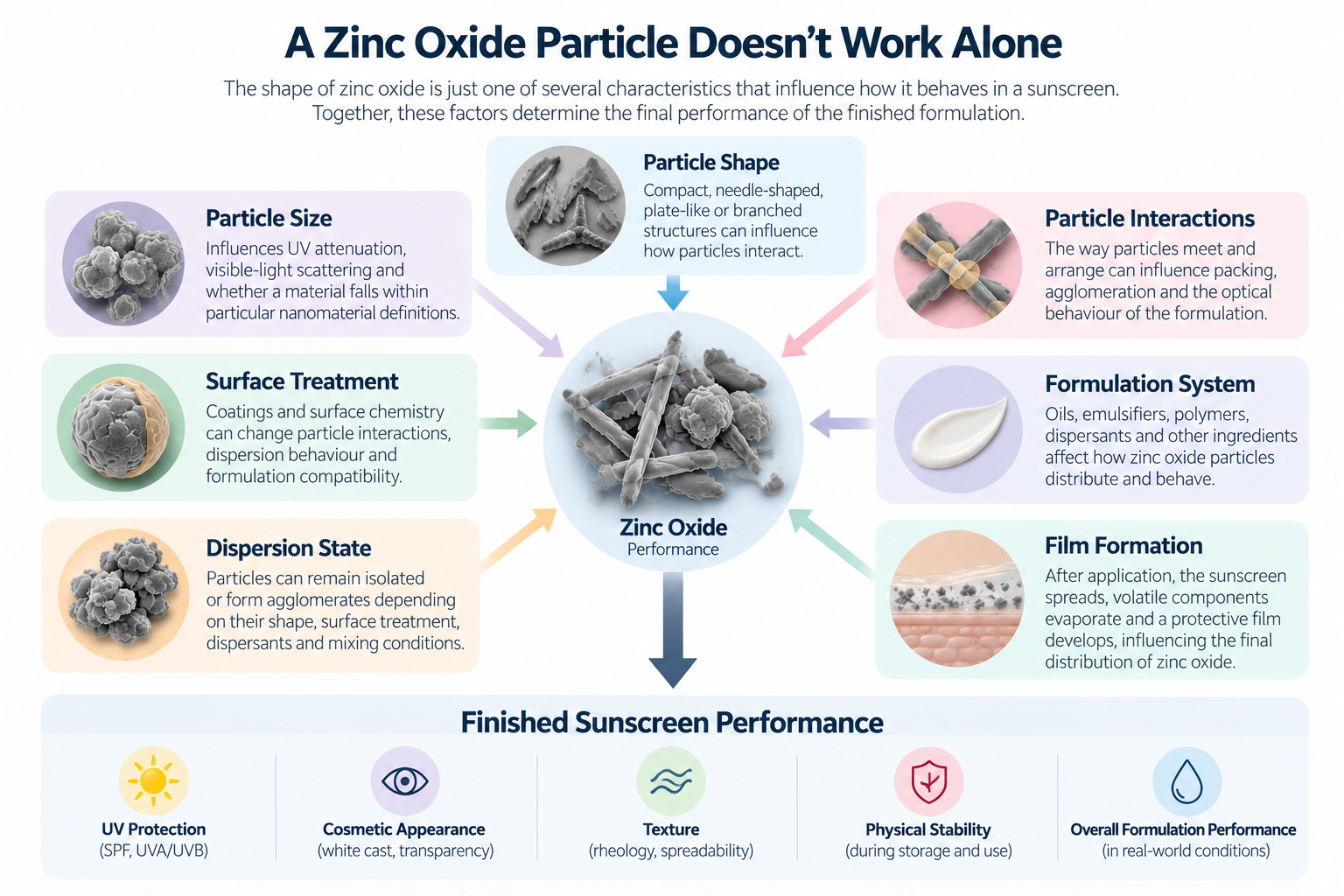
Similarly, a relatively conventional particle morphology may perform extremely well when paired with the right dispersion system. Shape matters, but it doesn’t work alone.
Maybe We’ve Been Asking the Wrong Question About Zinc Oxide
When I started looking into this subject, I expected to find a straightforward comparison between different zinc oxide shapes. Which morphology absorbs more UV? Which one disperses better? Which one produces less white cast?
But the research doesn’t point toward one universally superior geometry. Instead, it shows how closely particle morphology is connected to other characteristics that influence sunscreen performance.
The 2023 non-nano zinc oxide study demonstrated the potential value of combining different particle structures. The tetrapod research showed that unconventional morphology could produce comparable SPF alongside interesting differences in other formulation properties.
And the 2024 star-shaped nanoaggregate study demonstrated how dramatically experimental optical measurements can change within a particular UV-filter system. These studies investigated different materials under different conditions, so they shouldn’t be treated as direct comparisons.
But together, they reveal something I think is worth paying attention to. Concentration, particle size and surface treatment are certainly important, but they don’t describe the entire material.
Morphology adds another dimension. Once those particles enter a formulation, their geometry becomes part of a much more complicated relationship involving dispersion, optical behaviour, rheology and film formation.
So, does the shape of zinc oxide matter? Yes, but perhaps the more useful question is what that shape allows the zinc oxide to do once it becomes part of a sunscreen.
Because the best-performing material isn’t necessarily the one with the most unusual shape. It’s the one whose characteristics work together to deliver the performance the finished formulation actually needs.
______________________________________________________________________________________________________________________
Frequently Asked Questions (FAQs)
Does the shape of zinc oxide affect sunscreen performance?
Yes, the shape of zinc oxide can influence how particles interact, disperse and arrange themselves within a sunscreen formulation. However, shape does not work independently. Particle size, surface treatment, dispersion state and the overall formulation system also influence finished sunscreen performance.
What shapes can zinc oxide particles have?
Zinc oxide can be produced in several morphologies, including compact, needle-shaped, plate-like and branched or tetrapod structures. Research suggests that these different geometries can affect particle contact, packing, agglomeration and optical behaviour.
Is one zinc oxide particle shape better for sunscreen?
Current research does not identify one universally superior zinc oxide shape for sunscreen. Different morphologies may offer advantages under particular experimental or formulation conditions, but their performance depends heavily on how they interact with the rest of the formulation.
Can the shape of zinc oxide affect white cast?
Potentially, but white cast cannot be attributed to particle shape alone. Particle size, concentration, agglomeration, dispersion and the distribution of zinc oxide within the applied sunscreen film can all influence visible-light scattering and cosmetic appearance.
Is particle size or particle shape more important for zinc oxide?
They should not really be considered in isolation. Particle size and morphology describe different characteristics of zinc oxide, while surface chemistry, dispersion and formulation conditions determine how those particles ultimately behave. For formulators, understanding how these characteristics work together is more useful than focusing on a single specification