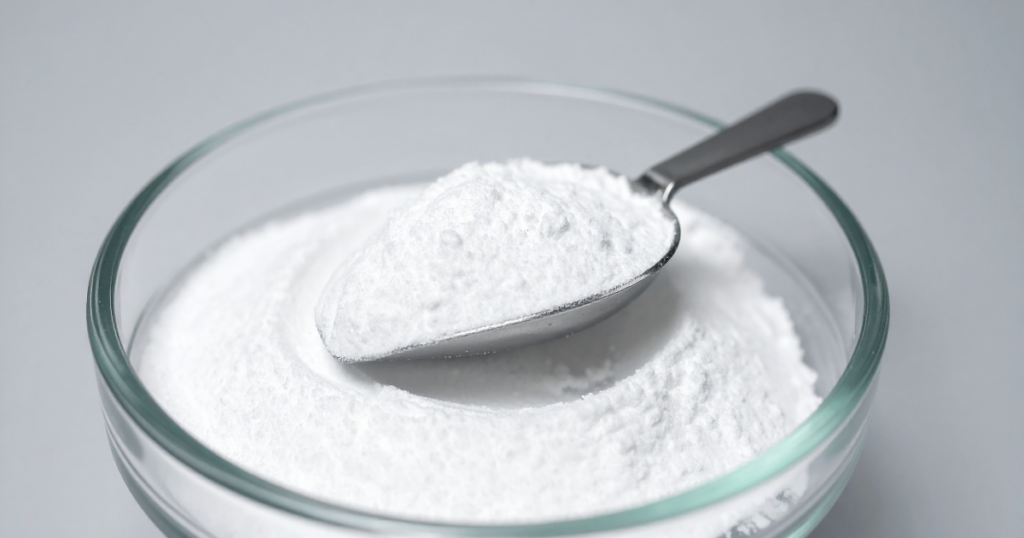
Put titanium dioxide and zinc oxide next to each other, and there is very little to tell them apart. Both are white powders. Both are mineral UV filters. Both have been used in sunscreen formulations for decades.
But take those same powders into a formulation lab, and the similarities start to disappear.
One may deliver strong UVB protection but need additional support across longer UVA wavelengths. The other may offer broader UV coverage, yet introduce its own challenges with dispersion, viscosity and skin feel. Even the white cast we associate with mineral sunscreens is not necessarily the same for both materials.
This is what makes titanium dioxide vs zinc oxide such an interesting comparison. We are looking at two ingredients that appear almost identical but interact with light, formulation ingredients and the skin in different ways.
And those differences can change the sunscreen we eventually put into a bottle.
White Is Just the Beginning
Titanium dioxide (TiO₂) and zinc oxide (ZnO) are inorganic UV filters. Both can attenuate ultraviolet radiation through a combination of absorption and scattering, although absorption plays a substantial role in their UV-protective behaviour.
For years, mineral sunscreens have been described as physical barriers that simply reflect sunlight away from the skin. That explanation is convenient, but it misses much of the science.
The two minerals have different electronic structures, optical properties and refractive indices. These characteristics influence which wavelengths they attenuate and how they interact with visible light.
A 2025 review of inorganic UV filters examines how material properties, particle engineering and surface modification influence their performance in sunscreen systems.
important point is that two ingredients can perform the same general function without behaving in the same way.
And nowhere is that more apparent than in the wavelengths they protect against.
The UV Spectrum Doesn’t Treat Them Equally
We often talk about UV protection as though ultraviolet radiation were a single thing. In reality, the distinction between UVB and UVA matters enormously when choosing sunscreen filters.
UVB radiation spans approximately 280–315 nm, while UVA extends from 315–400 nm. UVA is commonly divided into UVA2 (315–340 nm) and UVA1 (340–400 nm). These wavelength ranges are important because filters do not attenuate every part of the spectrum equally.
Titanium dioxide is particularly effective at attenuating UVB and shorter UVA wavelengths. Zinc oxide generally provides broader attenuation extending into the longer UVA region.
This difference is one reason ZnO is valuable in broad-spectrum sunscreen development.
An experimental comparison of microfine zinc oxide and titanium dioxide found that the ZnO material tested provided stronger attenuation between 340 and 380 nm. It also produced less visible whiteness than the TiO₂ materials included in that investigation.
The study is older, and the findings should not be applied indiscriminately to every modern grade of either mineral. Particle characteristics and formulation technology have evolved considerably since then.
Still, the underlying distinction remains relevant.
A sunscreen designed around strong UVB attenuation is not necessarily optimised for long-UVA protection. Similarly, a formula that achieves a high SPF may still require careful evaluation of its UVA performance.
This is where the choice between titanium dioxide and zinc oxide becomes more than a question of ingredient preference. It becomes a question of what kind of protection the formulation needs to deliver.
Why Two White Powders Don’t Leave the Same White Cast
White cast is probably the most recognisable challenge associated with mineral sunscreen.
But why does one mineral sunscreen leave a noticeable white film while another appears almost invisible?
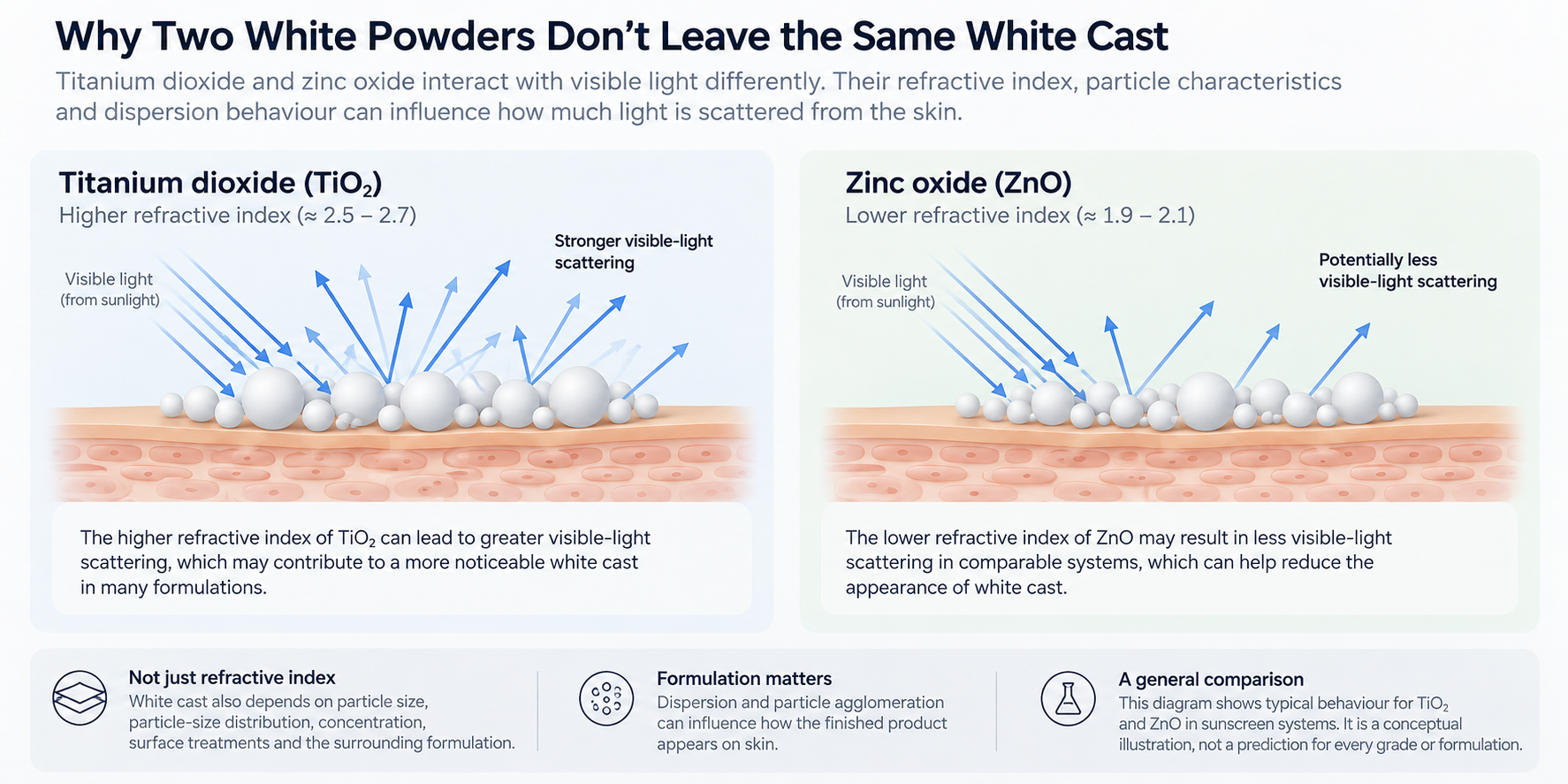
Part of the explanation lies in refractive index.
Titanium dioxide has a relatively high refractive index, typically around 2.5–2.7 depending on its crystalline form. Zinc oxide has a lower refractive index, generally around 1.9–2.1.
That difference influences how strongly each material can scatter visible light when dispersed in a formulation.
Visible light scattering is particularly important because the human eye can detect the contrast between a sunscreen film and the skin beneath it. When that scattering becomes significant, the product may appear white, grey or ashy.
However, refractive index alone cannot predict the appearance of a finished sunscreen. Particle size, particle-size distribution, agglomeration, concentration, surface treatments and the surrounding formulation all influence the final result.
A 2024 paper examining the white-cast potential of metal oxide UV filters addresses the need for more consistent ways to assess this behaviour.
That is an important development because white cast is not simply a property of a powder. It is also a property of how that powder behaves in a particular formulation and how the finished product appears when applied.
A well-engineered ZnO dispersion may help reduce visible whitening, but ZnO itself is not automatically transparent. The same principle applies to TiO₂.
And this brings us to one of the most interesting trade-offs in mineral sunscreen formulation.
Smaller Particles Don’t Solve Everything
One approach to reducing visible whitening is to use smaller mineral particles.
The reasoning is straightforward. When particle dimensions become sufficiently small relative to visible wavelengths, visible-light scattering can decrease, making the sunscreen appear more transparent.
But the relationship between particle size and sunscreen performance is more complicated than simply making everything smaller.
Changing particle size can also change UV attenuation, surface area, particle interactions and dispersion behaviour. The optimal particle characteristics for reducing visible whitening may not be identical to those that maximise attenuation across every UV wavelength.
Particle-size distribution also matters. A material with a small reported primary particle size may still contain larger agglomerates when introduced into a formulation.
Those agglomerates can behave quite differently from the individual particles used to describe the raw material.
A 2023 experimental study involving ball-milled TiO₂ and ZnO explored how particle processing can influence the characteristics and UV-protective behaviour of these materials. It offers a useful reminder that particle engineering changes more than appearance.
There is another distinction worth making here. Primary particle size and aggregate or agglomerate size are not interchangeable, and regulatory definitions of nanomaterials depend on the relevant jurisdiction and measurement criteria.
For formulators working with non-nano mineral ingredients, the same broader lesson remains useful: the way particles are processed and distributed can influence the final product, even when the primary material has not changed.
Particle size is therefore one part of the formulation decision.
What happens when those particles meet the rest of the formula is another.
The Real Test Begins When the Powder Enters the Formula
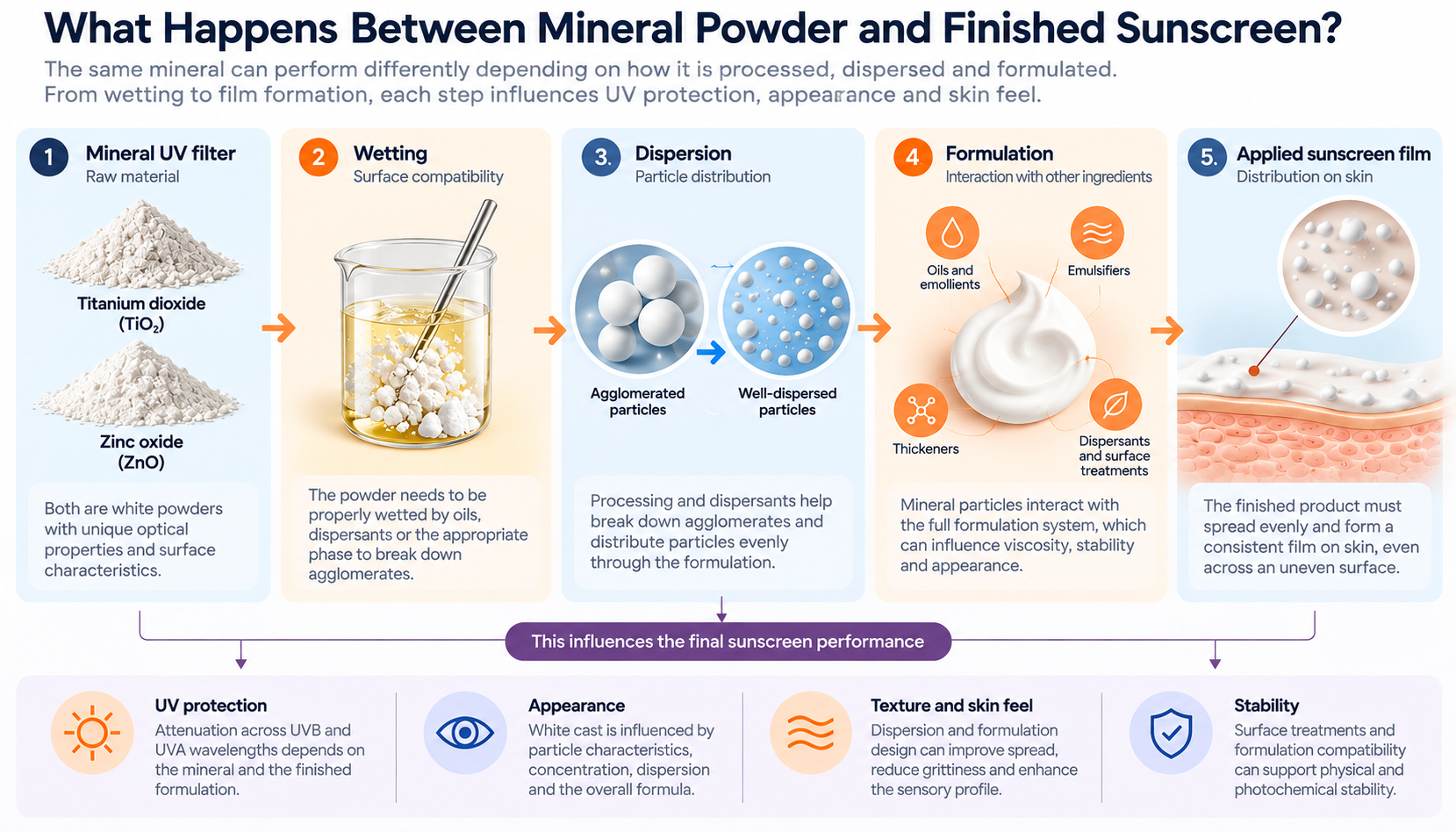
A mineral powder sitting in a container tells us surprisingly little about how it will perform in sunscreen. Once titanium dioxide or zinc oxide enters a formulation, it must interact with oils, emulsifiers, dispersants, thickeners and other ingredients.
The particles need to be wetted and distributed through the appropriate phase. Their surfaces interact with the surrounding medium, and those interactions influence whether the particles remain separated or form larger clusters.
This is where the formulation challenges associated with the two minerals become particularly interesting.
TiO₂ and ZnO can both present difficulties with agglomeration and compatibility, but they do not necessarily respond identically to the same dispersant or processing conditions.
Surface chemistry plays a role. So do surface coatings, the polarity of the dispersion medium and the amount of mechanical energy applied during processing.
A formulation that works well with one mineral cannot always accommodate the other through a simple one-for-one substitution.
Viscosity may change. Stability may change. The appearance of the finished product may change. And even when the formulation remains physically stable, its measured UV protection may not remain the same.
This is why I find dispersion technology such an important part of mineral sunscreen development.
A powder may have desirable optical properties, but those properties still need to be translated into a workable, reproducible formulation.
The challenge is not merely getting the particles into the product. It is controlling how they behave once they are there.
Surface Treatments Change the Conversation Again
Neither titanium dioxide nor zinc oxide necessarily enters a sunscreen formulation with an untreated surface.
Mineral UV filters may be supplied with coatings or other surface modifications designed to influence their compatibility, dispersibility and photochemical behaviour. These modifications can affect how particles interact with the formulation medium and surrounding ingredients.
That matters because mineral surfaces can participate in light-driven chemical reactions under certain conditions.
Both TiO₂ and ZnO can exhibit photocatalytic activity, although the extent depends on factors such as crystal structure, surface characteristics, coatings and the surrounding environment. In sunscreen development, formulators generally want effective UV attenuation without unwanted reactions that could compromise other formulation components.
Appropriate surface engineering can help address these challenges.
A 2025 review of titanium dioxide and zinc oxide as inorganic UV filters discusses the importance of material properties and surface modification when evaluating their sunscreen applications.
What I find particularly interesting is that the mineral’s chemical identity is only the starting point. Two ZnO grades may behave differently because their surfaces have been engineered differently. The same is true for TiO₂.
That means a comparison based solely on ingredient names can miss some of the most consequential formulation decisions. And it explains why choosing a mineral UV filter is rarely as simple as comparing two lines on an ingredient list.
The Sunscreen on Skin Is Not the Sunscreen in the Beaker
There is another stage of sunscreen performance that deserves more attention.
Application.
We spend considerable time evaluating sunscreen formulations in the laboratory, but the finished product must eventually spread across skin and form a protective layer. That layer is rarely perfectly uniform.
Skin has texture, pores, fine lines and areas where product may accumulate or spread more thinly. The formulation must distribute its UV filters across this uneven surface while maintaining acceptable sensory properties. For mineral sunscreens, particle distribution within the applied film becomes particularly important.
Agglomerates, uneven spreading and differences in film thickness can influence how consistently UV radiation is attenuated. This is also where the differences between titanium dioxide and zinc oxide become harder to separate from the formulation around them.
A mineral may have an excellent attenuation profile under controlled conditions, but the finished sunscreen still depends on how the product spreads, dries and remains on the skin.
A 2025 critical review of the optical and structural properties of ZnO sunscreens discusses the importance of physical characterisation and performance assessment in understanding these systems.
It reinforces the need to examine mineral sunscreen performance through more than a single measurement. For me, this is one of the most useful ways to think about sunscreen formulation. The ingredient determines what may be possible. The finished film helps determine what protection is actually delivered under the conditions of testing and use.
Does a Higher SPF Mean We’ve Chosen the Better Mineral?
It is tempting to compare two sunscreen formulas and declare the one with the higher SPF the winner.
But SPF is not a complete description of UV protection.
SPF primarily reflects protection against erythema, or sunburn, under standardised testing conditions. Because the erythemal response is strongly weighted toward shorter UV wavelengths, SPF does not describe long-UVA protection in the same way.
This distinction is especially relevant when comparing titanium dioxide and zinc oxide.
A formulation containing TiO₂ may achieve strong SPF performance while requiring additional consideration of its long-UVA attenuation.
A ZnO-based formulation may offer a useful broad-spectrum profile, but its measured SPF still depends on concentration, dispersion, the surrounding formulation and the resulting film.
Neither mineral can be evaluated fairly through SPF alone.
Formulators may also need to consider UVA protection measurements, critical wavelength, photostability, aesthetics and stability, depending on the intended market and product requirements.
A 2025 review of sunscreen filters and formulations provides broader context for how filter selection and formulation design influence sunscreen development.
The question, then, is not simply which mineral produces the higher number.
It is whether the finished formulation delivers the protection profile, appearance and user experience it was designed to achieve.
So, Which White Powder Would I Choose?
If I were developing a mineral sunscreen, I would begin with the performance requirements rather than assuming that one mineral is universally better.
What wavelengths need particular attention? What SPF and UVA targets must the formula meet? How much visible whitening is acceptable? What texture is the product expected to deliver?
These questions would influence whether TiO₂, ZnO or a combination of both makes sense.
Titanium dioxide remains a valuable mineral UV filter, particularly for UVB and shorter-UVA attenuation. Zinc oxide offers an important advantage through its broader UV attenuation profile, especially toward longer UVA wavelengths.
But neither material operates independently of the formulation.
Particle engineering, surface treatments, dispersion quality and film formation can all influence the finished result.
For zinc oxide in particular, improving dispersion and compatibility can help formulators address some of the aesthetic and processing challenges traditionally associated with mineral sunscreen development.
That does not mean better dispersion automatically produces higher SPF or eliminates white cast. Those outcomes need to be demonstrated in the finished formulation.
It means there is considerably more room for formulation innovation than a simple comparison of two raw powders might suggest.
Titanium dioxide and zinc oxide may begin as two remarkably similar-looking ingredients. Yet by the time they have been processed, dispersed, formulated and applied to skin, they can contribute to very different sunscreen experiences.
Two white powders. Two different sets of possibilities. And a reminder that sunscreen performance is never just about the ingredient itself.
_______________________________________________________________________________________________________________
Frequently Asked Questions
What is the main difference between titanium dioxide and zinc oxide in sunscreen?
Titanium dioxide is particularly effective at attenuating UVB and shorter UVA wavelengths, while zinc oxide generally provides broader coverage extending into longer UVA wavelengths. Their optical properties and formulation behaviour also differ.
Is zinc oxide better than titanium dioxide for broad-spectrum sunscreen?
Zinc oxide has an advantage in long-UVA attenuation, making it valuable for broad-spectrum formulations. However, overall sunscreen performance depends on the complete formulation, UV filter concentration, dispersion and testing results.
Which causes more white cast, titanium dioxide or zinc oxide?
Titanium dioxide’s higher refractive index can contribute to stronger visible-light scattering. However, actual white cast depends on particle characteristics, concentration, dispersion and the finished formulation, so neither mineral always produces the same result.
Can titanium dioxide and zinc oxide be used together in sunscreen?
Yes. Formulators can combine the two minerals to balance their UV attenuation characteristics and meet specific performance targets. The combination still requires careful optimisation for dispersion, stability and appearance.
Does zinc oxide dispersion affect sunscreen SPF?
Dispersion can influence particle distribution and the uniformity of the applied sunscreen film, which may affect measured SPF. However, improved dispersion does not guarantee a higher SPF, and the finished formulation must be tested.