I’ve always found it interesting how we decide whether a skincare product feels luxurious. Sometimes it’s the packaging, sometimes it’s the fragrance, and sometimes it’s simply the way a cream melts into the skin. We associate luxury skincare with beautiful textures, effortless application and that satisfying feeling of using something thoughtfully made.
But I’ve also noticed how quickly our expectations change when we hear the word mineral. We tend to imagine something thicker, powderier or less elegant than the silky formulas we associate with premium beauty. It’s an interesting contradiction, especially when some of the most familiar mineral ingredients have been part of cosmetic formulations for decades.
I find this particularly interesting in sun care, where mineral sunscreens have traditionally faced criticism for their texture, visible residue and heavier feel. As consumers begin expecting their daily sun protection to feel as elegant as their favourite skincare products, the distinction between functional sun care and luxury skincare is becoming harder to maintain.
So I’ve been wondering whether mineral ingredients really deserve their reputation for being difficult to formulate elegantly, or whether the way we work with them has changed enough to challenge that perception.
Luxury Skincare Is About More Than Expensive Ingredients
When I think about luxury skincare, I don’t immediately think about the price of a moisturizer or the rarity of its ingredients. I think about the experience of using it. The way a product feels when I first touch it, how easily it spreads and whether my skin still feels comfortable afterward all influence my impression of its quality.
There’s research behind this connection between sensory experience and product perception. A 2025 review published in Heliyon explored how the sensory elements of skincare, from packaging to application, can influence engagement and product experience. The researchers discussed how cosmetic products combine functional benefits with pleasure, making the experience of using them an important part of their appeal.
I think this explains why a product can contain an impressive list of ingredients and still feel disappointing. If it drags across the skin, leaves an uncomfortable residue or doesn’t deliver the texture someone expects, the formula may struggle to feel premium.
At the same time, luxury doesn’t always mean rich or heavy. A lightweight serum can feel just as indulgent as a thick night cream when its texture suits the experience it’s designed to deliver.
Why Do We Still Associate Minerals With Heavy, Chalky Formulas?
Mineral ingredients have a complicated relationship with cosmetic elegance. Zinc oxide and titanium dioxide are familiar examples of inorganic materials used in personal care, but their solid-particle nature presents challenges that differ from those of ingredients dissolved into a formula.
I think much of the reputation comes from experiences with products that leave a visible film, feel difficult to spread or create a powdery finish. Those experiences are real, but they don’t tell us everything about what mineral ingredients can do.
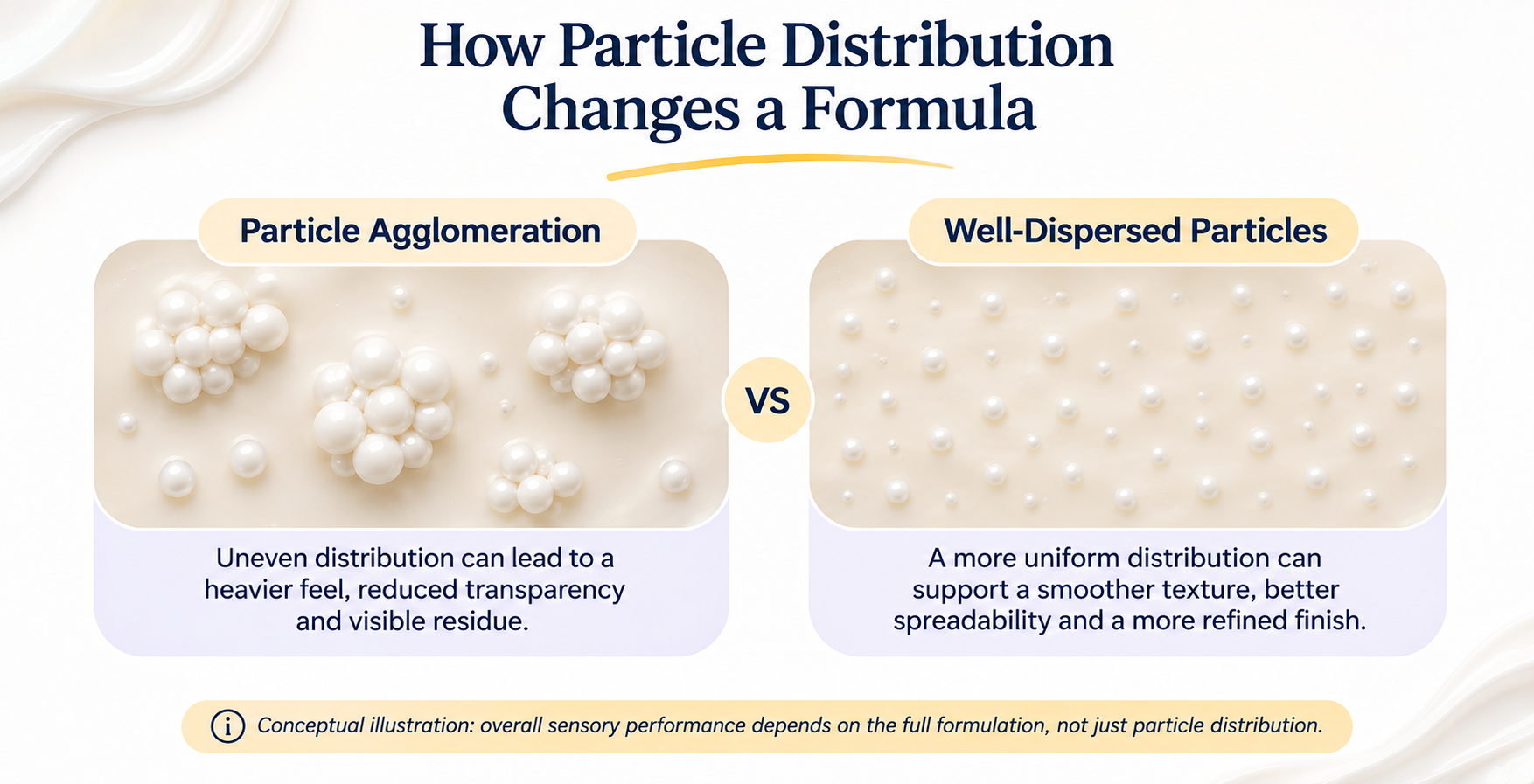
Unlike dissolved ingredients, solid particles have to be distributed throughout a formulation. Their concentration, surface characteristics and interactions with surrounding ingredients can influence how a product looks and feels.
A 2024 review in the International Journal of Cosmetic Science examined how the physical properties of personal care emulsions relate to sensory characteristics such as spreadability, firmness and stickiness. It reinforced something I find particularly relevant to mineral formulations: texture isn’t determined by one ingredient in isolation. It’s the result of how the entire system behaves.
That changes the question from whether minerals can feel luxurious to how they need to be formulated to create that experience.
What Happens When We Start Engineering the Ingredient Itself?
One of the most interesting developments in cosmetic science, to me, is how much attention now goes into the physical characteristics of an ingredient before it reaches the finished formula.
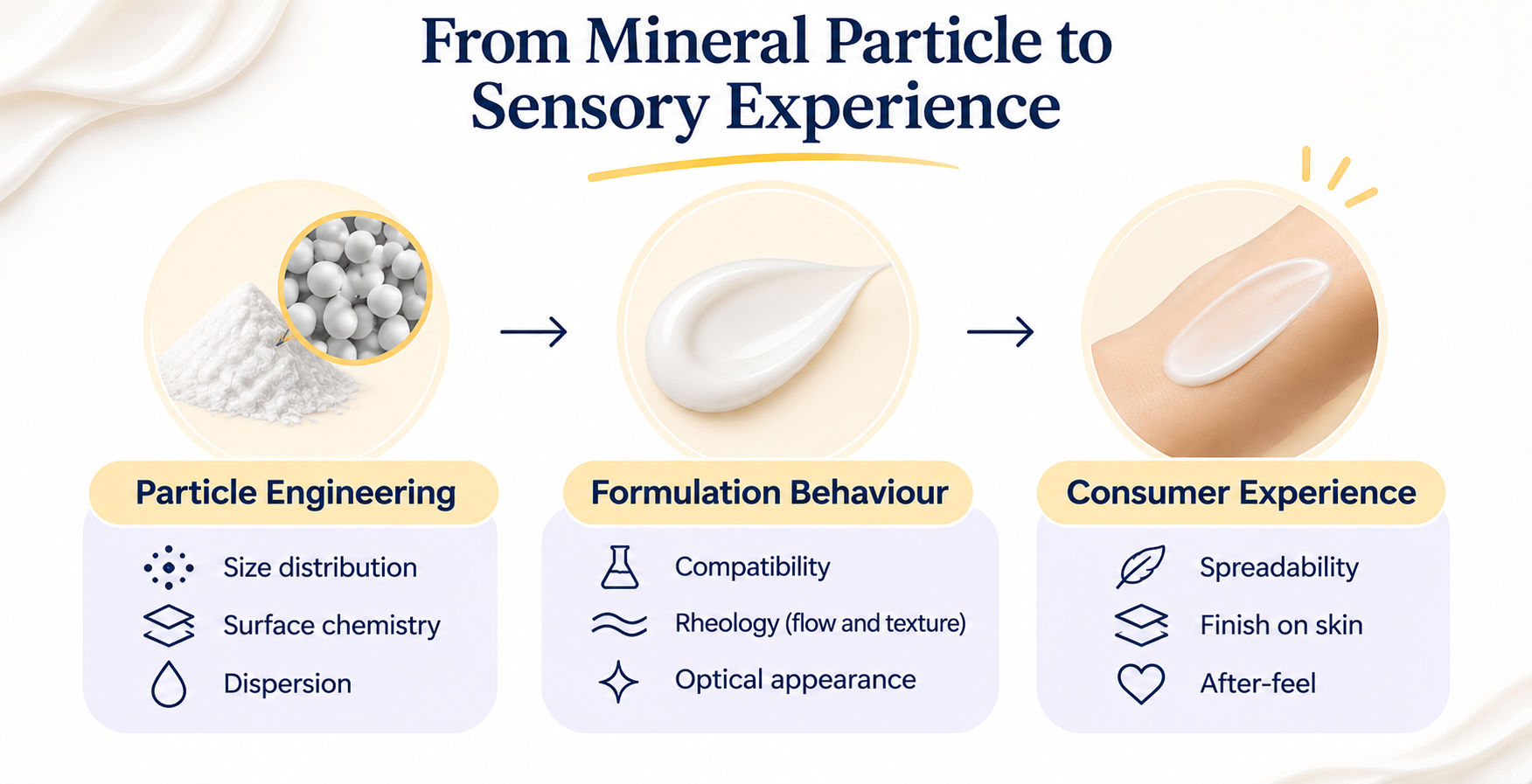
With mineral particles, properties such as size distribution, surface chemistry and dispersion can affect how the material interacts with the surrounding formulation. Surface treatments may be used to modify compatibility with particular formulation environments, while dispersion techniques help distribute particles throughout a liquid carrier.
I find this fascinating because two materials with the same chemical identity can behave differently in a formulation. Knowing that an ingredient is zinc oxide, for example, doesn’t tell us everything about its optical appearance, processing characteristics or effect on texture.
The difference becomes particularly noticeable when we consider the way products spread. A mineral-containing formula needs to maintain an appropriate distribution of particles while also delivering the slip, consistency and after-feel expected from the finished product.
Research published in Applied Rheology in 2024 explored how instrumental measurements could help predict cosmetic sensory attributes, including softness, spreadability, thickness and stickiness. I find studies like this useful because they show that qualities we often describe emotionally can also be investigated through measurable physical behaviour.
A luxurious texture may feel effortless to the person applying it, but creating that experience involves a great deal of formulation science.
Why Transparency Has Become Part of the Luxury Conversation
There’s something about a product that blends into the skin without drawing attention to itself. Whether it’s a moisturizer, a primer or a mineral-based facial formula, I think a natural-looking finish often contributes to the impression of refinement.
This is where mineral ingredients introduce another interesting challenge. Materials such as zinc oxide interact with light, and depending on their properties and how they’re incorporated, they can influence the opacity of a formulation.
For formulators, transparency isn’t simply about making particles smaller. Light scattering depends on several factors, including particle characteristics, how particles are distributed and the optical properties of the surrounding material.
What I find particularly important is that a formula’s appearance cannot be judged independently of the skin on which it’s used. A finish that seems barely noticeable on one complexion may appear more visible on another.
For luxury skincare brands, this makes aesthetic versatility worth considering from the beginning of product development. A refined finish should be evaluated under realistic application conditions and across the range of consumers the product is intended to serve.
And transparency is only one part of the experience. A product that looks beautiful but feels sticky or difficult to spread still has work to do.
Does a Lightweight Texture Automatically Feel More Luxurious?
I think this is especially relevant to mineral sunscreens. Consumers want products that fit comfortably into their daily skincare routines, whether they’re applying moisturizer, makeup or other facial products. Creating that experience while maintaining effective UV protection adds another layer of complexity to formulation development.
I’ve noticed how often lightweight textures are treated as a sign of sophistication in beauty marketing. Words such as weightless, silky and barely there have become familiar ways of describing premium products.
I understand their appeal, but I don’t think a lighter texture is automatically better.
A rich cream may feel luxurious when someone wants comfort and a substantial moisturizing experience. A fluid emulsion may be more appealing when the goal is a fresh finish that layers comfortably beneath other products. Both can feel premium, provided their sensory qualities match what the consumer expects.
The challenge with mineral-containing formulations is that reducing thickness doesn’t necessarily solve every sensory issue. The formula still needs to maintain suitable particle distribution, physical stability and application characteristics.
This is where I think the relationship between texture and formulation structure becomes particularly interesting. Emulsifiers, oils, structuring agents and dispersed solids all contribute to the finished experience, and changing one component can influence the behaviour of the others.
The 2024 review on tactile sensory attributes of personal care emulsions also highlights the complexity of connecting instrumental measurements with what people actually feel. Measurements can provide useful information, but individual sensory preferences and product expectations still matter.
For me, the goal isn’t to make every mineral formula feel weightless. It’s to give formulators enough control to create the texture that best suits the product.
The Ingredient List Doesn’t Tell the Whole Story
I’ve often thought about how much attention beauty consumers give to ingredient lists. We search for familiar names, compare concentrations and look for ingredients associated with particular benefits.
Those details matter, but they don’t always reveal how a product will behave when we use it.
Consider two formulas containing the same mineral ingredient. One might feel smooth and spread easily, while the other might seem thicker or leave a more noticeable finish. The difference may come from the formulation vehicle, particle characteristics, processing conditions or the interactions between ingredients.
This is one reason I find the science of cosmetic texture so interesting. It reminds us that ingredient selection is only the beginning of product development.
A 2024 study on predicting cosmetic sensory textures used rheological measurements and machine-learning methods to investigate characteristics such as spreadability and softness. Although the research doesn’t establish a universal formula for luxury, it demonstrates how product developers can investigate sensory qualities more systematically.
I think that’s particularly relevant to premium beauty. A beautiful experience shouldn’t have to depend entirely on trial and error, even if human evaluation remains essential.
Can Mineral Ingredients Change What We Expect From Luxury Skincare?
What interests me most about this conversation is that the definition of luxury skincare doesn’t have to stay fixed.
We once associated premium products with richness, fragrance and elaborate rituals. Today, a product can communicate luxury through simplicity, an elegant finish or the feeling that every part of its formulation has been carefully considered.
Mineral ingredients can participate in that evolution, but I wouldn’t suggest that their presence alone makes a product innovative or luxurious. Their value depends on what they contribute to the finished formula and whether that contribution fits the intended experience.
Advances in particle engineering, surface treatments and dispersion methods can give formulators more options for working with mineral materials. At the same time, sensory science helps explain why certain textures feel appealing and how those characteristics might be developed more consistently.
I also think there’s an opportunity here to move beyond the assumption that mineral-based products must look or feel a particular way. A mineral ingredient can present genuine formulation challenges without those challenges defining every product that contains it.
The most interesting progress happens when we stop treating the ingredient’s limitations as permanent and start exploring how formulation design can address them.
The Future of Luxury Skincare May Be More About How It Feels
The more I look at luxury skincare, the more convinced I become that the best formulas are rarely defined by one extraordinary ingredient. They’re defined by how thoughtfully everything works together. Texture, appearance, application and after-feel are not secondary details. They’re part of what makes a product memorable.
I think this is particularly relevant to mineral sun care. For years, consumers have had to balance effective sun protection with the textures and finishes they actually enjoy wearing. But as sunscreen becomes a more natural part of everyday skincare routines, those compromises are becoming harder to justify.
Advances in particle engineering, surface treatments and dispersion technology are giving formulators more opportunities to create mineral sunscreens that feel as refined as the luxury skincare products consumers already love. The challenge is to deliver that sensory experience while maintaining the protection and performance expected from a sunscreen.
I don’t think the future of luxury skincare is about choosing between mineral ingredients and beautiful textures. And I certainly don’t think sun protection should feel like a separate category of skincare that requires different expectations.
Perhaps that’s where the next chapter of mineral sun care begins: when a sunscreen feels so effortless to wear that people appreciate the experience just as much as the protection.
_________________________________________________________________________________________________________________________
Frequently Asked Questions (FAQs)
-
What makes a skincare product feel luxurious?
I think luxury skincare is defined as much by the experience as by the ingredients. Texture, spreadability, appearance and after-feel all influence how premium a product feels. A well-formulated product should deliver its intended benefits while making application comfortable and enjoyable.
-
Can mineral ingredients be used in luxury skincare?
Absolutely. Mineral ingredients such as zinc oxide and titanium dioxide can be incorporated into premium cosmetic formulations when their properties suit the product’s intended function. I believe the key lies in thoughtful formulation design, including particle characteristics, ingredient compatibility and sensory performance.
-
Why do some mineral skincare products feel heavy or chalky?
I’ve found that this often comes down to how solid particles interact with the rest of the formulation. Particle concentration, dispersion quality, surface properties and the surrounding ingredients can influence thickness, spreadability and visible residue. A heavy texture isn’t an unavoidable characteristic of every mineral-based product.
-
How does particle engineering improve luxury skincare formulations?
Particle engineering allows formulators to work with characteristics such as particle size distribution and surface properties. These factors can influence dispersion, optical appearance and compatibility with other ingredients. I find this particularly interesting because materials with the same chemical identity can behave differently depending on how they’re engineered.
-
Does a lightweight texture always mean better luxury skincare?
Not necessarily. I think a rich cream can feel just as luxurious as a lightweight serum when its texture matches the intended experience. What matters is how the product spreads, settles and feels afterward, rather than whether it has a thick or fluid consistency.
-
Why is transparency important in mineral-based skincare?
Transparency can influence how naturally a product blends into the skin, particularly across different skin tones. Mineral particles can scatter light and create visible residue, depending on their properties and formulation. Improving optical appearance can help formulators create more aesthetically versatile products.
-
Can two skincare products with the same ingredients feel different?
Yes, and I think this is one of the most interesting aspects of cosmetic formulation. Ingredient concentrations, processing methods, particle characteristics and the overall formulation structure can produce different textures and application experiences, even when ingredient lists appear similar.
-
What role will mineral ingredients play in the future of luxury skincare?
I expect mineral ingredients to remain relevant wherever their functional properties meet a genuine formulation need. Advances in particle engineering, surface treatments and dispersion technology may give formulators more flexibility in developing elegant textures and finishes. For me, the future of luxury skincare is about bringing technical performance and sensory experience together, rather than treating them as competing priorities.